This post is intended to help you understand the basics underlying the problems of eternal growth. It is a fundamental problem with our current situation because our leaders and our populace have convinced themselves that growth can be a permanent condition.
Unbridled, uncontrolled growth, as Diamond, Homer-Dixon, The Club of Rome, and others, have pointed out, cannot and will not go on forever. It never has and never will. To believe it can depends on believing that human beings are completely and utterly divorced from the natural system of this planet, and even the universe.
Cycles happen. In everything. Period. There is not a single highly complex civilization in history that has not collapsed. Not one. Think on that.
I have posted on these issues before, so will leave you with a simple flow of info that should bring this home to you. It is vital you understand this, for if you do not, you may not have sufficient motivation to make changes. Necessary, unavoidable changes. From energy to food to economics to weather and climate, it is all affected by the underlying issue of exponential, constant growth.
Please use time you might have used to read a book, watch a movie, or just sitting doing nothing to go over these materials. It will be time very well spent.
First, the reason for this post. Here is a video (h/t WRH) that makes exponents really easy to understand. You don't need to know any math or science. It's self-evident. It's essentially Al Bartlett's hour-long lecture condensed into five minutes.
Below that is Al Bartlett explaining the problem of exponential growth (also have linked to the right.) If you want to understand the math/consequences of exponential growth, spend time to immerse yourself. Are we dumber than yeast? (Hint: apparently so!)
Next is an interview with Thomas Homer-Dixon (h/t to Dryki @ TOD) explaining the relevance of this issue in terms of growth and collapse of complex systems.
Finally, is an excellent review/overview of Homer-Dixon's book, The Upside of Down. It will pull various elements of The Perfect Storm together for you.
So, first, Did You Know?
Stop for minute and think about what the above might mean for population, for energy consumption, for food production...
Next, now that you see how fast things have been growing, watch Al Bartlett explain why ignorance of exponents is a HUGE problem. (About 1 hour.)
General page with audio, video and transcript links: Are we dumber than yeast?
Video stream (RealPlayer): Are we dumber than yeast?
Audio stream: Are we dumber than yeast?
Audio download: Are we dumber than yeast?
Now listen to Thomas Homer-Dixon explain, via an interview on a C-Realm podcast, why these things are relevant now. He does this in terms of complexity of our current system. If you don't understand complexity and chaos clearly, don't worry. After watching/listening to these three media sources, you will have some idea.
Audio: Thomas homer Dixon on Complexity and Collapse: The Growth Imperative
Now, if you have time to read and/or listen to and/or watch only one of these, read this review/overview of Homer-Dixon's book by contributor Stoneleigh at The Oil Drum: Canada dot com:
The Upside of Down: Catastrophe, Creativity and the Renewal of Civilization
Note: Stoneleigh and her partner, Ilargi, now have their own quite excellent economics-oriented website, The Automatic Earth (also linked to the right.)
Not to bum you out, but time is short. Action is needed.
Start now.
Cheers
Saturday, February 7, 2009


Thursday, December 18, 2008
Political Will, Political Won't (or Boy Are We In Deep Doo-doo)
This piece by Paul Chefurka gives an excellent overview of where we've been, where we are, and what we need to do. I don't need to add to it. I have reformatted to fit this space.
The article is reprinted whole with permission of the writer. (See permissions at the end of the article.)
The article is reprinted whole with permission of the writer. (See permissions at the end of the article.)
Political Will, Political Won'tHat tip to a commenter at Climate Progress for his inappropriately long comment.
Introduction
Today's environmental reform movement is founded on two core assumptions. The first is that most of the technical solutions we need to address the world's various crises are available, or at least could be swiftly developed by sufficiently intelligent, hard-working people. The second assumption is that all that's lacking for a successful outcome is the political will to put these technical solutions into effect.
Whether we're talking about replacing coal-fired power plants with wind turbines and using electric cars instead of SUVs, converting industrial agriculture to organic permaculture, or reversing the decline of ocean life though international regulations, it is an article of faith in the reformist environmental movement that we know what we need to do and all that's lacking is a sufficiently visionary leader to put more planet-friendly solutions in place.
Unfortunately, both those assumptions ignore significant aspects of the situation that considerably diminish the prospects that the reforms will succeed. This article examines those assumptions and uncovers the confounding issues.
Global ProblemsWicked ProblemsAs the list of negative trends to the right clearly illustrates, the scale and diversity of the problems we face are significant. These sorts of problems are known as wicked problems: they are messy, circular, aggressive and interlinked, so that trying to solve one may worsen others. In some cases the trends have been visible for centuries (for example the loss of arable land and desertification), sometimes for decades (as with the loss of aquatic biomass), and some like Peak Oil for a scant few years. In all cases the global trends show no signs of reversing, however much effort has been expended to alter their local or regional trajectories . As their effects become more pronounced, it becomes easier to see their potential to hit our globalized industrial civilization like a planet-sized version of Hurricane Katrina.
The amount of carbon dioxide in the atmosphere is approaching 400 parts per million.
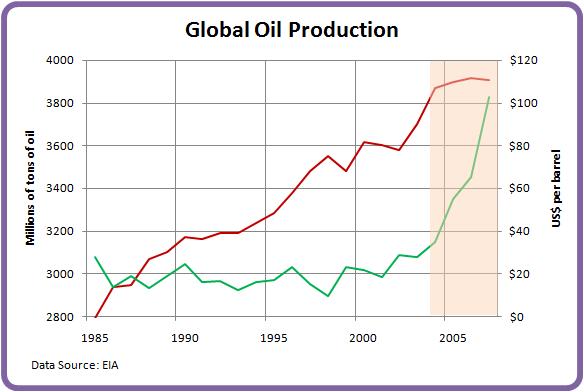
World oil production is on a 4 year plateau.
Ice caps and glaciers are disintegrating.
In the oceans the coral reefs are dying, dead zones are expanding, and predatory fish species (the ones we eat) have declined by 90% in the last 50 years.
The estimated extinction rate of plants and animals is at least 75 species per day.
Over 75,000 square miles of arable land is lost each year to urbanization and desertification.
A billion people in over 110 countries are affected by desertification.
On the American Great Plains, half the topsoil has been lost in the last hundred years, and the Ogallala aquifer is being drained up to 100 times faster than it is being refilled.
Indian farmers have drilled over 21 million water wells using oil-well technology. They take 200 billion tonnes of water out of the earth each year for irrigation.
We have eaten more grain than we have grown in 7 of the last 8 years, while world carry-over grain stocks declined from 130 days of consumption in 1986 to 53 days today.
The price of fertilizer is rising exponentially.
Climate change may cut African food production in half by 2020.
The cost of food is skyrocketing. Some countries have banned exports of wheat or rice.
We are in the beginning stages of a global financial crisis that could result in either a deflationary or hyper-inflationary depression lasting for a decade or more.
As daunting as the individual problems are, the linkages between them are even more important. In many cases, trying to solve one problem can inadvertently make others worse. One prominent example is the attempt to address global warming through the use of ethanol as a vehicle fuel. While there may have been some merit to that primary intention, the secondary effects – increasing dead zones in the oceans due to fertilizer runoff, and rising food prices due to the use of food crops as fuel – eliminated the overall benefit of the effort, and even created a net negative outcome. One dark quip that addresses this sort of backfire is, "Around every silver lining there is a cloud."
It is obvious that dealing with the panoply of problems besetting our world involves considerably more than just knocking them down one at a time. If we don't apply holistic, system-level thinking to the converging crisis, our well-meaning efforts stand an excellent chance of making the situation worse. It is a mistake to think of "solving" these problems in any global or final sense. Some of them may be improved regionally, especially if they are not in conflict with other local problems. The logical corollary is that there will be other regions where those same problems cannot be solved, due to different local circumstances.
The big concerns, however, are those problems do not respect national or regional boundaries. Global warming and the death of ocean life affect us all, and failing to address these problems in any region can make the situation worse for everyone. In these cases, it's obvious that a collective global response is called for – a response that brings together the political, economic, industrial and opinion-making institutions of our world. If these institutions acted together they might have a chance of implementing the deep and wide-ranging changes the situation calls for.
Unfortunately, we have seen precious little evidence of such a collective response. For example, we have repeatedly seen climate change conferences break down or issue watered-down statements that fail to address the scale of the accelerating crisis. While individuals, citizens' groups and even some governments are obviously aware of the urgency, collective action repeatedly fails to gain the required global traction.
This state of affairs is no accident. This is not because of some dark and sinister cabal or conspiracy to hold back change in the name of personal profit, though there probably are some instances of that. The real reasons are at once more banal and more worrisome than the Bilderberg watchers assume.
In the next section we will begin to examine the reasons for this sorry situation.
Our OriginsHunter-GatherersIn order to understand the role that politics plays in our collective failure to address our predicament we need to examine the nature of modern civilization.
There have been some remarkable recent discoveries about the quality of life in the times before modern civilization. We have always known that society back then consisted of hunter-gatherers, organized as tribes. The classical impression was that their lives were, in the words of Thomas Hobbes, "solitary, poor, nasty, brutish and short".
Recent research has shown that in fact hunter-gatherer societies enjoyed a remarkable quality of life characterized by low levels of effort, plenty of leisure time, good nutrition, low levels of disease, egalitarianism, very low levels of suicide, homicide and warfare, a high degree of personal autonomy and close-knit communities. In the words of anthropologist Marshall Sahlins, hunter-gatherers were "the original affluent society."
In one of our more damaging semantic restatements we have defined "subsistence" living as bad and "sustainable" living as good – even though in the context of a hunter-gatherer society, they mean exactly the same thing.
Now, when I use the term "modern civilization" I’m not just talking about the growth of industrialism over the last two hundred years or even the growth of Western culture over the last two thousand years. What we usually think of as modern civilization is the development, refinement and culmination of cultural changes that began ten thousand years ago. To understand who we have become we need to look back at who we were before we became "modern and civilized" and what happened to push us across that threshold.
Human beings have been around in one form or another for over two million years, first as Homo habilis, then as Homo erectus, and finally as Homo sapiens. For virtually all of those two million years, we lived in harmony with our environment. While it may not always have been a comfortable life (how could it have been, without color cable television or cars?), we were nonetheless perfectly adapted to our habitat. This statement is supported by two facts: over most of that period our presence caused little or no damage to the planetary biosphere; and during that time the human population was essentially stable, growing to only about five million in two million years – a net addition of a scant two people per year.
So here we have a species that was exquisitely adapted to its environment, living an affluent yet sustainable life, treading lightly on the earth, never outgrowing or overrunning its habitat, at least in terms of the species as a whole. We lived in harmony with our world for two million years, for 99.5% of the time we have been on the planet. Then suddenly, in the last ten thousand years – a mere 0.5% eye blink of time – our population increased over 1000 times, we decimated the earth's stocks of non-renewable resources, we cut down 90% of the planet's forests, we fished her oceans to the edge of extinction, and we live in a near-constant state of conflict with each other. In this grievously short time we have brought about all the wicked problems listed above.
So what the hell happened?
What Changed Us?
In a word, it was agriculture.
About 10,000 years ago humanity developed organized, settled agriculture. Starting from a small area in the Middle East, over the next few thousand years the world's predominant social model gradually changed as the new agricultural societies replaced hunter-gatherer or horticultural societies by means of displacement, absorption or genocide. We settled down (as one has to, to raise monoculture crops), and started to form larger social structures – villages, towns and cities. Nobody is precisely sure why we developed monocrop agriculture – after all, our previous ways of life had been perfectly satisfactory for millions of years. It may have been precipitated by climate changes, or growing populations in some areas, or it may have been just one of those things. Whatever the trigger was, the threshold of radical human change is clearly demarcated by fields of grain.
Humans and Resources
The most far-reaching change that came out of our development of agriculture was a heady awareness of our ability to control the world. For the first time in our two million year history we did not have to simply take whatever Mother Nature offered. We suddenly realized that we could control her bounty, we could coax, cajole and coerce her into providing what we wanted.
As we planted the seeds of millet and maize in the earth, we planted a very different seed within ourselves – the seed of a new idea about our relationship with the earth. We now saw our ability to control the earth's produce as a sign of our mastery, our ownership, our dominion. No longer would we need to be just another nexus in the web of life, now the web belonged to us. And just like any other possession it was ours to do with as we saw fit.
We came to the profound conclusion that the world consisted of only two broad classes of things: human beings and resources.
The Growth of Hierarchy
The shift to settled cultivation entrained a host of other changes. Our diet was dramatically impoverished. Levels of chronic disease and malnutrition increased. Levels of social violence escalated. And we witnessed the appearance of hierarchies that had not previously existed in our tribal social systems.
Anthropologists are still debating why the development of agriculture resulted in the simultaneous growth of social hierarchies. In my opinion it happened because the risk to farming communities from crop failures was very high. If the crops failed, these communities contained too many people to survive on local foraging or hunting – both because population densities were so high and because the habitat destruction caused by farming had reduced the amount of local wild food. There was also no way to bring in enough food from other unaffected regions. Therefore the risk of crop failures had to be mitigated. This mitigation involved many activities. For example, local hunting kept larger crop-eating pests at bay, irrigation helped in times of drought, and shamanic intercession took care of storms and blights.
Each of these activities of hunter, irrigation engineer and shaman was highly specialized in comparison to the more generic farming skills required for planting and harvesting. This specialization conferred power on the holders of those skills. This was especially true in the case of shamans, whose power could not be entirely learned, but was said to emanate from a mysterious connection with the supernatural. Their attempt to exercise control over nature gave the shamans the real ability to exercise control over other people ("Obey me or the gods will frown on us, and the crop failure will be your fault!"), and the first power hierarchies were born.
The Effects of Surplus
Centralizing the production of food and managing its distribution introduced new elements to the growing hierarchies. Since some of the food was needed by people who had no direct hand in producing it (such as weavers, shamans and granary guards), some means had to be found to give them equitable access to it. This meant we had to come up with a way of defining the relative values of different kinds of work, and to establish a medium of exchange so that people could obtain the amount of food their work was deemed to be worth. In one stroke the concepts of money and wages appeared. This of course transferred a lot of of power to those who established the value of work and controlled the money supply.
Yet another major impact of organized agriculture was the psychological effect of reliable food surpluses. For the previous two million years, our existence had been shaped by sustainable subsistence – our wants had been satisfied by the concept of "enough". People worked until they had enough, then they stopped. Now there was almost always "more than enough". This awareness caused yet another radical change in how we looked at the world.
The combination of food surpluses and a medium of exchange made trade for non-food goods possible. This trade enabled a continuous growth in the material comfort of peoples' lives, and it did not take long for them to become accustomed to this new state of affairs. As memories of the past faded over just a few generations, the new conditions of growing abundance were rapidly accepted as the "natural" order of things.
The Roots of Modern Civilization
We now had the three critical preconditions for "modern civilization": the belief that humans owned the world and all its products; the belief that continuous growth in material prosperity is the natural order of the universe and the birthright of humanity; and the belief that hierarchy is essential to manage the rapidly growing complexity of civilization.
Guardian Institutions
As always happens with hierarchies, power flows uphill. Along with it go the perquisites of power, the most important being the right to higher levels of material abundance than those lower in the pecking order. To ensure that this comfortable situation is maintained, part of the accumulated social power is used to protect the situation. This is done by strongly defending the three preconditions set out above. The people to whom this power flowed quickly realized that the status quo is most easily maintained if the rest of the community sees this situation as the only possible way life can work, and any suggestions to the contrary are the result of either some nefarious agenda or outright insanity.
Over time an interlocking system of guardian institutions grew up to protect and defend the three key ideas of ownership, growth and hierarchy:
- Economic and financial institutions cooperate with business and industry to set the value of work and control the money supply (thereby controlling access to food). In this role it doesn't make any difference whether an economy is capitalist, socialist or communist. The core beliefs it guards are always the same: ownership and growth.
- Educational institutions teach successive generations how the system works, giving them the tools to integrate into it and manipulate it, while at the same time training them to see this as the only possible way the world can work.
- Communications media reinforce this message by enlisting people in the growth paradigm. They do this both through overt messages like advertising and covert messages embedded in the story lines of entertainment.
- Religious institutions (as distinct from the religions they purport to enshrine) are primarily normative social structures. Many incorporate an overt message that we should be content with things as they are. There are often injunctions against questioning authority, as all authority is seen to devolve from the supernatural – just as it did for the shamans of the early agricultural era.
- Legal institutions enforce the norms of ownership and hierarchy in ways too numerous to count. These range from the protection of privilege (one law for the rich, one for the poor) to the preferential defense of property rights over human rights.
- Political institutions sit at the tip of the pyramid. Political institutions encode, enshrine and manage the application of social power. Politics is the institution that legitimizes all the others. Because of its unique ability to make laws and its access to legalized violence to defend those laws, politics is the fullest expression of the power hierarchy of modern civilization.
At the base of the hierarchy, supporting it all, are an ever-diminishing number of farmers who apply ever-increasing amounts of knowledge, technology and petroleum to ensure an ever-expanding supply of food. Because at the core it is their food that makes the whole edifice possible.
So where does this put us in relation to the array of wicked problems we listed at the beginning? Simply put, every one of those problems is the result of unbridled growth. They are the logical results of the continual exercise of the first two preconditions of modern civilization, the twin drummers of ownership and growth we have been marching to for ten thousand years since the invention of agriculture.
Politics is the problem, not the solution
In light of this analysis it is obvious why we are repeatedly failing to address any of these wicked problems. The only permanent "solution" to any of them is the secession of growth and the relinquishment of ownership. That idea is anathema to our guardian institutions. And as the occupants of the pinnacle of power, our politicians have every reason to derail efforts in that direction, no matter how small.
Politics, regardless of party or ideology, is part of the problem and can never be part of the solution. While it may be easier for the average person to live under the rule of a more humane parcel of rogues, at its heart politics is the primary guardian institution of modern civilization. The role of all politics is to manage power, and power is always managed for the benefit of the holders of power. It doesn't matter whether the power managers are Democrats, Republicans, Tories, Grits, Social Democrats, Communists or a military junta. They all fulfill the same role in service of the same beneficiaries.
In order to fulfill that role they unite with the other guardian institutions – the economic, industrial, legal, religious, educational and communications organizations. Together they create, maintain and guard a noetic milieu (a globalized intuitive, non-rational consciousness) in which any values that challenge the two fundamental preconditions to modern civilization are seen as incomprehensible, self-evidently absurd, dangerous or even insane. Since the primary value system these guardians protect is the paradigm of continuous material growth, the most dangerous of all radical ideas are any proposals to limit, halt or reverse that growth.
The guardian institutions are so firmly embedded in our global culture that it is ultimately fruitless to try and remove them from power by either direct or indirect confrontation. The penalties for trying this are severe and ruthlessly applied.
Conclusion
In light of this rather dismal assessment, is there any hope for a return to a sustainable, egalitarian, interconnected, considerate and just civilization? I strongly believe that there is, but getting there will be neither sure nor easy.
The institutions that stand between us and such a future are trapped by their dependence on the very paradigm they are sworn to protect. They defend the belief that permanent material growth is natural, possible and inevitable. While they defend that belief with laws, guns and television, ultimately their power comes from people who accept that premise. If people stop believing that such growth is possible the institutions' power declines, no matter how many defense mechanisms they engage. If growth falters, the people lose faith and the institutions crack and crumble.
Look back at the list of wicked problems. Every single one of them is the result of our growth encountering limits. While we may be able to figure out ways to temporarily circumvent some of these limits, the pattern is now clear. The growth of modern civilization is slowing down, and is even showing evidence of coming to a halt. For the guardian institutions that depend on growth for their very survival, this is like a diagnosis of terminal cancer.
What that means is that our guardian institutions will inevitably start losing their monolithic top-down power. This dis-integration will leave "cracks in the sidewalk of civilization". And just as grass grows through cracks in real concrete, small communities and individuals will start to appear through the metaphorical concrete of our industrial civilization.
No one can predict when, where or how the dis-integration will appear. It will take different forms in different places. The response of the guardians will probably be violently draconian in most cases. But there are places where communities have already formed in anticipation of such an opportunity. Like "Gaia's antibodies" they will work to heal the wounds, widen the cracks, and let the sunshine and fresh air revitalize the hidden earth. As the seed stock of the next phase of civilization they will spread their values on the wind.
The next cycle of human experience on this planet will be very different from any that has gone before. We will have fewer resources, but more knowledge. We will have to deal with toxic landscapes, a warming climate, shifting rainfall patterns and the emergence of new diseases. To balance that we will have better communications and longer memories than any civilization that has gone before us. We will not fall back into the stone age, but neither will we motor off happily into the sunset in our electric cars. There will be hardship and misery, but there will also be joy – the joy that comes from looking forward, from participating in our communities, from the love of those around us.
Above all, there will be the future.
Acknowledgments
I'm indebted to the writing of Daniel Quinn and John Zerzan, as well as to Riane Eisler for her book "The Chalice and the Blade". I'd also like to acknowledge the philosophy of Anarcho-Primitivism for its critique of civilization (though perhaps not for its suggested solutions).
September 3, 2008
© Copyright 2008, Paul Chefurka
This article may be reproduced in whole or in part for the purpose of research, education or other fair use, provided the nature and character of the work is maintained and credit is given to the author by the inclusion in the reproduction of his name and/or an electronic link to the article on the author's web site. The right of commercial reproduction is reserved.
Thursday, October 23, 2008
Disaster Capitalism for Dummies
We are no longer waiting for The Perfect Storm to come, it is here. The outer bands are sweeping the beaches, the storm surge is lapping at the sea walls and breaches are occurring. But it's not just the economy, stupid. Keep in mind energy prices were the pin that popped the housing bubble. Keep in mind energy prices and environmental disasters drove the costs of food and fertilizer higher. This is a Perfect Storm of converging storms, large and small.
We have energy prices (at current "low" prices, they are still 3 - 4x prices in 2003) driving food, fertilizer, pesticide prices, bio-fuels creating havoc with food production, impacting funding for alternative energies, and slowing the economy.
We have weather disasters driven by Climate Change causing destruction we cannot seem to recover from (Katrina, Galveston) and reducing harvests in a number of areas, notably the US, Australia and Bangladesh.
We have the economic disaster (We *might* be in a recession? Freaking liars and/or idiots.) literally resulting in the nationalization of economies all over the globe. We have sold our nations to the bankers. All of this compounded by the wars in Iraq and Afghanistan, which had already been used as excuse to strip away our rights and freedoms, draining the coffers and dragging on the economy. Our ability to adapt to Climate Change, rebuilding as a sustainable society is deeply impacted. Global Warming is likely unstoppable simply because we will likely not be able to afford the transition.
We are in deep poop, people. The longer this goes without the We the Sheeple standing up and telling our leaders what to do, rather than being led to our own slaughter, the more likely there will be nothing but the ultra wealthy and powerful buying their custom built oases, fully staffed by Blackwater, and the rest of us baking in the sun scratching about for a few weeds to nibble on.
With regard to the Economic Storm, I don't think it can be said any better than this:
"America has become a plutocracy run by and for the wealthy."
Indeed.
And you are not invited to partake.
More info on "Shock Doctrine" from Naomi Klein:
The Shock Doctrine, the book.
The Shock Doctrine, Short Video
The Shock Doctrine, Long Video
We have energy prices (at current "low" prices, they are still 3 - 4x prices in 2003) driving food, fertilizer, pesticide prices, bio-fuels creating havoc with food production, impacting funding for alternative energies, and slowing the economy.
We have weather disasters driven by Climate Change causing destruction we cannot seem to recover from (Katrina, Galveston) and reducing harvests in a number of areas, notably the US, Australia and Bangladesh.
We have the economic disaster (We *might* be in a recession? Freaking liars and/or idiots.) literally resulting in the nationalization of economies all over the globe. We have sold our nations to the bankers. All of this compounded by the wars in Iraq and Afghanistan, which had already been used as excuse to strip away our rights and freedoms, draining the coffers and dragging on the economy. Our ability to adapt to Climate Change, rebuilding as a sustainable society is deeply impacted. Global Warming is likely unstoppable simply because we will likely not be able to afford the transition.
We are in deep poop, people. The longer this goes without the We the Sheeple standing up and telling our leaders what to do, rather than being led to our own slaughter, the more likely there will be nothing but the ultra wealthy and powerful buying their custom built oases, fully staffed by Blackwater, and the rest of us baking in the sun scratching about for a few weeds to nibble on.
With regard to the Economic Storm, I don't think it can be said any better than this:
Wall Street's 'Disaster Capitalism for Dummies'14 reasons Main Street loses big while Wall Street sabotages democracy
ARROYO GRANDE, Calif. (MarketWatch) -- Yes, we're dummies. You. Me. All 300 million of us. Clueless. We should be ashamed. We're obsessed about the slogans and rituals of "democracy," distracted by the campaign, polls, debates, rhetoric, half-truths and outright lies. McCain? Obama? Sorry to pop your bubble folks, but it no longer matters who's president.
Why? The real "game changer" already happened. Democracy has been replaced by Wall Street's new "disaster capitalism." That's the big game-changer historians will remember about 2008, masterminded by Wall Street's ultimate "Trojan Horse," Hank Paulson. Imagine: Greed, arrogance and incompetence create a massive bubble, cost trillions, and still Wall Street comes out smelling like roses, richer and more powerful!Yes, we're idiots: While distracted by the "illusion of democracy" in the endless campaign, Congress surrendered the powers we entrusted to it with very little fight. Congress simply handed over voting power and the keys to trillions in the Treasury to Wall Street's new "Disaster Capitalists" who now control "democracy."
Why did this happen? We're in denial, clueless wimps, that's why. We let it happen. In one generation America has been transformed from a democracy into a strange new form of government, "Disaster Capitalism."
Here's how it happened:
So you, me and the other 300 million better get out of denial. America is no longer a democracy. Voting is irrelevant. Best case scenario: We're a plutocracy, a government ruled by the wealthy, the richest 1%, the Forbes 400, the influential wealthy elite, while the other 99% are their "servants." Meanwhile, the inflation-adjusted income of wage-earners has declined for three decades.
Worst case scenario: America's no democracy and as a result of the meltdown and the surrender of our power to Wall Street's new Disaster Capitalism we are morphing into what one WWII dictator called "corporatism," a "merger of state and corporate power," kind of like what's going on now with Goldman Sachs' ex-boss as de facto president.Wolves in sheep's clothing
Yes, a strong charge. But like a lot of our readers, I don't like what's happening to America. I'm a patriot. I volunteered for the Marines. Served four years. Volunteered for Korea. I don't like how our freedoms, rights and value system are being subverted in the name of greed, arrogance, self-righteous intolerance and other false gods.
We know for the last eight years disaster capitalists ignored obvious warnings of a coming meltdown. They apparently planned it. They road the bull, got very rich. Now they have the ultimate disaster capitalist weapons, trillions in tax money, virtual control of government.
That's why I fear we're on the edge of a dangerous line between Wall Street's version of disaster capitalism and a toxic "merger of state and corporate power." The wolf is in sheep's clothing. Wall Street pretends we're a democracy. Yet America more closely resembles the kind of "corporatism" that Laurence W. Britt wrote about five years ago in Free Inquiry magazine.
We adapted his historical analysis of 14 key traits for today's discussion. Notice how they have a huge impact your investments and retirement:
1. Wall Street rich get first priorityThink "bailout." Wall Street's greedy con game spins out of control globally. Millions of homeowners misled, lose. Who gets hundreds of billions first? Wall Street's con men.2. National security obsessionThink of the expansion of executive powers in the name of national security: Preemptive wars, wiretapping private citizens, Gitmo, torture; driven by a dark wealthy neocon elite.3. Superpower with massive militaryThink of our $3 trillion Iraq/Afghan War. Disaster capitalists love the thrill of military power. We outspend all nations, over half the federal budget to strut before the world.4. Extreme nationalismSigns are everywhere: Flags, lapel pins, "support the troops" slogans, all to get huge military budgets passed. Challenge them and you're un-American and unpatriotic.5. Rally the masses by scapegoating enemiesThink "axis of evil," mushroom clouds, "Islamofascists," more terrorist attacks on the homeland. Propaganda creates "enemies" in the public's mind and distracts from real issues.6. Corruption and cronyismThink earmarks, no-bid defense contracts, paid mercenaries outnumbering military in Iraq, superlobbyist Jack Abramoff, biofuels, bridge to nowhere, millions donated to campaigns.7. Obsession with crimeThink of prison-building as just another investment opportunity, rather than focusing on reforming our criminal justice system. Stoke irrational fear of criminals and extremists.8. Labor and low wagesThink corporate earnings versus the wages paid to workers. No "trickling down," leaves more for tricklers: Rich insiders, stockholders. Wages dropping as CEO salaries skyrocket.9. Contempt for human rightsThink of abuses of habeas corpus, loss of right to trial, bogus charges, plus "demonizing" the victims, all in the name of national defense and homeland security.10. Mass media manipulationThink of leaking false information, Joseph Wilson, Valerie Plame, Scooter Libby, Colin Powell's United Nation's testimony, Condoleezza Rice's mushroom clouds, WMDs, all to suppress the truth.11. Obsession with sexismThink of paternalism, antigays, antiabortion, subordinate women -- then codify the system as the law of the land reinforcing a male-dominated society, punish violators.12. Disdain for intellectualsThink of conservative intellectuals Francis Fukuyama and Bill Buckley. Contrast them to Sarah Palin and Joe Sixpack conservatism, Bush's funding cuts for arts and science education.13. Religion in governmentThink of all the faith-based programs versus antiscience in drug approvals, creationism vs. evolution, Ten Commandments enshrined in public buildings, public money to churches.14. Fraudulent electionsThink of police and prosecutorial intimidation and threats to voters, challenging minority voters, ballots disappearing, party election officials committing outright fraud.For more, read Britt's original article, then add comments here: Was the meltdown planned by Wall Street's Disaster Capitalists?
Yes, officially America is still a democracy. We have enough signs and rituals to support that illusion. But the truth is America has become a plutocracy run by and for the wealthy. And since Wall Street's Disaster Capitalism coup de grace, we are rapidly morphing into a dangerous new government.
"America has become a plutocracy run by and for the wealthy."
Indeed.
And you are not invited to partake.
More info on "Shock Doctrine" from Naomi Klein:
The Shock Doctrine, the book.
The Shock Doctrine, Short Video
The Shock Doctrine, Long Video
Friday, October 3, 2008
Of Crashes, Failures and Bailouts - Round III
Should the Senate pass its revised version of the $700 billion bailout bill?
Yes - No
35% - 65%
FIGHT BACK.
CALL YOUR REPRESENTATIVES.
REJECT THIS ATTEMPT TO USURP YOUR POWER AND MONEY.
Yes - No
35% - 65%
FIGHT BACK.
CALL YOUR REPRESENTATIVES.
REJECT THIS ATTEMPT TO USURP YOUR POWER AND MONEY.
Representative Sherman's remarks on the House floor at 8:07 PM EST, Thursday, Oct. 2nd:
The only way they can pass this bill is by creating and maintaining a panic atmosphere. That atmosphere is not justified. Many of us were told in private conversations that if we voted against this bill on Monday... the markets would fall 2 or 3,000 points the first day, another couple thousand the second day, and a few members were even told that there would be Martial Law in America if we voted no.This is what is driving the debate, the vote: Fear. It is what we have seen for the last 7+ years. Are you not tired of the lies?
UPDATE: Rep. Sherman also spoke again at 8:23 AM Friday morning. He points out again the pork and the fact the "oversight" is B.S.: the Congress has no power to enforce. He says again: let's stay here a week and develop a GOOD bill.
Let's review:
Claim by Paulson, Bernanke, Bush, McCain, et a.: The economy is fundamentally strong. Paulson: It's contained.
Reality: Obviously false.
---------------------------------------------------------------------
Claim: Paulson, Bernanke, Bush, et al.: We must act now. We don't have weeks. There will be financial disaster and Martial Law.
Reality: Obviously false.
- It's been more than a week.
- Secret conference call assures Wall Street first funds won't be used for a couple weeks while they decide who lives and who dies. Also, provisions have no teeth; all 700 billion will be available immediately.
Financial Eugenics: The Paulson Plan for Survivor Bias
As I write this... I suspect that Congress will force the passage of the bill in some form because the media and political narrative on the necessity of the measure is unremitting and so horribly biased.--------------------------------------------------------------------------------------------------
No alternatives will be considered.
No constraints on the unilateral executive authority of Hank Paulson will be considered.
No assurances that funds will be used to unlock credit markets or promote lending to the real economy (as opposed to the financial robber barons) will be considered.
...Having listened to all 42 minutes of the late night Treasury briefing of investment banks on Sunday, there is no doubt in my mind that this legislation represents the sort of federal largesse for Goldman Sachs, Morgan Stanley, Citibank and JPMorgan Chase that the Iraq war provided for Halliburton and Blackwater.
The most cynical moment in the call is when the Treasury official confirms, ”our preference would be to help the healthy banks become even healthier” rather than helping troubled banks or illiquid banks.
America is now a centrally planned economy where the Treasury will determine which firms survive and prosper...
Clearly what is going on here has nothing to do with kick starting the credit markets or stabilising the equity markets or restoring depositor confidence in banks. (Treasury official: “No provision in the legislation that mandates re-lending.”) What is going on here is a blatant attempt to provide government funds to a select cadre of firms (not all banks) which are chosen to be the survivors feasting off the carcasses of their less fortunate and less well-connected brethren as the downturn intensifies in the years to come.
The crash in equities will still happen. The debt deflation of the economy leading to mass commercial and consumer credit defaults will still happen. The collapse of many national, regional and local financial institutions will still happen. The bankruptcy of many municipalities and shortfalls in state budgets will still happen.
This bill is about engineering survivor bias to friends of the Bush administration... and unconditional authority of the Secretary of the Treasury.
...The SEC will support the plan and survivor bias by relaxing FASB 157 on mark to market accounting...
The Federal Reserve will support the plan by relaxing the definition of “control stake” in US banks and bank holding companies to allow secretive cabals to hold through private equity and offshore hedge funds... Many foreign creditors are irate at the losses... and this plan provides a secret way to buy them off and keep them lending and investing...
I would like to believe Americans expressed the courage to change over last weekend when they 25 to 1 rejected an unconstrained and unconditional bailout of Wall Street in favour of cold turkey deleveraging of the economy. I wish I could believe that it mattered in the political calculus, but the result of the House vote on the bill will tell us that.
Fight the survivor bias. It’s not your survival they’re engineering.
Claim: $700 billion will save us.
Reality: The Fed, a.k.a. Helicopter Ben, put over 60o billion in play and it did... nothing.
---------------------------------------------------------------------------------------------------
Claim: This will save Main Street.
Reality: Obviously false. There are mortgage resets coming for the next two or three years. That means this problem will just grind on and on... and this bill does NOTHING about that.
In fact, foreign investors get relief. I stated earlier this is inappropriate. It is likely unconstitutional. And why threaten veto if the provision is taken out? How can it possibly be of urgent interest to Americans? Sure, the world economy is important,but the ENTIRE WORLD is going to implode if this isn't passed this week? I've got a bridge to sell ya...
And who's buying banks and insurance companies? B of A, Goldman Sachs, JP Morgan... etc.... all buying, not selling. Buying assets and leaving liabilities... to YOU:
AIG to sell as many assets as needed to pay bailout
As Big Banks Converge...
Citigroup Inc.'s decision this week to gobble up most of ailing Wachovia Corp. is the latest in a string of blockbuster acquisitions that have transformed the banking landscape. A huge chunk of consumer deposits are now consolidated in three banking behemoths -- Citigroup, Bank of America Corp. and J.P. Morgan Chase & Co. -- not known for wooing consumers with high interest rates and low fees.
Wells Fargo to acquire Wachovia for $15.1 billion in all-stock deal, ends Citigroup talks
---------------------------------------------------------------------------------------------------
Claim: Not acting will cause a recession.
Reality: We have been in recession since the last quarter 2007 according to some, and virtually never got past the recession of 2001 according to others. The people saying we are not in a recession are in the government or neo-con pundits.

Inflation?

Unemployment?

And guess when the money supply started drying up. Last week? No.... Check out M3, which Bush stopped reporting in 2006 because it was "too expensive" to report and not important:

FIGHT BACK.
CALL YOUR REPRESENTATIVES.
REJECT THIS ATTEMPT TO USURP YOUR POWER AND MONEY.
CALL YOUR REPRESENTATIVES.
REJECT THIS ATTEMPT TO USURP YOUR POWER AND MONEY.
Ex-Treasury secretary O'Neill says Bailout Plan 'crazy,' 'lunacy'
Former U.S. Treasury Secretary Paul O'Neill said the $700 billion bank-rescue proposal under negotiation in Washington is "crazy," with potentially "awful" consequences for the world's largest economy.Peter Schiff and Bob O'Brien on Glenn Beck: Causes and What the Future Holds
"Doesn't this seem like lunacy to you?" said O'Neill, who was President George W. Bush's first Treasury chief, from 2001 to 2002, in a telephone interview Wednesday. "The consequences of it are unbelievably bad in terms of public intrusion into the private sector."
O'Neill's objections mirror those of Republicans in the House of Representatives who rejected the plan in a Sept. 29 vote. The former Treasury chief said he lobbied for an alternative solution that would offer guarantees for troubled assets, stopping short of purchasing the debt.
"Is anybody thinking there?" asked O'Neill, who also served as deputy budget director in the Ford administration. "It's too late, it's not going to make any difference and it's aggravating as hell when there's a better idea and you can't even get it in play," he said.
O'Neill, 72, was fired after an almost two-year tenure marked by strains with White House officials and comments that roiled markets.
Great comments at:
3:10: GDP top drop 10% ~ 15% over next 12 ~ 15 months (Beck)
7:40: Govt' made it easy to borrow instead of work hard (Schiff)
8:09: - Gov't atfault - For years gov't kept things artificially supported... money supply... stopped working a few months ago... now engineering price of money...gov't actions pernicious, untested (O'Brien)
This is from an e-mail I got from Democrats.com:
The Senate's 74-25 vote for Paulson's Plunder came as no surprise, since the Senate is run by and for millionaires. So now it's back to the House of Representatives, where we shocked those millionaires on Monday by defeating their bailout bill by 228-205.
A terrified army of corporate lobbyists is working around the clock to switch 13 votes, but only 7 have switched so far - Jim Ramstad (R-MN), John Shadegg (R-AZ), Zach Wamp (R-TN), Ileana Ros-Lehtinen (R-FL), Shelley Berkley (D-NV), Emanuel Cleaver (D-MO) and John Lewis (D- GA). Other possible switches include Pat Tiberi (R-OH), Pete Hoekstra (R-MI), John Yarmouth (D-KY), Brian Bilbray (R-CA), Steve Rothman (D-NJ), Lee Terry (R-NE), Jim Gerlach (R-PA), Tim Murphy (R-PA), Jason Altmire (D-PA), and Gabrielle Giffords (D-AZ). But others may switch from Yes to No, including Ed Markey (D-MA), Charlie Melancon (D-LA), and Spencer Bachus (R-AL).
Bush's first Treasury Secretary, Paul O'Neill, called Paulson's plan "crazy" and "lunacy" with potentially "awful" consequences for the world's largest economy. Many of the best economists agree with O'Neill. Paulson's strongest supporters - including panicked CNBC hosts - now admit it will not raise stock prices or boost the economy as it falls into recession. Then why on earth should we give
$700$850 billion of our tax dollars to Wall Street??? Joe Lieberman gave away the real game when he told FOX " it will be good for John McCain."With so much at stake, Congress should stay in session for another week (or two) to pass a much better (and cheaper!) plan proposed by Pete DeFazio (D-OR). But Congress desperately wants to go home so Friday may be our last chance to stop this $850 billion disaster .
(1) Call your Representative today!
First check how your Representative voted on Monday (and note switches above):
http://clerk.house.gov/evs/2008/roll674.xml
If (s)he voted NO, say "Thank you for helping stop the Bailout on Monday. Don't betray us now by voting YES on Friday, or I will vote NO against you on Election Day."
If (s)he voted YES, say "I'm outraged that you supported the Bailout on Monday, and I will remember on Election Day. If you want my vote on Election Day, you must vote NO on Friday."(2) Join or organize a street protest against the bailout:
http://bailoutmainstreet.com/
FIGHT BACK.
CALL YOUR REPRESENTATIVES.
REJECT THIS ATTEMPT TO USURP YOUR POWER AND MONEY.
CALL YOUR REPRESENTATIVES.
REJECT THIS ATTEMPT TO USURP YOUR POWER AND MONEY.
Wednesday, October 1, 2008
Bailout Alternatives
Are your reps in Congress listening to you? Scroll down the front page of CNNMoney.com to vote. (Thanks to Geckolizard at The Oil Drum.)
Should the Senate pass its revised version of the $700 billion bailout bill?
If you're going to complain about what's wrong, you should be willing to talk about what's right. So, here are the plans that might help.
Rubini's plan on CNBC Look for the video called "HARDTalk US Bailout Special."
Congressman Defazio's plan: No Bailouts Act
Karl Denninger's Genensis Plan:
If you like one of these, put it in the ear of your Rep/Senator.
Should the Senate pass its revised version of the $700 billion bailout bill?
If you're going to complain about what's wrong, you should be willing to talk about what's right. So, here are the plans that might help.
Rubini's plan on CNBC Look for the video called "HARDTalk US Bailout Special."
Congressman Defazio's plan: No Bailouts Act
Karl Denninger's Genensis Plan:
The solution to the trust issues in our financial system is elegant and it will work.And more...
1. Force all off-balance sheet "assets" back onto the balance sheet, and force the valuation models and identification of individual assets out of Level 3 and into 10Qs and 10Ks. Enact this requirement beginning with the 3Q 2008 reporting period which begins next month.
Total taxpayer cost: $0.00
2. Force all OTC derivatives onto a regulated exchange similar to that used by listed options in the equity markets. This permanently defuses the derivatives time bomb. Give market participants 90 days to get this done; any that are not listed in 90 days are declared void; let the participants sue each other if they can't prove capital adequacy.
Total taxpayer cost: $0.00
3. Force leverage by all institutions to no more than 12:1. The SEC intentionally dropped broker/dealer leverage limits in 2004; prior to that date 12:1 was the limit. Every firm that has failed had double or more the leverage of that former 12:1 limit. Enact this with a six month time limit and require 1/6th of the excess taken down monthly.
Total taxpayer cost: $0.00
If you like one of these, put it in the ear of your Rep/Senator.
Subscribe to:
Posts (Atom)