Showing posts with label peak oil. Show all posts

Saturday, July 4, 2009

Iraq, Oil, War, and Presidents and Vice-Presidents... err... Lying Liars... err... War Criminals

A small aside today via a walk down memory lane. Some things simply should not be forgotten, for they show you where you have been and are likely to go. Energy needs to be out of the hands of big corporations and in the hands of indivicuals, towns, cities and regions.

It wasn't about the oil, except that it was.

A little history lesson first. It saddens me to say Jimmy Carter got the ball rolling with a goodly toss, but he did. Unintended consequences, I suppose, as he was responding directly to a perceived USSR threat. Still... All those years later, this doctrine was considered support for the invasion of Iraq. Being about outsiders and not locals, it's bogus, but slippery slopes are called slippery for a reason. But, really, that's a minor point in all this.

Comes 9/11 and the excuse is laid at the feet of an administration bent on securing oil supplies. Here we need a little history else all looks like mere greed. And G_d knows no American President would ever engage in THAT! It's un-American! Except one did. In 1953.

But there were other issues at work, which I've blogged about before. Namely, Peak Oil. (It's a shame we had to name a simple geological reality. It makes it easier for people to pretend it's something other than simple geology and math, but what'r ya gonna do?) Cheney set it out rather accurately in 1999. (I'm not thrilled about the source, but it's the most complete transcript I've seen of the quote.)

Producing oil is obviously a self-depleting activity. Every year, you've got to find and develop reserves equal to your output - just to stand still, just to stay even. This is true for companies as well in the broader economic sense for the world.

A new merged company like Exxon-Mobil will have to secure over a billion and a half barrels of new oil equivalent reserves every year just to replace existing production.

It's like making a return of 100% interest on investment. It’s like discovering another major field of some 500 million barrels every four months, or finding two Hibernia’s [a major find off Canada] a year.

For the world as a whole, oil companies are expected to keep finding and developing enough oil to offset our 71 million barrels a day of oil depletion, and also to meet new demand.

By some estimates, there will be an average of 2% annual growth in global oil demand over the years ahead along with, conservatively, a 3% natural decline in production from existing reserves. That means by 2010, we will need in the order of an additional 50 million barrels a day.

So, where is the oil going to come from?

Governments and the national oil companies obviously control about 90% of the assets. Oil remains fundamentally a government business. While many regions of the world offer great oil opportunities, the Middle East with two thirds of the world's oil and the lowest cost, is still where the prize ultimately lies.

Many of us knew the invasion was about oil, but many us were not aware of the underlying realities that were driving BuCheney to their ruinous, illegal and immoral war. What I want you to take away from this is the following:

They had the choice to move strongly to alternative energy and chose to butcher, kill, maim, steal and sacrifice American and Iraqi lives instead.

People inside and outside the US government have known about Peak Oil for decades. I have previously written of Admiral Rickover, Jimmy Carter's Sweater Speech and, of course, King Hubbert. This was not a surprise or shock to BuCheney, to anyone who would have reason to know.

The Hirsch Report (2005) is linked in sidebar. It clearly states that waiting until peak production occurs means a huge crisis. Starting mitigation 10 years before means crisis. Starting 20 years before means a possible smooth transition. Well, as I posted not long ago from Tony Erikson, peak is almost certainly past. Any rise back to past levels of production will be short-lived, if they happen at all. Even the IEA admits decline rates are such that we need a new Saudi Arabia every two years or so. And the decline rate will accelerate. Remember: it's simple geology and mathematics.

So, given this, had BuCheney chosen to act on alternative energy instead of wasting time, money and talent on their war of oil theft, we would be in much better shape with regard to our economics, our energy supplies and with GHG emissions.

But don't believe me. Let BuCheney do the talking.

Eager to Tap Iraq's Vast Oil Reserves, Industry Execs Suggested Invasion

by: Jason Leopold, t r u t h o u t | Report

Two years before the invasion of Iraq, oil executives and foreign policy advisers told the Bush administration that the United States would remain "a prisoner of its energy dilemma" as long as Saddam Hussein was in power.

That April 2001 report, "Strategic Policy Challenges for the 21st Century," was prepared by the James A. Baker Institute for Public Policy and the US Council on Foreign Relations at the request of then-Vice President Dick Cheney.

In retrospect, it appears that the report helped focus administration thinking on why it made geopolitical sense to oust Hussein, whose country sat on the world's second largest oil reserves.

"Iraq remains a destabilizing influence to the flow of oil to international markets from the Middle East," the report said.

"Saddam Hussein has also demonstrated a willingness to threaten to use the oil weapon and to use his own export program to manipulate oil markets. Therefore the US should conduct an immediate policy review toward Iraq including military, energy, economic and political/diplomatic assessments."

The advisory committee that helped prepare the report included Luis Giusti, a Shell Corp. non-executive director; John Manzoni, regional president of British Petroleum; and David O'Reilly, chief executive of ChevronTexaco.

James Baker... Ken Lay... At the time of the report, Cheney was leading an energy task force made up of powerful industry executives who assisted him in drafting a comprehensive "National Energy Policy" for President George W. Bush.

A Focus on Oil

...But Bush's first treasury secretary, Paul O'Neill, later described a White House interest in invading Iraq and controlling its vast oil reserves, dating back to the first days of the Bush presidency.

In Ron Suskind's 2004 book, "The Price of Loyalty," O'Neill said an invasion of Iraq was on the agenda at the first National Security Council. There was even a map for a post-war occupation, marking out how Iraq's oil fields would be carved up.

Even at that early date, the message from Bush was "find a way to do this," according to O'Neill, a critic of the Iraq invasion who was forced out of his job in December 2002.

The New Yorker's Jane Mayer later made another discovery: a secret NSC document dated February 3, 2001 - only two weeks after Bush took office - instructing NSC officials to cooperate with Cheney's task force, which was "melding" two previously unrelated areas of policy: "the review of operational policies towards rogue states" and "actions regarding the capture of new and existing oil and gas fields." [The New Yorker, February 16, 2004]

By March 2001, Cheney's task force had prepared a set of documents with a map of Iraqi oilfields, pipelines, refineries and terminals, as well as two charts detailing Iraqi oil and gas projects, and a list titled "Foreign Suitors for Iraqi Oilfield Contracts," according to information released in July 2003 under a Freedom of Information Act lawsuit filed by the conservative watchdog group Judicial Watch.

...At about the same time as Rodon's trip to Iraq - October 2002 - Oil and Gas International, an industry publication, reported that the State Department and the Pentagon had put together pre-war planning groups that focused heavily on protecting Iraq's oil infrastructure.

Guarding the Oil Ministry

...After US troops captured Baghdad in April 2003, they were ordered to protect the Oil Ministry even as looters ransacked priceless antiquities from Iraq's national museums and stole explosives from unguarded military arsenals.

Unacceptable Options

...helping Iraq under Saddam Hussein extract more oil by easing embargoes...

...The report recommended Cheney move swiftly to integrate energy and national security policy as a means to stop "manipulations of markets by any state" and suggested that his task force include "representation from the Department of Defense."

...the price that has been paid by American troops, Iraqi civilians and the US taxpayers has been enormous.


Cheers

Wednesday, May 20, 2009

World Oil Production Forecast - Update May 2009

The following is a periodic analysis of world oil production conducted by Ace at The Oil Drum. It is a comprehensive report of the state of crude oil, and other petroleum liquids, production. The upshot is:

  • World crude oil production has likely peaked based on production data as well as socio-geopolitical factors.
  • The possibility of higher future peaks is constrained by geology (production decline rates) and economics (investment in new oil discovery and drilling due to economic stresses).
I disagree with Ace on one point: I think decline rates are and will be higher than his estimates. Full disclosure: I'm talking out of my arse (somewhat informed gut instinct) while he is doing excellent, ongoing, comprehensive analysis.

My reasons for posting this long article here are two:
  1. I consider this the finest analysis Ace has done to date and
  2. I consider it vital for people to understand the depth and breadth of the challenges ahead.
Enjoy.

Many thanks to Ace and The Oil Drum.

World Oil Production Forecast - Update May 2009

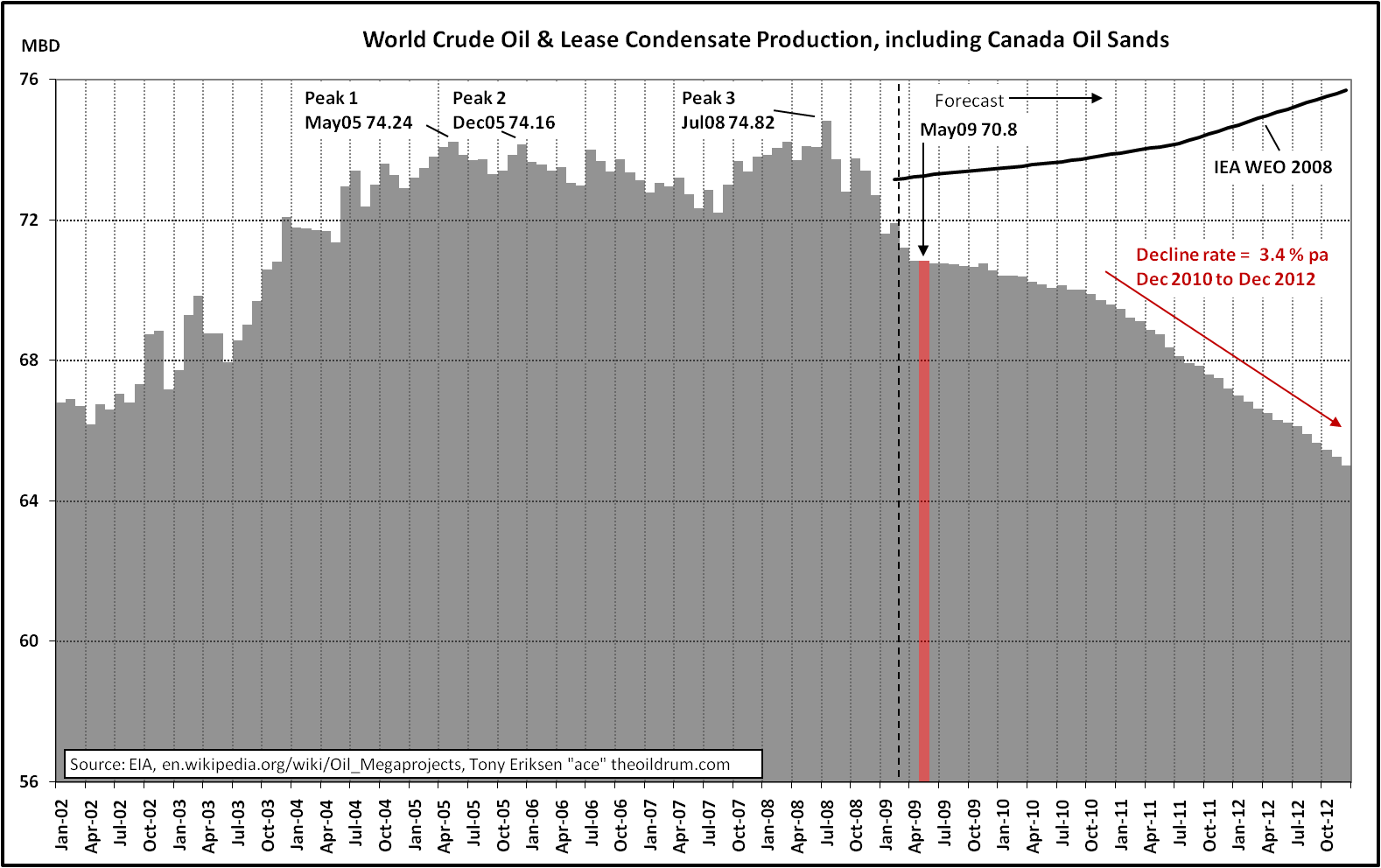
World oil production peaked in July 2008 at 74.82 million barrels/day (mbd) and now has fallen to about 71 mbd. It is expected that oil production will decline slowly to about December 2010 as OPEC production increases while non-OPEC production decreases. After 2010 the resulting annual production decline rate increases to 3.4% as OPEC production is unable to offset cumulative non-OPEC declines. The forecast from the IEA WEO 2008 is also shown for comparison.

The US Energy Information Administration (EIA) and the International Energy Agency (IEA) should make official statements about declining world oil production now to renew the focus on oil conservation and alternative renewable energy sources.

Fig 1 - World Oil Production to 2012 - click to enlarge (oil includes crude oil, lease condensate and oil sands)

World Oil Production

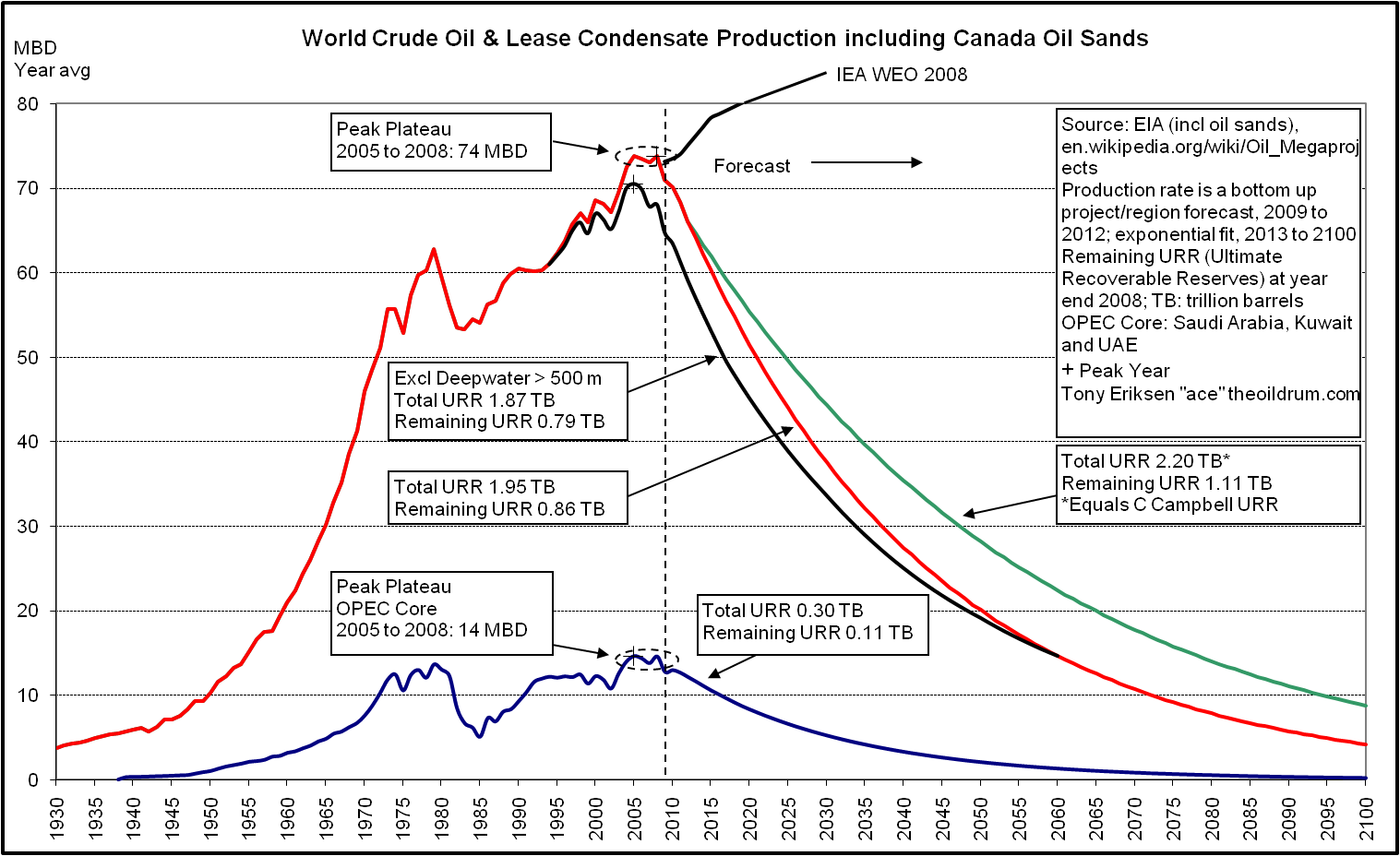
World crude oil, condensate and oil sands production peaked in 2008 at an average of 73.78 million barrels per day (mbd) which just exceeded the previous peak of 73.74 mbd in 2005, according to recent EIA production data. Production is expected to decline further as non OPEC oil production peaked in 2004 and is forecast to decline at a faster rate in 2009 and beyond due mainly to big declines from Russia, Norway, the UK and Mexico. Saudi Arabia's crude oil production peaked in 2005. By 2011, OPEC will not have the ability to offset cumulative non OPEC declines and world oil production is forecast to stay below its 2008 peak.

My estimate of 1.95 trillion barrels (TB) of total Ultimate Recoverable Reserves (URR) of oil is used to generate the forecast shown by the red line below. If Colin Campbell's estimate of 2.20 TB is used, which is 250 billion barrels (Gb) greater than my estimate due mainly to more optimistic assumptions about OPEC reserves, the peak production date remains at 2008. This shows that an additional 250 Gb of recoverable oil reserves does not change the peak oil date and instead increased production rates occur later as indicated by the green line below. Additional reserves and the related production from prospective areas such as the arctic, Iraq, and Brazil's Santos basin are highly unlikely to produce another peak but should decrease the production decline rate after 2012.

Fig 2 - World Oil Production to 2100 - click to enlarge

World Liquids Production

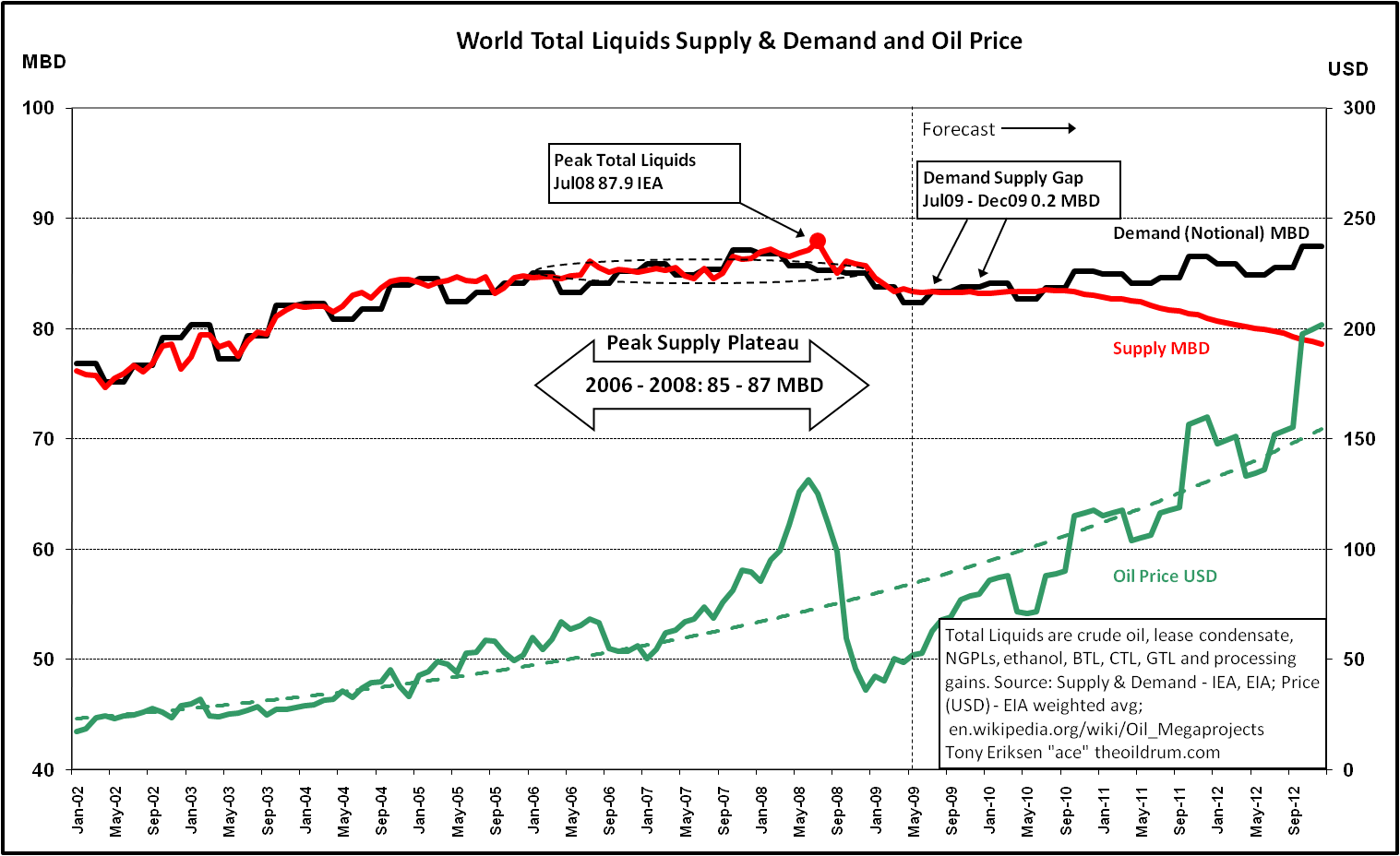
The definition of oil used by the International Energy Agency (IEA) also includes natural gas liquids (NGL), bio-fuels, processing gains and other liquids derived from natural gas and coal. OPEC NGLs were supposed to cause a significant net increase in world NGLs but this has not happened yet as NGL production is struggling to exceed 8 mbd. According to the EIA NGL data, 2007 production was 7.96 mbd, 2008 was 7.94 mbd and 2009 year to date was lower again at 7.80 mbd. Although bio-fuels production has been growing exponentially, world liquids production has probably passed peak in July 2008 at 87.9 mbd as shown below. In 2008, US ethanol production was 0.6 mbd, Brazilian ethanol production was 0.4 mbd, and bio-fuels production outside the US and Brazil was 0.5 mbd.

The average oil price should stay below $US 80/barrel for the remainder of the year as average demand is forecast to be only slightly greater than supply from July 2009 to December 2009. Furthermore, OPEC is unlikely to cut supply further which reduces the upward pressure on oil prices. Some recent evidence of increased demand is shown by US crude oil stocks dropping from a recent peak of 26.2 days at the end of April down to 25.5 days in early May. However, oil prices could exceed $100 in late 2010 as world liquids production drops further. High volatility of future oil prices is also expected due partly to delays in investment causing future oil capacity additions to decline sharply to 2012.

Fig 3 - World Supply, Demand and Price to 2012 - click to enlarge

Sources of Future Liquids Production

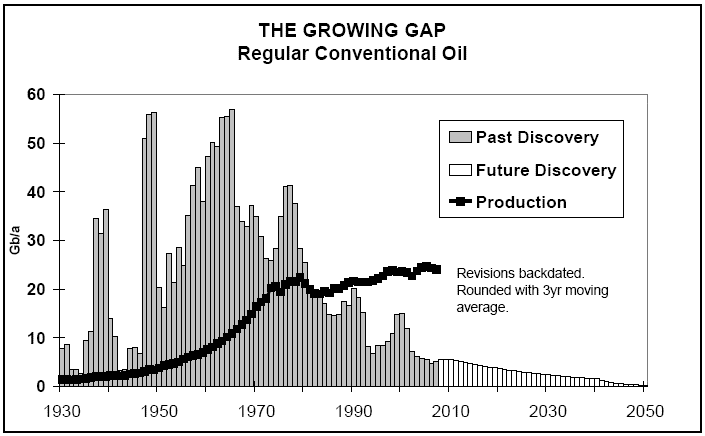
There are many sources of future liquids production but it is highly unlikely that production from these sources will cause liquids production to increase above its July 2008 peak because the cumulative declines from existing crude oil production sources are too great. Key sources of future production are future discoveries. The chart below, from Colin Campbell's newsletter, shows that annual discoveries have been decreasing since the mid 1960s. It also shows that production has exceeded discoveries since 1984 which is clearly unsustainable. Campbell also forecasts future discoveries to be 110 billion barrels (Gb) which is also the number assumed for the forecasts in Fig 2 above.

Fig 4 - World Oil Discoveries and Production, excluding Extra Heavy, Deepwater and Polar Oil - click to enlarge

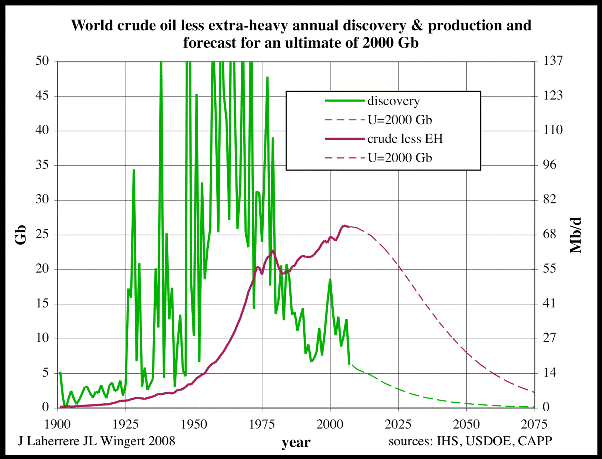
Jean Laherrere also produced a discovery and production chart below from his 2008 presentation. Future discoveries, represented by the area under the dashed green line, are about 120 Gb being slightly higher than Campbell's estimate. Laherrere's discovery curve includes deepwater discoveries and also indicates that production peaked in 2008. Many of these future discoveries are likely to be either deepwater or in arctic regions. These discoveries may be significant but the time between discovery and first oil can easily be ten years which will probably not change the peak production year of 2008 but should lessen the future production decline rate.

Fig 5 - World Oil Discoveries and Production, excluding Extra Heavy Oil - click to enlarge

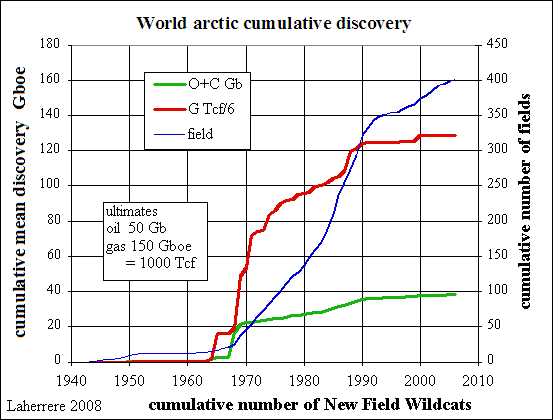
The arctic region is prospective for both oil and gas but quantities need to be estimated. Jean Laherrere estimated that the ultimate recoverable oil reserves are about 40 Gb while Colin Campbell estimates 52 Gb. There was a panel presentation at the 2009 Offshore Technology Conference (OTC.09) which discussed arctic energy challenges. One of the speakers was from Wood Mackenzie who confirmed that the arctic was prospective but mainly for gas not for oil. A report by Wood Mackenzie and Fugro Robertson estimated that the arctic will produce only about 3 percent of the world's oil and that arctic oil production, at best, would peak at 3 mbd several decades from now. Future production from the arctic region should help decrease future oil production decline rates but will probably not change the peak oil production year from 2008.

Fig 6 - World Arctic Cumulative Discovery Oil and Gas - click to enlarge

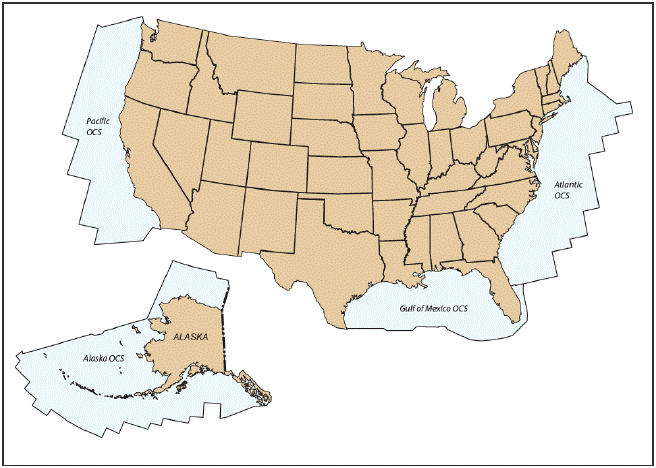
Other regions considered prospective are the US outer continental shelf (OCS) and Alaska's Arctic National Wildlife Refuge (ANWR). (Please note that the oil production potential of ANWR has also been included in the discussion above of the arctic). At this OTC.09 panel presentation on energy challenges, there was much discussion about allowing further drilling on the OCS and the ANWR. The American Petroleum Institute (API) was represented by its CEO at the panel and the API recently released this ICF report detailing potential reserves and future production from currently restricted areas in the OCS and the ANWR. This report concluded that an additional 1.1 (middle case) to 2.0 mbd (alternative case) of oil production, the majority from ANWR, might be possible by 2030 if drilling was allowed in these restricted areas. This additional production would benefit the US but would not change the peak oil date of 2008.

Fig 7 - US Outer Continental Shelf (OCS) - click to enlarge

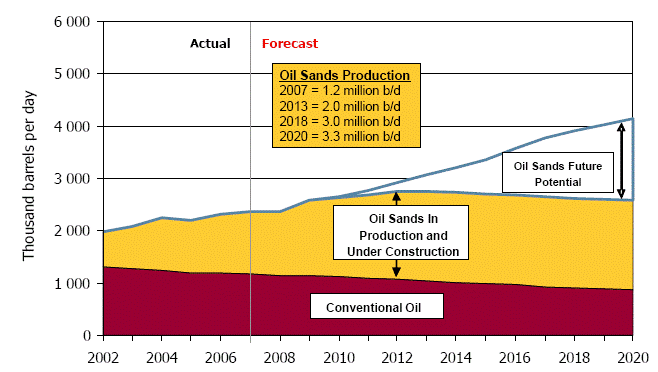
Canada often states that its oil reserves are almost 180 Gb. However, it is critical that 173 Gb of these reserves relate to oil sands which are not easy to produce. The chart below is from a recent presentation by the Canadian Association of Petroleum Producers and indicates the potential of Canada's total oil production to reach over 4 mbd by 2020. The forecast indicated by the red line in Figure 2 assumes that Canada oil sands production will reach a maximum of 2 mbd. Oil sands production was 1.2 mbd in 2007 and the International Energy Agency (IEA) is forecasting 2009 oil sands production to be slightly greater at 1.34 mbd. David Hughes, a Canadian geologist estimates that oil sands production will stay below 2.5 mbd due to constraints on natural gas, water and diluents. Oil sands production may reach 2.5 mbd but will not change the peak oil year.

Fig 8 - Canada Oil Sands Production Forecast to 2020 - click to enlarge

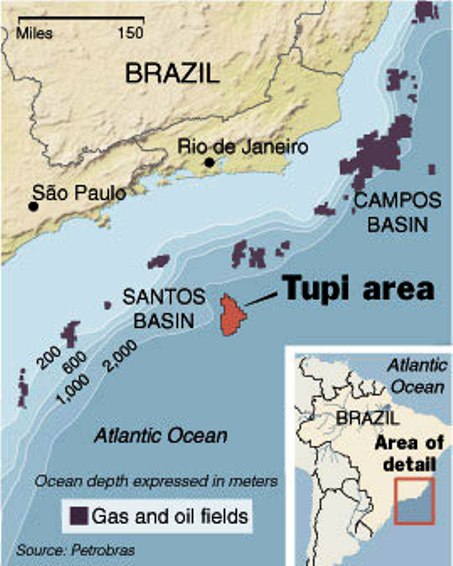
A promising area of future liquids production is the Santos basin, offshore Brazil. There are technical challenges, explained during a Petrobras OTC.09 presentation, with the pre-salt discoveries such as very high pressures and temperatures but Petrobras is optimistic about the Santos basin, stating that this basin may almost double Petrobras' oil reserves. This implies that the Santos basin could hold as much as 15 billion barrels of recoverable oil. However, it is always important to focus on the potential future production rates in addition to the size of the reserves.

The Tupi field was discovered in November 2007 in the Santos basin and an extended well test (EWT) started in early May at a rate of 15 thousand barrels per day (kbd), to be increased to 30 kbd by the end of 2009. The Tupi EWT will run for about 16 months to better understand the flow characteristics of the pre-salt reservoir. If this EWT performs well, then a pilot test of 100 kbd should start in late 2010. If the pilot test is satisfactory then plans for full scale commercial production would be implemented. However Petrobras CFO expects a long ramp up period with Tupi peaking at over 200 kbd at the earliest in 2017. A Wood MacKenzie analyst predicted that Tupi could peak at around 1 mbd in 2022 which appears significant but Petrobras will need this increased production from the Santos basin to maintain total production at 2 mbd. The reason is that declines from existing offshore fields are about 10% or 0.2 mbd per year as confirmed by the Petrobras CFO. Future production from the Santos basin will benefit Brazil but will probably have only a negligible impact on the world production past 2012 (see Fig 2 above).

Fig 9 - Tupi Field and Santos Basin - click to enlarge

Iraq is perhaps the most promising country in the world for future potential oil production. However, it has not been an attractive country for investment not just because of terrorism but also the lack of petroleum legislation which includes national revenue sharing from the oil fields of the semi-autononous region of Kurdistan. The chart below shows that Iraq's production might reach 8 mbd by 2020 if sufficient investment was available, peace prevailed and satisfactory petroleum legislation was passed. The ultimate recoverable reserves of oil of 130 Gb is based upon Laherrere's 2003 analysis. Colin Campbell had originally forecast 4.5 mbd being reached by 2014 but now has revised that lower to 2.65 mbd in his June 2008 newsletter. In mid May 2009, the former Iraq oil minister said that Iraq's output could reach 4 mbd by 2014 and 7 mbd by 2019 if satisfactory petroleum legislation is passed in 2010. My forecast, shown by the red line in Fig 2, assumes that Iraq will produce 2.7 mbd in 2012. If the former Iraq oil minister's predictions become true then future production may be closer to the green line in Fig 2 rather than the red line. The peak oil year of 2008 would be unchanged.

Fig 10 - Iraq Crude Oil and Lease Condensate Production to 2050 - click to enlarge

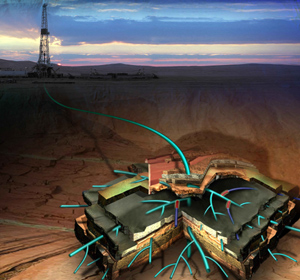
The application of advanced technology on existing discoveries is often thought to have potential for increasing production rates and recovery factors. The first production wells developed were vertical then horizontal wells became common practice. Next maximum reservoir contact wells were used for some reservoirs. Finally extreme reservoir contact wells, graphically illustrated below, are being researched by Saudi Aramco in an effort to boost recovery efficiencies. Generally, more horizontal laterals in a production well allows faster extraction of the oil but at the expense of higher production decline rates later. This recent Uppsala University report on decline rates of giant oil fields stated the following:

The important conclusion is that higher decline rates must be applied to giant fields that enter decline in the future. Prolonged plateau levels and increased depletion made possible by new and improved technology result in a generally higher decline rates. Detailed case studies of giant oilfields suggest that technology can extend the plateau phase, but at the expense of more pronounced declines in later years.

In conclusion, this analysis shows that the average decline rate of the giant oil fields have been increasing with time, reflecting the fact that more and more fields enter the decline phase and fewer and fewer new giant fields are being found. The increase is in part due to new technologies that have been able to temporarily maintain production at the expense of subsequent more rapid decline. Growing average decline rates have also been noted by IEA (2008). The difference between using a constant decline in existing production and an increasing decline rate is significant and could mean as much of a difference of 7 Mb/d by 2030.

There are other technologies such as injection to increase pressure in the reservoir. Natural gas, water, nitrogen and carbon dioxide injection can all help to maintain reservoir pressure and production rates. In 2008, Saudi Aramco injected a massive 13.7 mbd of water to maintain reservoir pressure so that 8.9 mbd oil could be produced. Fracing or fracturing the reservoir formation is another technology which can help increase production rates. The fracing can be done by forcing fluid into the formation causing fractures which are held open by special frac sand. Acid can also be used for fracing as the acid can dissolve some of the rock and increase permeability.

New technologies can extract the oil faster but can the recovery factor be increased? Schlumberger has stated that the average recovery factor for all reservoirs is about 35%. This BP study stated that the average global recovery factor is about 30-35% based on 9,000 fields from the IHS Energy database. Conversely, Saudi Aramco stated in its 2008 Annual Review that they are targeting recovery factors of 70 percent partly through the use of reservoir nano-bots known as Resbots. These Resbots would be deployed with the fluids injected into a reservoir to record pressure, temperature and fluid type which could be retrieved later in an effort to increase recovery rates. The OTC.09 Panel Presentation on Technology discussed the importance of technology and one of the presenters believed that technology will allow companies to recover over 3 trillion barrels of oil. It appears that recovery factors can be increased by using new technology but the magnitude of the increase is not clear yet. However, it is unlikely that the improved recovery factors will cause oil production to exceed its 2008 peak.

Fig 11 - Extreme Reservoir Contact Well - click to enlarge

Mexico's Cantarell field is an excellent example of the use of advanced technology to stimulate the production rate, followed later by a steep decline rate. This field once produced over two million barrels per day (mbd) in 2004 and now production is less than one mbd with an annual production decline rate of over 30%. The chart below, from Matt Simmons' OTC.09 peak oil presentation, shows the steep production decline continuing into 2009. In early 2000, Pemex started using the technology of nitrogen gas injection to keep up pressure to increase production rates which was successful. However, production began to decline after 2004 and Pemex drilled horizontal wells in 2006 in an effort to extract more oil. These horizontal wells probably helped to slow the production decline rate. These technologies of nitrogen injection and horizontal wells have helped to keep production rates high. As the impact of these technologies weakens, the annual production decline rate has increased to over 30%. The expanding gas cap in the Cantarell dome continues to intersect more production wells which decreases the production rate leading to an expectation that Cantarell could become uneconomic as early as 2014.

Fig 12 - Mexico Cantarell Field Production Rate - click to enlarge

Implications

The future sources of liquids production discussed above will help decrease the future rate of decline but it is highly unlikely that the 2008 peak will be exceeded because there are not enough countries with increasing oil production able to offset those countries with decreasing oil production. IEA oil supply warnings have been made in late 2008 when chief economist Birol said that the world needs the equivalent of four new Saudi Arabias just to maintain existing production to 2030. In April 2009, IEA's executive director Tanaka said that the world may face a crude oil shortage by 2013. As world oil production declines, consumption must also decline. Consequently, action must be taken now to reduce oil consumption and switch to alternative renewable energy sources. These sources include electricity generation from wind turbines, photovoltaic panels and geothermal sources. Other sources might be ocean energy which includes tidal energy, wave energy, thermal energy and ocean algae biofuels. Ocean thermal energy conversion was the subject of an OTC.09 panel discussion.

The IEA has recently published some recommendations to improve energy efficiency which apply not just to individuals but also to industry. For example, in the transport sector, the IEA is encouraging the use of fuel efficient tires and introducing mandatory fuel efficiency standards for light duty vehicles. In addition, this IEA document, called Energy Efficiency Policy, also encourages energy efficiency by providing links to almost 30 documents containing energy efficiency policies. One of these documents called Saving Oil in a Hurry suggests many conservation actions including increased use of public transit, car-pooling, telecommuting and speed limit restrictions. For further information, the IEA has its own energy efficiency web page. This recent Oil Drum story proposes many oil conservation ideas for individuals such as moving to a walkable neighbourhood and trading in your car for one with better mileage.

There is no simple solution to the problem of declining world oil production. A simultaneous multipronged approach will emerge which not only addresses oil conservation but also the development of alternative renewable energy sources. As oil production declines, a possible solution is to secure long term oil supply contracts ahead of the next oil price shock. China has been securing long term oil supplies from Russia, Venezuela and Iran. As oil remains critical for economic activity there is a high probability that some countries will act more aggressively in securing oil supplies, even to the extent of oil resource wars. In mid May 2009, Russia raised the prospect of war to enforce its claims on Arctic oil and gas riches.

Additional Information Sources

World Oil Production Peaked in 2008, March 17, 2009

Saudi Arabia's Crude Oil Production Peaked in 2005, March 3, 2009

Non OPEC-12 Oil Production Peaked in 2004, February 23, 2009

USA Gulf of Mexico Oil Production Forecast Update, February 9, 2009

Disclosure: The author, Tony Eriksen, has investments in the oil and gas sector. The American Petroleum Institute (API) sponsored the author's attendance to the Offshore Technology Conference (OTC.09) in Houston, Texas on May 4-7, 2009 of which the presentations reaffirmed the author's views on declining world oil production.

Tuesday, May 5, 2009

The Perfect Storm World Simulation: Peak Oil, Climate Change, Economic Collapse

Enough economics for awhile. All two of you, besides myself, that read this blog already know what I think on that. Other facets of The Perfect Storm need some attention. I'd like to look at the big picture with an eye toward solutions.

The problem is simple: Anthropogenically-forced Climate Change (ACC), Peak Oil (PO), economic collapse, etc., are in the early stages of potentially remaking our world in ways we really would like to avoid, but there is almost nothing being done about any of it in any real sense when you consider the massive changes that are needed to deal with all these problems. If you think a bit on how long it takes to change the way a few billion people live, it's clear we have nearly run out of time to find solutions and implement them.

Robert Hirsch, et al., determined in a study done in 2005 that mitigating PO with minimal effects would require starting twenty years before the peak. Starting ten years before would lead to serious issues, but could be done. Waiting until peak would result in serious problems. Peak appears to have come in 2008.

Oops.

Then there's ACC. A recent poll of climate scientists shows they are far more worried about ACC than is generally understood. But for James Hansen, they tend to be pretty quiet and conservative in their pronouncements on climate. This is (intellectually) understandable. They are scientists and are expected to state what they can prove, not what they know to be true. But aren't we past the point of this little luxury? Are not the dire consequences of no action or too little action being taken - a world 2 to 6C warmer - too great to risk? Well, finally some are speaking out... anonymously. (Way to put your necks out there, Profs!)

World will not meet 2C warming target, climate change experts agree

Guardian poll reveals almost nine out of 10 climate experts do not
believe current political efforts will keep warming below 2C

The poll of those who follow global warming most closely exposes a widening gulf between political rhetoric and scientific opinions on climate change.

While policymakers and campaigners focus on the 2C target, 86% of the experts told the survey they did not think it would be achieved.

...60% of respondents argued that, in theory, it was still technically and
economically possible to meet

...global warming of 2C

... But 39% said the 2C target was impossible.

...84 of the 182 specialists (46%) who answered the question said it would reach 3-4C by the end of the century; 47 (26%) suggested a rise of 2-3C, while a handful said 6C or more. While 24 experts predicted a catastrophic rise of 4-5C, just 18 thought it would stay at 2C or under.

Geewillickers... You gotta see some quotes from here:

Climate change experts reveal their hopes and fears

  • By 2100 I seriously fear there will be civilization collapse and chaos.
  • We should also be mindful that temperature sensitivity of the planet... has been grossly underestimated... We are in extremely dangerous territory.
  • Nothing short of a major restructuring of the energy generation system will see us limiting climate change to a 2C rise.

Now, don't you feel all warm and fuzzy? No? It gets worse.

To meet climate goal, cut fossil fuels use: study

The paper, published by the British journal Nature, implies only a revolution in energy use can achieve the aim of limiting warming to less than two degrees Celsius (3.8 degrees Fahrenheit) above pre-industrial levels.

To achieve the objective -- embraced by the European Union (EU) and many scientists -- means that only 1,000 billion tonnes of carbon dioxide (CO2) can be emitted between 2000 and 2050, it said.

By comparison, the world has emitted a third of that amount in just nine years.

"If we continue burning fossil fuels as we do, we will have exhausted the carbon budget in merely 20 years, and global warming will go well beyond two degrees," said the study's lead author, Malte Meinshausen of the Potsdam Institute for Climate Impact Research in Berlin.

So, how much carbon have you cut out of your life today? None? Well! We're moving right along, aren't we! Look around you. Other than cuts caused by the recession, do you see people really changing how they use energy?

Paradoxically, PO will both helping us reduce our use of Fossil Fuels and make it harder to do so. To wit:

  1. Crude oil production likely peaked in 2008.
  2. On one hand, the use of oil will fall over the next few decades. On the other, if renewable forms of energy can't replace crude oil, then tar sands and coal will. Both are much greater emitters of CO2 than crude oil is.
  3. Having run out of hands, now use your feet to factor in the economic hit of declining oil production. (In both recessions in the '70's, the percentage drop in crude oil production and the drop in GDP were about the same, e.g.)
  4. As the "recession" begins to abate, the economic hit from PO will most likely stop it in its tracks.
  5. Investments for renewable energies will almost certainly be reduced by the economic crash.

To make matters ever-so-much better, what do Americans think about climate change? Not much.

Only 34% blame humans for global warming

Just one-out-of-three voters (34%) now believe global warming is caused by human activity, the lowest finding yet in Rasmussen Reports national surveying. However, a plurality (48%) of the Political Class believes humans are to blame.

Forty-eight percent (48%) of all likely voters attribute climate change to long-term planetary trends, while seven percent (7%) blame some other reason. Eleven percent (11%) aren’t sure.

These numbers reflect a reversal from a year ago when 47% blamed human activity while 34% said long-term planetary trends.

If you're feeling like kicking the dog or drinking your way through every bar between you and the Restaurant at the End of the Universe, hold on a second. I have a plan. Really.

Below is an e-mail (modified for this post) I sent not long ago to someone I thought, based on previous work, might be interested in modeling global solutions to The Perfect Storm. Sadly, no response. Maybe someone will stumble across it here and find a kernel of a good idea in it.

Dear X,
My wife and I have had an idea in our minds for quite some time for a massively interactive virtual reality world/MMPRPG/global climate model/global energy model/global economic model: The Perfect Storm World Simulation: Peak Oil, Climate Change, Economic Collapse.

The idea started from a simple question we, as teachers, asked ourselves: How could we do outreach on the issues of Climate Change, Peak Oil and the Economic Crash - what I call a Perfect Storm? (E.g. my blog is aperfectstormcometh.blogspot.com.) We needed something that would integrate everything we faced, but do it at the personal level and governmental level. We needed a synthesis of both to help get change going since government moves too slowly and grassroots movements alone are not going to manage the massive changes needed - though I think grassroots movements like Transition Towns, the Post-Carbon Institute and the Relocalization movement will be the primary players in the end since the changes start and end with what we do, what we buy, how we live day-to-day.

The answer was an on-line game. Rather, a live modeling project that would both inform people (nearly half of all Americans still have significant doubts about Climate Change and far less know about Peak Oil) about the issues and help find a collaborative solution.From there we brainstormed and by the time we were done had an idea that was so massively beyond our skill sets we knew we were hopelessly over matched. We envisioned something with the following components or characteristics:

- It would be huge, along the lines of MMPRPGs, but necessarily bigger than any before it. This needs to be international in scope since any solutions must also be, and must offer realistic simulations.

- It would include participation of individuals from all levels of society, i.e., gov't. officials and orgs, non-profits, NGO's and, most importantly, the public.

- It would preferably have an interface like virtual reality game.

- It would have real climate models attached, or at least data from models as part of the data so people can see climate effects of their own actions as they happen in the game.

- It would would include energy decline reality.

- It would include other resource constraints (water, fisheries, farming, etc.)

- It would include real-world economic data.

- It would allow for new models of governance, economic systems and societal structures to be tried and tested, such as Steady State economic models (1, 2, 3), barter economies, etc.

- Perhaps multiple runs/games going simultaneously, much like Global Climate Models. Maybe individuals could start up their own runs and people could jump in if they liked the parameters set by the originator?

- Perhaps dummy nodes/agents coded to model the averages for given regions/cities/countries to get the numbers up as high as possible.

Etc.

I started research on what was already out there. The RPG idea was clear enough. Such things as The Sims, SecondLife, World Without Oil, etc., already exist.

My research found possible components for other elements. Purdue University has SEAS. It has been used for gov't simulations before. The software team codes a scenario and real people are agents in the game. There are other nodes (agents) that are run as part of the model and represent people. It's been used for some disaster planning, etc. The goal, of course, is to have millions of real people actually acting in the simulations. They may already have that, but my impression is that only gov't officials and first responders actually participate. It might be a good foundation for the basic structure - or not. I *believe* they have a virtual presentation like an MMPRPG.

A second is the T21 program out of the Millennium Institute.

T21-North America User Interface Released!
Arlington, VA, October 18, 2007

The T21-North America (T21-NA) model user interface was released today. The user interface allows the model to be open, modified and simulated on any Windows-based computer.

The T21-NA model project is a collaboration with Association for the Study of Peak Oil and Gas-USA and State University of New York’s College of Environmental Science and Forestry to examine energy issues in the context of an integrated framework that incorporates the relations of the energy sector to the broader economic, social, and environmental framework. The project is part of ASPO-USA’s Global Energy Modeling project.

Their software is a package run by programmers, so far as I can tell. That is, it is not an MMPRPG-, SEAS- or Alternate Reality-style package that real people are involved in; it's based on a few people inputting what they think is important rather than real people acting as they, hopefully, would in reality. I think.

A third choice might be the World3 program used by for Limits to Growth. Delores Garcia is developing/has developed an updated version of this program:

Abstract: An updated systems model of global climate, resources, and energy extending the original World3 (“Limits to Growth”) model by inclusion of climate change and it's interaction with resources and energy. Outcomes are derived for total energy resources, human population, nutrition, consumption, economic activity and other parameters. Long-term outcomes are derived for a 1900 C.E. to 2100 C.E. time sequence, with human population decline.

The weakness here is, of course, that it is not a live simulation, but a model dependent solely on inputs from the programmer. It does, however, represent a good bit of the breadth we need as it includes energy, food production, climate, etc., as noted above, and may be the closest of the three to what we are thinking of.

It may well be that something this complex and wide-ranging needs to be built from scratch. Having worked in the documentation department of a main frame software company, I can appreciate the difficulties encountered trying to integrate software not designed to work together.

As for implementation, I'd be hoping to have this made available world-wide for free so there are no restrictions. Ideally, we'd capture the imagination of some important people and be able to make a big deal of the launch and subsequent modeling with an eye toward 1. raising awareness of how serious the times are and 2. actually modelling a solution or two that might be viable, or at least move us towards some solutions.

This approach also, and perhaps most importantly, takes the policy, research and data input out from behind the closed doors and gilt halls of TPTB and gets them into the hands of the public at large.

Time is short. People need to wake up to the serious problems we face and we need a workable solution yesterday. I believe The Perfect Storm World Simulation: Peak Oil, Climate Change, Economic Collapse can both raise awareness and model possible solution scenarios.

Cheers

Tuesday, April 14, 2009

Of Crashes, Failures and Bailouts - Round V: Blacker Than Ever

THIS POST IS no longer IN PROGRESS. LAST UPDATE AT 1:31 PM EDT 4/15/09

The following is excerpted from an interview in Barron's (click the title to go to the original) of William Black by Jack Willoughby. What Black says isn't so amazing. Others have said it, and far earlier. I have previously posted comments and links to The Automatic Earth (which is where I found the original article from Barron's), Karl Denninger, Peter Schiff and others saying essentially all the same things. It's that he's the one saying it. William Black has gravitas. He has the pedigree. Those who would dismiss, and have dismissed, the voices in the wilderness noted above, can't so easily do the same to William Black.

There's not really anything new here that wasn't in Of Crashes, Failures and Bailouts - Round IV, but it's all worth repeating just for emphasis.

My comments below the interview.

Barron's: Just how serious is this credit crisis? What is at stake here for the American taxpayer?

Black: ...The scale of fraud is immense...

So you are saying Democrats as well as Republicans share the blame? No one can claim the high ground?

We have failed bankers giving advice to failed regulators on how to deal with failed assets. How can it result in anything but failure? ...Tim Geithner, the current Secretary of the Treasury, and Larry Summers, chairman of the National Economic Council, were important architects of the problems...

So you aren't a fan of the recently announced plan for the government to back private purchases of the toxic assets?

It is worse than a lie. Geithner... is really pandering to the interests of a select group of banks who are on a first-name basis with Washington politicians. The current law mandates prompt corrective action, which means speedy resolution of insolvencies. He is flouting the law, in naked violation, in order to pursue the kind of favoritism that the law was designed to prevent...

...It is like Gresham's law: Bad money drives out the good. Well, bad behavior drives out good behavior, without good enforcement.

...By promoting this notion of too-big-to-fail, we are allowing a pernicious influence to remain in Washington...

Summarize the problem as best you can for Barron's readers.

With most of America's biggest banks insolvent, you have, in essence, a multitrillion dollar cover-up by publicly traded entities, which amounts to felony securities fraud on a massive scale.

These firms will ultimately have to be forced into receivership, the management and boards stripped of office, title, and compensation. First... a Pecora-style fact-finding mission conducted without fear or favor... Then... pursue criminal cases...

What, then, is staying the federal government's hand? Have the banks become too difficult or complex to regulate?

...to do so would force it to put some of America's biggest financial institutions into receivership... these banks are some of the most well-connected in Washington...

Can you explain your idea of control fraud, and how it applies to the current banking and the earlier thrift crisis?

Control fraud is when a seemingly legitimate corporation uses its power as a weapon to defraud or take something of value through deceit.

...These accounting frauds create huge bubbles...

Why then is there so much smoke and so little action?

...The reason we don't see it -- aren't told about it -- is that if they were honest, prompt corrective action would kick in...

You say the evidence of a breakdown in the regulatory structure comes from the fact that America avoided an earlier subprime crisis in the 1990s.

Exactly. Why had no one heard of the subprime crisis back in 1991? Because America's regulators also faced down the crisis early... the problem didn't spread -- because regulators intervened.

What needs to be done?

Well, these international behemoths need to be broken down into smaller units... And a new seriousness must be put into regulation... We just need folks who can enforce the ones already on the books.

The bank-compensation system also creates an environment that leads to mismanagement and fraud... the top 20% get the bulk of the benefits and the bottom 10% get fired... Compensation systems... discourage whistleblowing -- the most common way that frauds are found in America -- because the system draws upon the cooperation of everyone.

This whole thing isn't over. Those in government or the financial industry saying we are past the bottom and will be coming out of recession within months, or maybe the end of the year, are liars or fools. The proof is in the pudding.

Question: How can the recession end when loan defaults - of all kinds and all sectors of the economy - are still raging? Take a look at this Mortgage Reset Chart. We are currently at a lull in resets. They surge again through 2010-2011.

Which brings us to inventory. John Mauldin at Minyanville observes:

No Housing Recovery Lurks in Shadow Inventory
- The Shadow Inventory of Homes

...a strange thing is happening: We're seeing what's being called a "shadow inventory" of foreclosed homes.

The San Francisco Chronicle reports:"We believe there are in the neighborhood of 600,000 properties nationwide that banks have repossessed but not put on the market," said Rick Sharga, vice president of RealtyTrac...

A RealtyTrac survey found that only 30% of foreclosures were listed for sale in real-estate listings, like the MLS (Multiple Listing Service). Add in homes that people would like to sell but simply can't find buyers for and must either hold or rent, and the unsold inventory numbers that are public are likely far below actual available homes.

Might some homes in foreclosure be held off the market because banks eventually want to negotiate with the homeowner? Possibly. But other surveys show that anywhere from 30%-40% of homes in the foreclosure process in many areas are actually already vacant. There's no one with whom to negotiate...

...Normally there are about 160,000 homes a year in foreclosure sales. We're now seeing 80,000 a month, or 6 times normal levels, and rising.

Second, lenders could be deferring sales to put off having to acknowledge the actual extent of their losses. "With banks in the stress they're in, I don't think they're anxious to show losses in assets on their balance sheets," one observer said.

Finally, banks may not want to flood the market with foreclosures, driving prices down even more...

But it gets worse.

And it does. He goes on to list some of the things I'm already writing here, and more. You should read the article.

And what about commercial real estate? Prices are crashing and defaults rising as we speak. Credit card debt? Credit lines are being canceled or slashed as banks look to control losses or costs. Being a good risk is now a liability: they earn no interest and/or fees from you if you don't carry a balance, yet have money out to you. Liquidity is at issue. Every bank and financial entity wants cash. They need cash. You lose.

More importantly, as Meredith Whitney has pointed out, credit cards and credit lines have been what enabled many families the flexibility to manage tricky finances. As more restrictions are placed on personal credit, the more families that will be forced into default.

Few doubt the importance of consumer spending to the U.S. economy and its multiplier effect on the global economy, but what is underappreciated is the role of credit-card availability in that spending. Currently, there is roughly $5 trillion in credit-card lines outstanding in the U.S., and a little more than $800 billion is currently drawn upon. While those numbers look small relative to total mortgage debt of over $10.5 trillion, credit-card debt is revolving and accordingly being paid off and drawn down over and over, creating a critical role in commerce in America.

Just six months ago, I estimated that at least $2 trillion of available credit-card lines would be expunged from the system by the end of 2010. However, today, that estimate now looks optimistic, as available lines were reduced by nearly $500 billion in the fourth quarter of 2008 alone. My revised estimates are that over $2 trillion of credit-card lines will be cut inside of 2009, and $2.7 trillion by the end of 2010.

Where is the recovery?

Global trade is still falling as can be seen in import and export numbers around the globe, which also reflects in shipping. Manufacturing - JOBS - will continue to fall in lockstep. Unemployment continues to rise even as extended benefits are running out for those early in the unemployment line. Real unemployment is now just below 20%.

Where is the recovery?

The financial sector is insolvent, but won't admit it. Housing and commercial real estate are so overbuilt squatters are taking over homes everywhere. Where the hell is the recovery supposed to come from? Foreign companies? Foreign countries? The U.S. is the consumption engine of the world. It is 20% or more of the global economy and 70% of that is consumerism. Service industries. In other words, pointless, useless and producing almost zero infrastructure/real capital. Do the math. That's 14% of the global economy that is kitsch and junk. Price/Earnings ratios are shot.

Et-flippin'-cetera.

Where is the recovery?

I call this blog A Perfect Storm Cometh. The financial unwind is only one part. Let's say we do go into recovery within the next six-to-eight months. Growth takes energy. Cheap energy. The densest energy we currently can tap cheaply and easily is oil. However, oil production is falling due to both above ground (non-geological) and below ground (geological) reasons.

The natural decline rate of crude oil production is at over 9% per year. That's over 6.5 million barrels a day. New production each year brings that number down to 6+% or 4.5 to 5 million barrels a day lost each year. Let's put that in perspective. That's a full Saudi Arabia every two years. We aren't finding anywhere near that much oil and haven't for decades. For now, the drop in production because of recession is masking the drop in production due to Peak Oil. Keeping this in mind, the recession **helps** with Peak Oil in the immediate future, but not in the longer term.

The problem is that the recession is not only reducing oil consumption, thus production, as a result of lowered demand, it is cutting future production. New wells aren't being drilled as fast. Old wells aren't being improved with technology. Expensive wells are being shut down while waiting for higher prices. IF a recovery started, it would run into the brick wall of slow-to-recover production and decline. The longer the recession (PC talk for depression, it seems) goes on, the more likely no new peak in production can be hit. The reason is simple: we have produced about half of all oil we can reasonably get to for reasonable prices. The rest is in smaller fields that are harder to reach. Consider my modified haystack analogy.

Imagine a giant haystack. Rather than the proverbial needle, in the hay are ten basketballs, 100 tennis balls and 1000 marbles. (Imagine our magic haystack keeps all objects suspended so they don't all fall to the floor.) The result?

  • We will absolutely find all of the ten basketballs before we find all 100 tennis balls. Or even a majority.
  • We will absolutely find all the tennis balls before we find all the marbles.
  • We will find some of each from the very start.
  • We will find all the basketballs in the early part of our search, say the first 25 - 40% of total time spent looking.
  • The basketballs will equal a majority of all balls/marbles by volume.
    (Take a look at the Discovery/Production graph at the bottom of the blog.)

We've already found all the basketballs and a bunch of the tennis balls. We're down a few tennis balls and a bunch of marbles. Regarding production, the basketballs are going seriously flat and a bunch of tennis balls are getting flat or are empty. There's a lot of oil, but it's just not going to be possible to increase how fast we can get at it.

Where is the recovery?

Economic impacts? In the two large recessions of the 70's, GDP and oil production reflected one another, falling by similar percentages. In historical terms economic growth, food production and population have all tracked along with oil production. Both GDP and oil production are falling at this time. Again, by similar amounts. (See graphs at the bottom of this blog.)

The historic interplay of oil and economy is also seen in oil prices and recessions. Check out the graph at the beginning of the post below.

Oil Addiction and Recession

Vulnerability to oil prices helped cause this collapse

Poorly regulated real-estate lending wasn’t the only cause of the economic meltdown now gripping the industrial economies. Oil addiction also contributed.

The extraordinary rise in oil prices since 2003 has sucked hundreds of billions of dollars out of the US economy (and the Cascadian economy).High oil prices have been a contributing cause of most recessions: Since 1948, “all large oil price increases but two have been followed by recessions,” as Andrew Hoerner and Nia Robinson of Redefining Progress (RP) write (pdf). “Four of the five recessions since 1970 . . . were preceded by big jumps in oil prices.”

Oil prices are now down 4 - 6%. Fourth quarter '08 GDP was falling at an annual rate of around 6%. Coincidence? These two posts discuss the connections between oil prices and the economy.

The oil shock and recession of 2008: Part 1
The oil shock and recession of 2008: Part 2

When, not if (barring a Dark Ages-level global collapse), production declines overtake falling demand, the prices will rocket upward. Again. Price volatility should be the norm, as it has been, now and in the future.

Where is the recovery?

The third part of the Perfect Storm is Anthropogenically-driven Climate Change (ACC.).

Without going into it too far, all of the above have a negative impact on ACC. Obviously, economic limits will affect the building of "green" infrastructure as credit is tight and resources are dwindling. It is important that governments understand that the long term health and safety of their nation and people depends on not losing sight of what happens if we don't successfully transition to sustainable energies and sustainable societies.

It has been reported that climate scientists are privately far more pessimistic about the future than they are letting on. Public pronouncements parrot the 2C warming locked in even if we successfully manage Green House Gas (GHG) emissions this century. Privately, there is talk that 3C or 4C is more likely. This is very bad news, of course, which illustrates that action can't wait, but with the economy crashing and energy decline likely to keep it crashing for the next 5 to 10 years (if renewables don't ramp up, it could last decades), how are we supposed to manage the transition to a low- or no-carbon society?

The answers might be simpler - though not necessarily easy - than one might think: Just say no.

More on that later.

Cheers

Thursday, December 18, 2008

Political Will, Political Won't (or Boy Are We In Deep Doo-doo)

This piece by Paul Chefurka gives an excellent overview of where we've been, where we are, and what we need to do. I don't need to add to it. I have reformatted to fit this space.

The article is reprinted whole with permission of the writer. (See permissions at the end of the article.)
Political Will, Political Won't
Introduction
Today's environmental reform movement is founded on two core assumptions. The first is that most of the technical solutions we need to address the world's various crises are available, or at least could be swiftly developed by sufficiently intelligent, hard-working people. The second assumption is that all that's lacking for a successful outcome is the political will to put these technical solutions into effect.

Whether we're talking about replacing coal-fired power plants with wind turbines and using electric cars instead of SUVs, converting industrial agriculture to organic permaculture, or reversing the decline of ocean life though international regulations, it is an article of faith in the reformist environmental movement that we know what we need to do and all that's lacking is a sufficiently visionary leader to put more planet-friendly solutions in place.

Unfortunately, both those assumptions ignore significant aspects of the situation that considerably diminish the prospects that the reforms will succeed. This article examines those assumptions and uncovers the confounding issues.

Global Problems
Wicked Problems
The amount of carbon dioxide in the atmosphere is approaching 400 parts per million.

World oil production is on a 4 year plateau.

Ice caps and glaciers are disintegrating.

In the oceans the coral reefs are dying, dead zones are expanding, and predatory fish species (the ones we eat) have declined by 90% in the last 50 years.

The estimated extinction rate of plants and animals is at least 75 species per day.

Over 75,000 square miles of arable land is lost each year to urbanization and desertification.

A billion people in over 110 countries are affected by desertification.

On the American Great Plains, half the topsoil has been lost in the last hundred years, and the Ogallala aquifer is being drained up to 100 times faster than it is being refilled.

Indian farmers have drilled over 21 million water wells using oil-well technology. They take 200 billion tonnes of water out of the earth each year for irrigation.

We have eaten more grain than we have grown in 7 of the last 8 years, while world carry-over grain stocks declined from 130 days of consumption in 1986 to 53 days today.

The price of fertilizer is rising exponentially.

Climate change may cut African food production in half by 2020.

The cost of food is skyrocketing. Some countries have banned exports of wheat or rice.

We are in the beginning stages of a global financial crisis that could result in either a deflationary or hyper-inflationary depression lasting for a decade or more.
As the list of negative trends to the right clearly illustrates, the scale and diversity of the problems we face are significant. These sorts of problems are known as wicked problems: they are messy, circular, aggressive and interlinked, so that trying to solve one may worsen others. In some cases the trends have been visible for centuries (for example the loss of arable land and desertification), sometimes for decades (as with the loss of aquatic biomass), and some like Peak Oil for a scant few years. In all cases the global trends show no signs of reversing, however much effort has been expended to alter their local or regional trajectories . As their effects become more pronounced, it becomes easier to see their potential to hit our globalized industrial civilization like a planet-sized version of Hurricane Katrina.

As daunting as the individual problems are, the linkages between them are even more important. In many cases, trying to solve one problem can inadvertently make others worse. One prominent example is the attempt to address global warming through the use of ethanol as a vehicle fuel. While there may have been some merit to that primary intention, the secondary effects – increasing dead zones in the oceans due to fertilizer runoff, and rising food prices due to the use of food crops as fuel – eliminated the overall benefit of the effort, and even created a net negative outcome. One dark quip that addresses this sort of backfire is, "Around every silver lining there is a cloud."

It is obvious that dealing with the panoply of problems besetting our world involves considerably more than just knocking them down one at a time. If we don't apply holistic, system-level thinking to the converging crisis, our well-meaning efforts stand an excellent chance of making the situation worse. It is a mistake to think of "solving" these problems in any global or final sense. Some of them may be improved regionally, especially if they are not in conflict with other local problems. The logical corollary is that there will be other regions where those same problems cannot be solved, due to different local circumstances.

The big concerns, however, are those problems do not respect national or regional boundaries. Global warming and the death of ocean life affect us all, and failing to address these problems in any region can make the situation worse for everyone. In these cases, it's obvious that a collective global response is called for – a response that brings together the political, economic, industrial and opinion-making institutions of our world. If these institutions acted together they might have a chance of implementing the deep and wide-ranging changes the situation calls for.

Unfortunately, we have seen precious little evidence of such a collective response. For example, we have repeatedly seen climate change conferences break down or issue watered-down statements that fail to address the scale of the accelerating crisis. While individuals, citizens' groups and even some governments are obviously aware of the urgency, collective action repeatedly fails to gain the required global traction.

This state of affairs is no accident. This is not because of some dark and sinister cabal or conspiracy to hold back change in the name of personal profit, though there probably are some instances of that. The real reasons are at once more banal and more worrisome than the Bilderberg watchers assume.

In the next section we will begin to examine the reasons for this sorry situation.

Our Origins
Hunter-Gatherers
There have been some remarkable recent discoveries about the quality of life in the times before modern civilization. We have always known that society back then consisted of hunter-gatherers, organized as tribes. The classical impression was that their lives were, in the words of Thomas Hobbes, "solitary, poor, nasty, brutish and short".

Recent research has shown that in fact hunter-gatherer societies enjoyed a remarkable quality of life characterized by low levels of effort, plenty of leisure time, good nutrition, low levels of disease, egalitarianism, very low levels of suicide, homicide and warfare, a high degree of personal autonomy and close-knit communities. In the words of anthropologist Marshall Sahlins, hunter-gatherers were "the original affluent society."

In one of our more damaging semantic restatements we have defined "subsistence" living as bad and "sustainable" living as good – even though in the context of a hunter-gatherer society, they mean exactly the same thing.
In order to understand the role that politics plays in our collective failure to address our predicament we need to examine the nature of modern civilization.

Now, when I use the term "modern civilization" I’m not just talking about the growth of industrialism over the last two hundred years or even the growth of Western culture over the last two thousand years. What we usually think of as modern civilization is the development, refinement and culmination of cultural changes that began ten thousand years ago. To understand who we have become we need to look back at who we were before we became "modern and civilized" and what happened to push us across that threshold.

Human beings have been around in one form or another for over two million years, first as Homo habilis, then as Homo erectus, and finally as Homo sapiens. For virtually all of those two million years, we lived in harmony with our environment. While it may not always have been a comfortable life (how could it have been, without color cable television or cars?), we were nonetheless perfectly adapted to our habitat. This statement is supported by two facts: over most of that period our presence caused little or no damage to the planetary biosphere; and during that time the human population was essentially stable, growing to only about five million in two million years – a net addition of a scant two people per year.

So here we have a species that was exquisitely adapted to its environment, living an affluent yet sustainable life, treading lightly on the earth, never outgrowing or overrunning its habitat, at least in terms of the species as a whole. We lived in harmony with our world for two million years, for 99.5% of the time we have been on the planet. Then suddenly, in the last ten thousand years – a mere 0.5% eye blink of time – our population increased over 1000 times, we decimated the earth's stocks of non-renewable resources, we cut down 90% of the planet's forests, we fished her oceans to the edge of extinction, and we live in a near-constant state of conflict with each other. In this grievously short time we have brought about all the wicked problems listed above.

So what the hell happened?

What Changed Us?
In a word, it was agriculture.

About 10,000 years ago humanity developed organized, settled agriculture. Starting from a small area in the Middle East, over the next few thousand years the world's predominant social model gradually changed as the new agricultural societies replaced hunter-gatherer or horticultural societies by means of displacement, absorption or genocide. We settled down (as one has to, to raise monoculture crops), and started to form larger social structures – villages, towns and cities. Nobody is precisely sure why we developed monocrop agriculture – after all, our previous ways of life had been perfectly satisfactory for millions of years. It may have been precipitated by climate changes, or growing populations in some areas, or it may have been just one of those things. Whatever the trigger was, the threshold of radical human change is clearly demarcated by fields of grain.

Humans and Resources
The most far-reaching change that came out of our development of agriculture was a heady awareness of our ability to control the world. For the first time in our two million year history we did not have to simply take whatever Mother Nature offered. We suddenly realized that we could control her bounty, we could coax, cajole and coerce her into providing what we wanted.

As we planted the seeds of millet and maize in the earth, we planted a very different seed within ourselves – the seed of a new idea about our relationship with the earth. We now saw our ability to control the earth's produce as a sign of our mastery, our ownership, our dominion. No longer would we need to be just another nexus in the web of life, now the web belonged to us. And just like any other possession it was ours to do with as we saw fit.

We came to the profound conclusion that the world consisted of only two broad classes of things: human beings and resources.

The Growth of Hierarchy
The shift to settled cultivation entrained a host of other changes. Our diet was dramatically impoverished. Levels of chronic disease and malnutrition increased. Levels of social violence escalated. And we witnessed the appearance of hierarchies that had not previously existed in our tribal social systems.

Anthropologists are still debating why the development of agriculture resulted in the simultaneous growth of social hierarchies. In my opinion it happened because the risk to farming communities from crop failures was very high. If the crops failed, these communities contained too many people to survive on local foraging or hunting – both because population densities were so high and because the habitat destruction caused by farming had reduced the amount of local wild food. There was also no way to bring in enough food from other unaffected regions. Therefore the risk of crop failures had to be mitigated. This mitigation involved many activities. For example, local hunting kept larger crop-eating pests at bay, irrigation helped in times of drought, and shamanic intercession took care of storms and blights.

Each of these activities of hunter, irrigation engineer and shaman was highly specialized in comparison to the more generic farming skills required for planting and harvesting. This specialization conferred power on the holders of those skills. This was especially true in the case of shamans, whose power could not be entirely learned, but was said to emanate from a mysterious connection with the supernatural. Their attempt to exercise control over nature gave the shamans the real ability to exercise control over other people ("Obey me or the gods will frown on us, and the crop failure will be your fault!"), and the first power hierarchies were born.

The Effects of Surplus
Centralizing the production of food and managing its distribution introduced new elements to the growing hierarchies. Since some of the food was needed by people who had no direct hand in producing it (such as weavers, shamans and granary guards), some means had to be found to give them equitable access to it. This meant we had to come up with a way of defining the relative values of different kinds of work, and to establish a medium of exchange so that people could obtain the amount of food their work was deemed to be worth. In one stroke the concepts of money and wages appeared. This of course transferred a lot of of power to those who established the value of work and controlled the money supply.

Yet another major impact of organized agriculture was the psychological effect of reliable food surpluses. For the previous two million years, our existence had been shaped by sustainable subsistence – our wants had been satisfied by the concept of "enough". People worked until they had enough, then they stopped. Now there was almost always "more than enough". This awareness caused yet another radical change in how we looked at the world.

The combination of food surpluses and a medium of exchange made trade for non-food goods possible. This trade enabled a continuous growth in the material comfort of peoples' lives, and it did not take long for them to become accustomed to this new state of affairs. As memories of the past faded over just a few generations, the new conditions of growing abundance were rapidly accepted as the "natural" order of things.

The Roots of Modern Civilization
We now had the three critical preconditions for "modern civilization": the belief that humans owned the world and all its products; the belief that continuous growth in material prosperity is the natural order of the universe and the birthright of humanity; and the belief that hierarchy is essential to manage the rapidly growing complexity of civilization.

Guardian Institutions
As always happens with hierarchies, power flows uphill. Along with it go the perquisites of power, the most important being the right to higher levels of material abundance than those lower in the pecking order. To ensure that this comfortable situation is maintained, part of the accumulated social power is used to protect the situation. This is done by strongly defending the three preconditions set out above. The people to whom this power flowed quickly realized that the status quo is most easily maintained if the rest of the community sees this situation as the only possible way life can work, and any suggestions to the contrary are the result of either some nefarious agenda or outright insanity.

Over time an interlocking system of guardian institutions grew up to protect and defend the three key ideas of ownership, growth and hierarchy:
  • Economic and financial institutions cooperate with business and industry to set the value of work and control the money supply (thereby controlling access to food). In this role it doesn't make any difference whether an economy is capitalist, socialist or communist. The core beliefs it guards are always the same: ownership and growth.
  • Educational institutions teach successive generations how the system works, giving them the tools to integrate into it and manipulate it, while at the same time training them to see this as the only possible way the world can work.
  • Communications media reinforce this message by enlisting people in the growth paradigm. They do this both through overt messages like advertising and covert messages embedded in the story lines of entertainment.
  • Religious institutions (as distinct from the religions they purport to enshrine) are primarily normative social structures. Many incorporate an overt message that we should be content with things as they are. There are often injunctions against questioning authority, as all authority is seen to devolve from the supernatural – just as it did for the shamans of the early agricultural era.
  • Legal institutions enforce the norms of ownership and hierarchy in ways too numerous to count. These range from the protection of privilege (one law for the rich, one for the poor) to the preferential defense of property rights over human rights.
  • Political institutions sit at the tip of the pyramid. Political institutions encode, enshrine and manage the application of social power. Politics is the institution that legitimizes all the others. Because of its unique ability to make laws and its access to legalized violence to defend those laws, politics is the fullest expression of the power hierarchy of modern civilization.

At the base of the hierarchy, supporting it all, are an ever-diminishing number of farmers who apply ever-increasing amounts of knowledge, technology and petroleum to ensure an ever-expanding supply of food. Because at the core it is their food that makes the whole edifice possible.

So where does this put us in relation to the array of wicked problems we listed at the beginning? Simply put, every one of those problems is the result of unbridled growth. They are the logical results of the continual exercise of the first two preconditions of modern civilization, the twin drummers of ownership and growth we have been marching to for ten thousand years since the invention of agriculture.

Politics is the problem, not the solution
In light of this analysis it is obvious why we are repeatedly failing to address any of these wicked problems. The only permanent "solution" to any of them is the secession of growth and the relinquishment of ownership. That idea is anathema to our guardian institutions. And as the occupants of the pinnacle of power, our politicians have every reason to derail efforts in that direction, no matter how small.

Politics, regardless of party or ideology, is part of the problem and can never be part of the solution. While it may be easier for the average person to live under the rule of a more humane parcel of rogues, at its heart politics is the primary guardian institution of modern civilization. The role of all politics is to manage power, and power is always managed for the benefit of the holders of power. It doesn't matter whether the power managers are Democrats, Republicans, Tories, Grits, Social Democrats, Communists or a military junta. They all fulfill the same role in service of the same beneficiaries.

In order to fulfill that role they unite with the other guardian institutions – the economic, industrial, legal, religious, educational and communications organizations. Together they create, maintain and guard a noetic milieu (a globalized intuitive, non-rational consciousness) in which any values that challenge the two fundamental preconditions to modern civilization are seen as incomprehensible, self-evidently absurd, dangerous or even insane. Since the primary value system these guardians protect is the paradigm of continuous material growth, the most dangerous of all radical ideas are any proposals to limit, halt or reverse that growth.

The guardian institutions are so firmly embedded in our global culture that it is ultimately fruitless to try and remove them from power by either direct or indirect confrontation. The penalties for trying this are severe and ruthlessly applied.

Conclusion
In light of this rather dismal assessment, is there any hope for a return to a sustainable, egalitarian, interconnected, considerate and just civilization? I strongly believe that there is, but getting there will be neither sure nor easy.

The institutions that stand between us and such a future are trapped by their dependence on the very paradigm they are sworn to protect. They defend the belief that permanent material growth is natural, possible and inevitable. While they defend that belief with laws, guns and television, ultimately their power comes from people who accept that premise. If people stop believing that such growth is possible the institutions' power declines, no matter how many defense mechanisms they engage. If growth falters, the people lose faith and the institutions crack and crumble.

Look back at the list of wicked problems. Every single one of them is the result of our growth encountering limits. While we may be able to figure out ways to temporarily circumvent some of these limits, the pattern is now clear. The growth of modern civilization is slowing down, and is even showing evidence of coming to a halt. For the guardian institutions that depend on growth for their very survival, this is like a diagnosis of terminal cancer.

What that means is that our guardian institutions will inevitably start losing their monolithic top-down power. This dis-integration will leave "cracks in the sidewalk of civilization". And just as grass grows through cracks in real concrete, small communities and individuals will start to appear through the metaphorical concrete of our industrial civilization.

No one can predict when, where or how the dis-integration will appear. It will take different forms in different places. The response of the guardians will probably be violently draconian in most cases. But there are places where communities have already formed in anticipation of such an opportunity. Like "Gaia's antibodies" they will work to heal the wounds, widen the cracks, and let the sunshine and fresh air revitalize the hidden earth. As the seed stock of the next phase of civilization they will spread their values on the wind.

The next cycle of human experience on this planet will be very different from any that has gone before. We will have fewer resources, but more knowledge. We will have to deal with toxic landscapes, a warming climate, shifting rainfall patterns and the emergence of new diseases. To balance that we will have better communications and longer memories than any civilization that has gone before us. We will not fall back into the stone age, but neither will we motor off happily into the sunset in our electric cars. There will be hardship and misery, but there will also be joy – the joy that comes from looking forward, from participating in our communities, from the love of those around us.

Above all, there will be the future.

Acknowledgments
I'm indebted to the writing of Daniel Quinn and John Zerzan, as well as to Riane Eisler for her book "The Chalice and the Blade". I'd also like to acknowledge the philosophy of Anarcho-Primitivism for its critique of civilization (though perhaps not for its suggested solutions).

September 3, 2008

© Copyright 2008, Paul Chefurka
This article may be reproduced in whole or in part for the purpose of research, education or other fair use, provided the nature and character of the work is maintained and credit is given to the author by the inclusion in the reproduction of his name and/or an electronic link to the article on the author's web site. The right of commercial reproduction is reserved.
Hat tip to a commenter at Climate Progress for his inappropriately long comment.