Saturday, July 4, 2009

Iraq, Oil, War, and Presidents and Vice-Presidents... err... Lying Liars... err... War Criminals

A small aside today via a walk down memory lane. Some things simply should not be forgotten, for they show you where you have been and are likely to go. Energy needs to be out of the hands of big corporations and in the hands of indivicuals, towns, cities and regions.

It wasn't about the oil, except that it was.

A little history lesson first. It saddens me to say Jimmy Carter got the ball rolling with a goodly toss, but he did. Unintended consequences, I suppose, as he was responding directly to a perceived USSR threat. Still... All those years later, this doctrine was considered support for the invasion of Iraq. Being about outsiders and not locals, it's bogus, but slippery slopes are called slippery for a reason. But, really, that's a minor point in all this.

Comes 9/11 and the excuse is laid at the feet of an administration bent on securing oil supplies. Here we need a little history else all looks like mere greed. And G_d knows no American President would ever engage in THAT! It's un-American! Except one did. In 1953.

But there were other issues at work, which I've blogged about before. Namely, Peak Oil. (It's a shame we had to name a simple geological reality. It makes it easier for people to pretend it's something other than simple geology and math, but what'r ya gonna do?) Cheney set it out rather accurately in 1999. (I'm not thrilled about the source, but it's the most complete transcript I've seen of the quote.)

Producing oil is obviously a self-depleting activity. Every year, you've got to find and develop reserves equal to your output - just to stand still, just to stay even. This is true for companies as well in the broader economic sense for the world.

A new merged company like Exxon-Mobil will have to secure over a billion and a half barrels of new oil equivalent reserves every year just to replace existing production.

It's like making a return of 100% interest on investment. It’s like discovering another major field of some 500 million barrels every four months, or finding two Hibernia’s [a major find off Canada] a year.

For the world as a whole, oil companies are expected to keep finding and developing enough oil to offset our 71 million barrels a day of oil depletion, and also to meet new demand.

By some estimates, there will be an average of 2% annual growth in global oil demand over the years ahead along with, conservatively, a 3% natural decline in production from existing reserves. That means by 2010, we will need in the order of an additional 50 million barrels a day.

So, where is the oil going to come from?

Governments and the national oil companies obviously control about 90% of the assets. Oil remains fundamentally a government business. While many regions of the world offer great oil opportunities, the Middle East with two thirds of the world's oil and the lowest cost, is still where the prize ultimately lies.

Many of us knew the invasion was about oil, but many us were not aware of the underlying realities that were driving BuCheney to their ruinous, illegal and immoral war. What I want you to take away from this is the following:

They had the choice to move strongly to alternative energy and chose to butcher, kill, maim, steal and sacrifice American and Iraqi lives instead.

People inside and outside the US government have known about Peak Oil for decades. I have previously written of Admiral Rickover, Jimmy Carter's Sweater Speech and, of course, King Hubbert. This was not a surprise or shock to BuCheney, to anyone who would have reason to know.

The Hirsch Report (2005) is linked in sidebar. It clearly states that waiting until peak production occurs means a huge crisis. Starting mitigation 10 years before means crisis. Starting 20 years before means a possible smooth transition. Well, as I posted not long ago from Tony Erikson, peak is almost certainly past. Any rise back to past levels of production will be short-lived, if they happen at all. Even the IEA admits decline rates are such that we need a new Saudi Arabia every two years or so. And the decline rate will accelerate. Remember: it's simple geology and mathematics.

So, given this, had BuCheney chosen to act on alternative energy instead of wasting time, money and talent on their war of oil theft, we would be in much better shape with regard to our economics, our energy supplies and with GHG emissions.

But don't believe me. Let BuCheney do the talking.

Eager to Tap Iraq's Vast Oil Reserves, Industry Execs Suggested Invasion

by: Jason Leopold, t r u t h o u t | Report

Two years before the invasion of Iraq, oil executives and foreign policy advisers told the Bush administration that the United States would remain "a prisoner of its energy dilemma" as long as Saddam Hussein was in power.

That April 2001 report, "Strategic Policy Challenges for the 21st Century," was prepared by the James A. Baker Institute for Public Policy and the US Council on Foreign Relations at the request of then-Vice President Dick Cheney.

In retrospect, it appears that the report helped focus administration thinking on why it made geopolitical sense to oust Hussein, whose country sat on the world's second largest oil reserves.

"Iraq remains a destabilizing influence to the flow of oil to international markets from the Middle East," the report said.

"Saddam Hussein has also demonstrated a willingness to threaten to use the oil weapon and to use his own export program to manipulate oil markets. Therefore the US should conduct an immediate policy review toward Iraq including military, energy, economic and political/diplomatic assessments."

The advisory committee that helped prepare the report included Luis Giusti, a Shell Corp. non-executive director; John Manzoni, regional president of British Petroleum; and David O'Reilly, chief executive of ChevronTexaco.

James Baker... Ken Lay... At the time of the report, Cheney was leading an energy task force made up of powerful industry executives who assisted him in drafting a comprehensive "National Energy Policy" for President George W. Bush.

A Focus on Oil

...But Bush's first treasury secretary, Paul O'Neill, later described a White House interest in invading Iraq and controlling its vast oil reserves, dating back to the first days of the Bush presidency.

In Ron Suskind's 2004 book, "The Price of Loyalty," O'Neill said an invasion of Iraq was on the agenda at the first National Security Council. There was even a map for a post-war occupation, marking out how Iraq's oil fields would be carved up.

Even at that early date, the message from Bush was "find a way to do this," according to O'Neill, a critic of the Iraq invasion who was forced out of his job in December 2002.

The New Yorker's Jane Mayer later made another discovery: a secret NSC document dated February 3, 2001 - only two weeks after Bush took office - instructing NSC officials to cooperate with Cheney's task force, which was "melding" two previously unrelated areas of policy: "the review of operational policies towards rogue states" and "actions regarding the capture of new and existing oil and gas fields." [The New Yorker, February 16, 2004]

By March 2001, Cheney's task force had prepared a set of documents with a map of Iraqi oilfields, pipelines, refineries and terminals, as well as two charts detailing Iraqi oil and gas projects, and a list titled "Foreign Suitors for Iraqi Oilfield Contracts," according to information released in July 2003 under a Freedom of Information Act lawsuit filed by the conservative watchdog group Judicial Watch.

...At about the same time as Rodon's trip to Iraq - October 2002 - Oil and Gas International, an industry publication, reported that the State Department and the Pentagon had put together pre-war planning groups that focused heavily on protecting Iraq's oil infrastructure.

Guarding the Oil Ministry

...After US troops captured Baghdad in April 2003, they were ordered to protect the Oil Ministry even as looters ransacked priceless antiquities from Iraq's national museums and stole explosives from unguarded military arsenals.

Unacceptable Options

...helping Iraq under Saddam Hussein extract more oil by easing embargoes...

...The report recommended Cheney move swiftly to integrate energy and national security policy as a means to stop "manipulations of markets by any state" and suggested that his task force include "representation from the Department of Defense."

...the price that has been paid by American troops, Iraqi civilians and the US taxpayers has been enormous.


Cheers

Saturday, June 27, 2009

Re: Strassel's Propaganda: The Climate Change Climate Change

Sorry, folks, but this crap just needed to be responded to and I no longer have the patience nor the respect for these people to even pretend at polite discussion. They lie, they lie and then they lie some more, so this was written quickly and is likely full of typos and poorly articulated. But, hey, they deserve no better than my worst.

The fruits of her poison pen can be found here, if you can stomach it.

Strassel,

Before we get into your bullshit, here's the REAL science, which you didn't mention because, well, you're a propagandist:

From the US gov't, much of it done while BuCheney were in office:
http://www.climatescience.gov/Library/sap/sap4-3/final-report/default.htm

Copenhagen Synthesis Report (Note to propagandist: REAL science inside. May make your head explode.):
http://www.pik-potsdam.de/news/press-releases/files/synthesis-report-web.pdf

And just to make it real simple-like for you:

http://www.guardian.co.uk/environment/2009/apr/14/global-warming-target-2c


http://www.guardian.co.uk/environment/interactive/2009/apr/14/climate-change-experts-predictions

My god, are you just bought? Appeal to Authority: Inhofe's list.

Utter bullocks. Of course, you can hide behind this being an "opinion piece" and not an "article" so you can pretend Inhofe is not a bought-and-paid-for shill of Big Oil/Coal, etc., and accept his "list" as meaning something. Only one problem: It's bullshit. Very few climate scientists therein. And virtually none actually DOING or PUBLISHING any science. Just like you cowards: can't compete, so you JUST LIE.

Funny, but you equate seven hundred fools who ARE NOT doing science and many of whom were bought by EXXON, et al., over the two thousand plus climate scientists who did the science behind the IPCC IV report? Are you completely unbalanced? Do you need meds?

And you LIE about it! You present the final WRITERS of the report, 50 or so you say, vs. the 700 when all they did was WRITE UP the paper. That is how science is done! How the hell would 2,000+ people write a single report together? (Lying is bad. You will go to hell! Don't you know? Where does your Christianity get off to?)

http://www.thedailygreen.com/environmental-news/latest/inhofe-global-warming-deniers-47011101

Here's more to consider:

http://www.realclimate.org/index.php/archives/2009/06/bubkes/langswitch_lang/pl


http://www.realclimate.org/index.php/archives/2006/12/inhofes-last-stand/langswitch_lang/in

I guess you dumbasses want your title back? To wit:
Most consistently wrong media outlet:
The Australian (runner-up the UK Daily Telegraph). Both comfortably beating out the perennial favorite, the Wall Street Journal - maybe things have really changed there?
http://www.realclimate.org/index.php/archives/2008/12/2008-year-in-review/langswitch_lang/in

Or how about this pile of manure offered up by Inhofe via Moronic Morano?
http://www.realclimate.org/index.php/archives/2009/01/warm-reception-to-antarctic-warming-story/langswitch_lang/in

Let's get to your "science," you criminal against humanity:
Earth is cooling. What a damned fool. ALL of the years in the last twelve have been among the warmest in millions of years. ALL OF THEM. Oh, I know you're using 1998 as your start line because THAT IS THE ONLY YEAR YOU CAN START WITH TO GET A TEN YEAR TREND THAT GOES DOWNWARD. (Actually, you aren't. You have never read ANY of the science. That is obvious. You're just the bought-and-paid-for mouthpiece of the far right willing to lie so your children, should you have any, can die for your ideology because your party affiliation is more important to you than your kids, your country, your G_d.) You're too stupid about science to know a ten year trend is WEATHER not CLIMATE. If you look back over the history of the planet you will see many, many short-term trends embedded in long term trends. Look back through the temp record since 1850 and you will see a number of ten year trends that go opposite of the long-term warming. Why? Natural variability. (Go ahead, look it up. You know you want to.)

As for the piece of shit "paper" you started your rant about? Here's what real scientists have to say about it:
"...First off the authors of the submission; Alan Carlin is an economist and John Davidson is an ex-member of the Carter administration Council of Environmental Quality. Neither are climate scientists. That's not necessarily a problem - perhaps they have mastered multiple fields? - but it is likely an indication that the analysis is not going to be very technical (and so it will prove). Curiously, while the authors work for the NCEE (National Center for Environmental Economics), part of the EPA, they appear to have rather closely collaborated with one Ken Gregory (his inline comments appear at multiple points in the draft). Ken Gregory if you don't know is a leading light of the Friends of Science - a astroturf anti-climate science lobbying group based in Alberta. Indeed, parts of the Carlin and Davidson report appear to be lifted directly from Ken's rambling magnum opus on the FoS site. However, despite this odd pedigree, the scientific points could still be valid.

Their main points are nicely summarised thus: a) the science is so rapidly evolving that IPCC (2007) and CCSP (2009) reports are already out of date, b) the globe is cooling!, c) the consensus on hurricane/global warming connections has moved from uncertain to ambiguous, d) Greenland is not losing mass, no sirree…, e) the recession will save us!, f) water vapour feedback is negative!, and g) Scafetta and West's statistical fit of temperature to an obsolete solar forcing curve means that all other detection and attribution work is wrong. From this "evidence", they then claim that all variations in climate are internal variability, except for the warming trend which is caused by the sun, oh and by the way the globe is cooling.

Devastating eh?

One can see a number of basic flaws here; the complete lack of appreciation of the importance of natural variability on short time scales, the common but erroneous belief that any attribution of past climate change to solar or other forcing means that CO2 has no radiative effect, and a hopeless lack of familiarity of the basic science of detection and attribution.

But it gets worse, what solid peer reviewed science do they cite for support? A heavily-criticised blog posting..."
There's more there. Read it if you have the fortitude. (Propagandists never do, though.)

Screw it. You're obviously too embedded in your screwed up fantasy of ultra-conservative politics. Since you are too lazy to do any of your own research, here's where your opinions were created FOR you:

http://www.uctv.tv/search-details.aspx?showID=13459

http://www.ucsusa.org/global_warming/science_and_impacts/global_warming_contrarians/exxonmobil-report-smoke.html

http://www.nytimes.com/2009/04/24/science/earth/24deny.html?_r=2

http://www.cbc.ca/fifth/denialmachine/video.html


I advocate EcoNuremberg for any and all that have lied, are lying, or will ever lie about the state of the environment, for they are killing us all. May you all rot in jail, or, better yet, be left to fend for yourselves with nothing but your limited wits where Climate Change hits hardest.

Thursday, June 11, 2009

Climate Change Denial, Family Style

So for months, well, years now I've been trying to get my family excited about responding to The Perfect Storm in the only way I know of that addresses all three facets of what we face: Anthropogenicaly-driven Climate Change (ACC, a.k.a. Climate Change, Global Warming), the economic crash and Peak Oil.

I've shared with them my observations and have found, happily they agreed with me! Yay! We all get that things are going chaotic! Yay! Peak Oil is real! Yay! The economy is run by crooks and liars! Yay! Real incomes haven't risen for decades! Yay!

Riiiiing.... riiiing.....riiiing....

Them: Hello?

Me: Hey, it's me. How's it going? (Blah, blah, blah.....) So, hey, bros, Mom, everyone... let's get the hell out of Dodge and set up in such a way that no matter how the future goes, we'll be able to muddle through!

Them: Ya.... er.... not so much, no.

Me: Huh?

Them: Well, sure, kinda sounds nice and all, but heck, we've got things going OK here.

Me: But, um... we can have things even better, and best of all, if things *don't* go to hell in a handbasket our lives will still be better, we can have a thriving business that helps reduce carbon emissions, live in homes that need no energy inputs for heating or cooling, thus save energy, produce goods and services that will always be in demand AND be as self-reliant as is possible. Let's do it!

Them: No, really, we've got things going OK here. And we don't like the cold.

Me: But you can't feed yourselves where you are. The water is running out. You're facing on-going droughts that could last decades.

Them: Avacadoes. We've got avacadoes. And our own water supply.

Me: I love avacadoes! But you can't live on avacadoes, can't sell them if there's no one to sell them to because there's no economy and you can't grow them if there's no water.

Them: Our own water supply.

Me: Cool! Aquifer?

Them: Rain.

Me: Hey, I'm all for water catchment. I think everyone should do it, buuut... the rains are pretty much expected to stop where you are. Even the massive reservoirs around you are having massive drops in level. And what about the temperatures? How hot can your avacadoes go? We're talking HOT ass summers. Even hotter than you've seen. So, sure, you can go in the house, but the avacadoes can't.

Tell you what. You guys stay there, but go in with us on this plan so we have enough resources to establish a place that we can all share if things get too tough where you are.

Them: Thanks, but... mumble mumble mumble.. natural.. mumble mumble..volcanoes.. CO2... mumble mumble...lying scientists....mumble mumble.. Al Gore...mumble mumble mumble... climate models...

Me: Dude, did you just say volcanoes? And you believe the "scientists" who have 1. done no science and/or 2. are bought and paid for or 3. aren't even scientists?

Them: You can't PROVE it!!!

Me: You really have no idea what you're saying, do you? Look, it's absolutely impossible to claim volcanoes do more damage than anthropogenic forcings do. It's flat wrong. It's a denialist talking point that has no grounding in science. Al Gore is not a scientist. That's a red herring. The climate models are wrong? Bull. In fact, their scenarios are underestimating the observable phenomenon to a great degree, so to say because they underestimate change that they don't represent any change is ridiculous. It makes no sense. Instead, you think the people who said there is NO change happening, thus deny ANY warming are more correct than those that underestimated. Seriously, WTF?

Oh, and if you think science, particularly climate science, begins and ends with modeling, then you really don't understand the most basic elements of scientific method.

Them: mumble mumble mumble.. natural.. mumble mumble.. volcanoes... CO2... mumble mumble... lying scientists.... mumble mumble.. Al Gore... mumble mumble mumble... climate models... You can't PROVE it!!!

Me: Prove it? Did you know E=mc2 was only mathematically proven in the last two or three years? ACC is pretty much the most intensively studied phenomenon in human history. There is ZERO doubt about the human factor. There is no debate based in science that is legit. The sun? Debunked. CO2 can't affect climate? Just ass-stupid. It's not us? 280 --> 387. 'Nuff said. Etc. Lying scientists? We have memos in hand showing that denialist organizations such as the Global Climate Coalition lied about ACC. We know for a fact that an organized effort to sow doubt - not disprove, which is an important point - about ACC existed and exists. ExxonMobile, the worst of the worst in this regard, has acknowledged ACC is real and happening and has promised to stop funding denialists' bullshit - though there's some evidence they lied about that, too.

Really, my head is going to explode. Tend your avacadoes. We'll be trying to carve out a way to help stop or slow ACC, deal with Peak Oil and survive should there be collapse of our civil systems, to whatever degree.

We'll leave the renewably powered light on if and when you change your minds.

Love you.

(Click.)

PS. watch the vdeo below. And this space. I might have a post just for you coming soon.

Wednesday, June 10, 2009

Re: Ten reasons why population control can’t stop climate change

This is a response to the essay found here:
Ten reasons why population control can’t stop climate change
1. Population does not cause climate change
2. The world is not ’full’
3. Social justice and contraception
4. The climate emergency demands immediate, transformative action now
5. Population arguments wrongly downplay the potential to win
6. Population control is an old argument tacked onto a new issue
7. Arguing for tighter migration restrictions in Australia is a dangerous policy
8. Population control has a disturbing history
9. People in the global South are part of the solution, not the problem
10. Who holds political power is the real ‘population’ issue
My response:
Speaking as a "leftie," Mr. Butler makes the same mistakes that most "lefties" do, and one is akin to the primary mistake that economists make: the invisible hand is invisible for a reason; it doesn't exist. What's best for one is supposed to be what is best for all, but this is never true in specific, thus we have the current economic madness visited upon us. The rich bankers of the world decided they had conquered risk and were far more important to the planet than, say, farmers. So they screwed us all for their own profits.

The same problem exists with regard to population. People will not stop having children "just because." They will do it once they are able to, via services and products not available to many, and once they are (relatively) wealthy. The problem here is, poverty is forever. There is only so much pie and there are always those who take more than an equal portion, particularly in a capitalist system (though we see this in every and any system). This will never change. Now, I would love to see a steady-state economy. I just don't think I ever will.

Thus, Mr. Butler's utopian view of population is a good way to get us all killed.

Mr. Butler's worst offense is to simply ignore three other factors: exponents, energy decline and Liebig's Law of the Minimum. These are all intricately woven together. Mr. Butler may want to look at consumption and population in the U.S. as an example of how not to think about population. Despite large gains in efficiency, the US continues to increase its consumption of energy. Curious! If we have become more efficient, and in some measures much, much more efficient, why has energy use continued to increase? The answer is obvious: population continues to increase. And it always will without some form of population control.

In fact, sustainable societies typically do manage population. One I read of, perhaps in Jared Diamond's Collapse, was a tribe that had lived for thousands of years in the same area. They were able to because they practiced infanticide of ill, weak, malformed babies, sent elderly people off to fend for themselves, practiced birth control and managed sexual behavior. I'm not an advocate of infanticide, forced sterilization, etc., but we must do something.

I recommend listening to Dr. Al Bartlett's lecture on this topic.

http://globalpublicmedia.com/node/461

And here are a few of my thoughts. Recommended readings/listenings, really:

http://aperfectstormcometh.blogspot.com/2009/02/why-exponents-growth-matters-or.html

Energy decline due to falling extraction of our most intensive source of energy, oil, means that per capita energy is falling. Falling energy = falling society. Everything we do takes energy and as the world aspires to the standard of living in the developed nations (at a minimum of ten barrels of oil a year/person, which is about 17 years of oil if we all live the same), that energy demand increases. It overtakes efficiency gains. You simply can't ignore Diminishing Returns.

Even if we move to all-renewables, eventually we run into Liebig's Law of the Minimum. That is, the weakest link. A system is only as robust as its weakest link, and a supply chain is only as long as its rarest resource/raw material. Even now, issues are cropping up with rare earth metals, 95% of which are apparently controlled by China.

Exponents. Energy. Minimums.

Population matters, Mr. Butler, and it is ignorance (non-pejorative sense) on your part that allows you to falsely reassure yourself and your readers otherwise.

Cheers

Wednesday, May 20, 2009

World Oil Production Forecast - Update May 2009

The following is a periodic analysis of world oil production conducted by Ace at The Oil Drum. It is a comprehensive report of the state of crude oil, and other petroleum liquids, production. The upshot is:

  • World crude oil production has likely peaked based on production data as well as socio-geopolitical factors.
  • The possibility of higher future peaks is constrained by geology (production decline rates) and economics (investment in new oil discovery and drilling due to economic stresses).
I disagree with Ace on one point: I think decline rates are and will be higher than his estimates. Full disclosure: I'm talking out of my arse (somewhat informed gut instinct) while he is doing excellent, ongoing, comprehensive analysis.

My reasons for posting this long article here are two:
  1. I consider this the finest analysis Ace has done to date and
  2. I consider it vital for people to understand the depth and breadth of the challenges ahead.
Enjoy.

Many thanks to Ace and The Oil Drum.

World Oil Production Forecast - Update May 2009

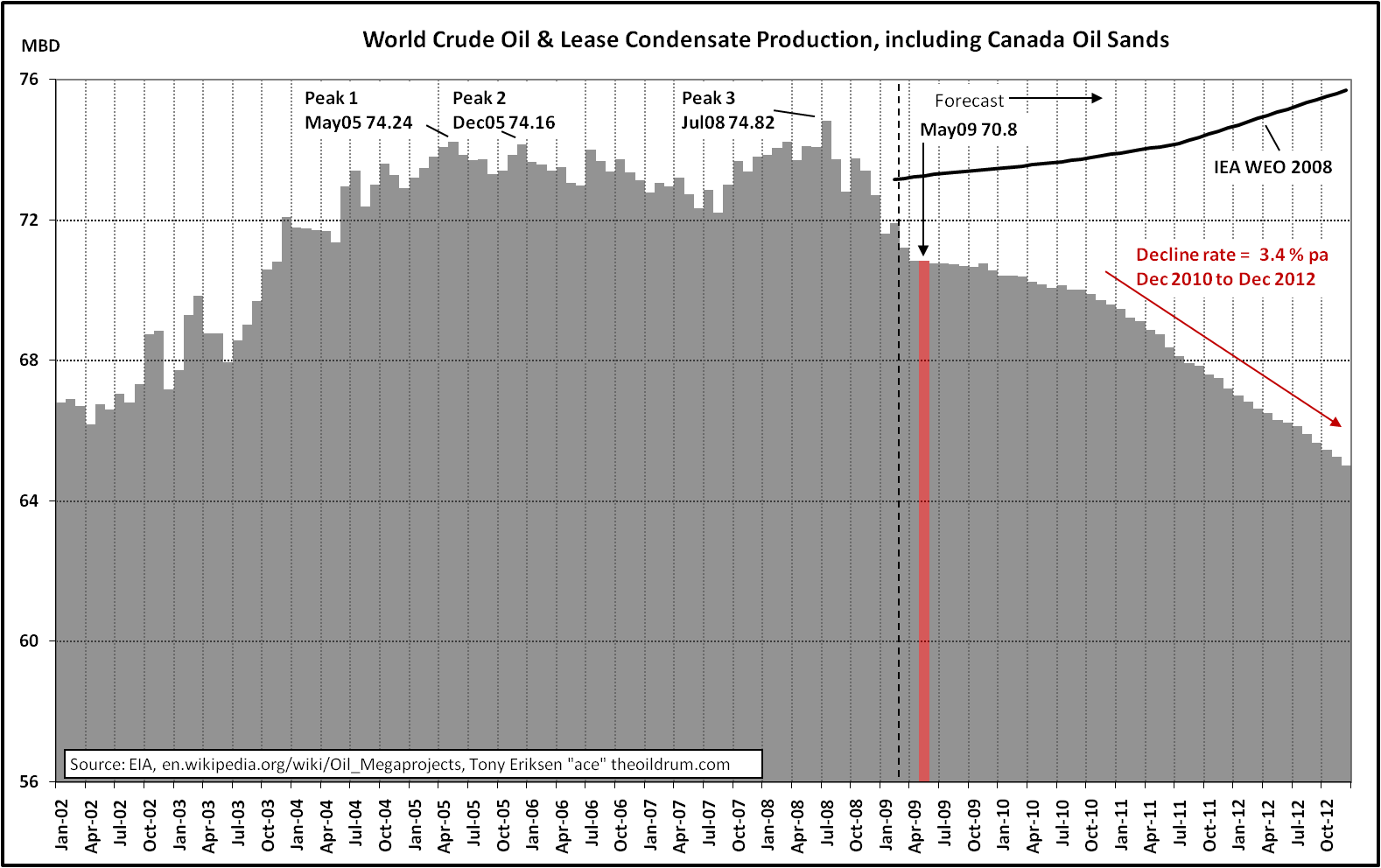
World oil production peaked in July 2008 at 74.82 million barrels/day (mbd) and now has fallen to about 71 mbd. It is expected that oil production will decline slowly to about December 2010 as OPEC production increases while non-OPEC production decreases. After 2010 the resulting annual production decline rate increases to 3.4% as OPEC production is unable to offset cumulative non-OPEC declines. The forecast from the IEA WEO 2008 is also shown for comparison.

The US Energy Information Administration (EIA) and the International Energy Agency (IEA) should make official statements about declining world oil production now to renew the focus on oil conservation and alternative renewable energy sources.

Fig 1 - World Oil Production to 2012 - click to enlarge (oil includes crude oil, lease condensate and oil sands)

World Oil Production

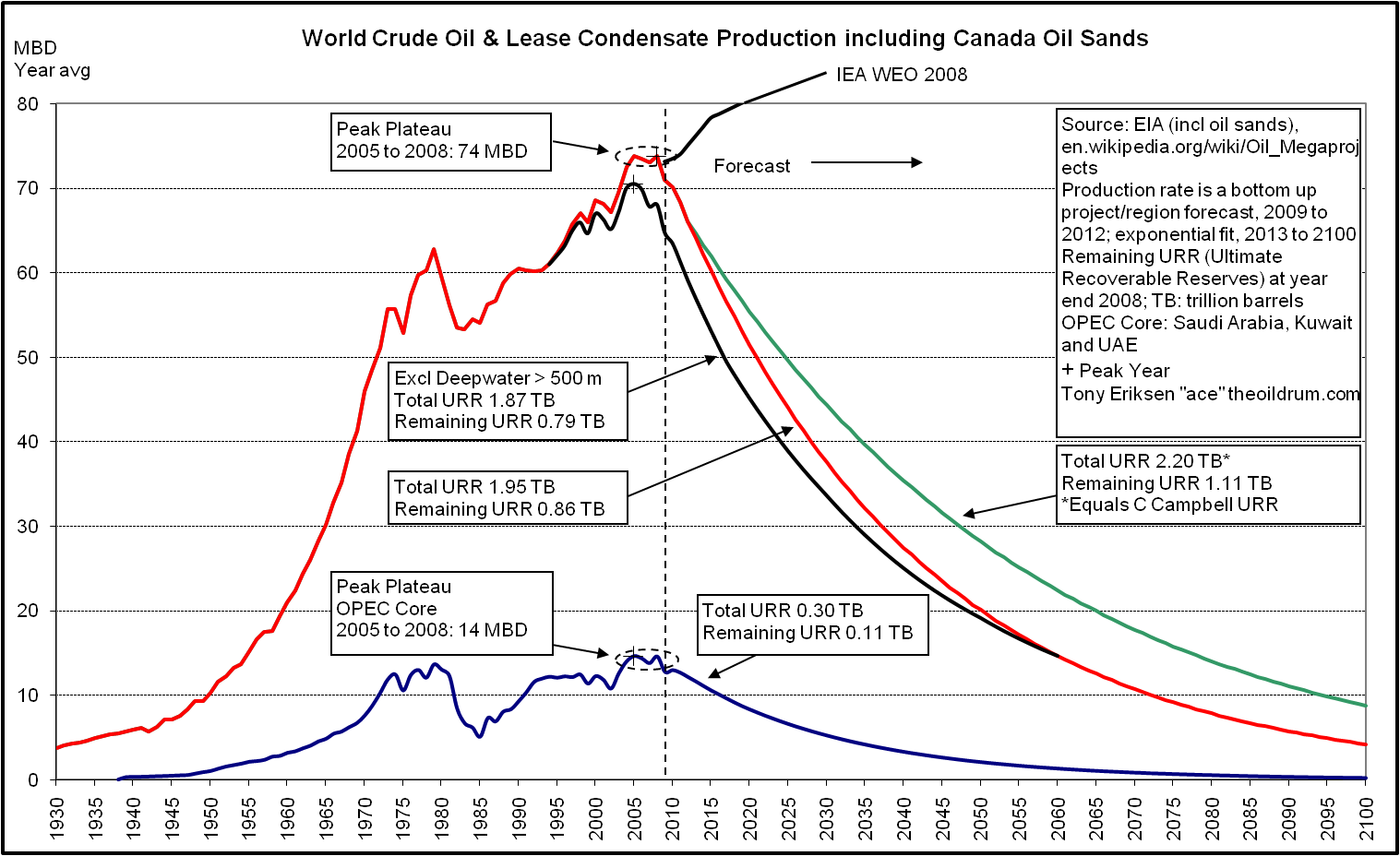
World crude oil, condensate and oil sands production peaked in 2008 at an average of 73.78 million barrels per day (mbd) which just exceeded the previous peak of 73.74 mbd in 2005, according to recent EIA production data. Production is expected to decline further as non OPEC oil production peaked in 2004 and is forecast to decline at a faster rate in 2009 and beyond due mainly to big declines from Russia, Norway, the UK and Mexico. Saudi Arabia's crude oil production peaked in 2005. By 2011, OPEC will not have the ability to offset cumulative non OPEC declines and world oil production is forecast to stay below its 2008 peak.

My estimate of 1.95 trillion barrels (TB) of total Ultimate Recoverable Reserves (URR) of oil is used to generate the forecast shown by the red line below. If Colin Campbell's estimate of 2.20 TB is used, which is 250 billion barrels (Gb) greater than my estimate due mainly to more optimistic assumptions about OPEC reserves, the peak production date remains at 2008. This shows that an additional 250 Gb of recoverable oil reserves does not change the peak oil date and instead increased production rates occur later as indicated by the green line below. Additional reserves and the related production from prospective areas such as the arctic, Iraq, and Brazil's Santos basin are highly unlikely to produce another peak but should decrease the production decline rate after 2012.

Fig 2 - World Oil Production to 2100 - click to enlarge

World Liquids Production

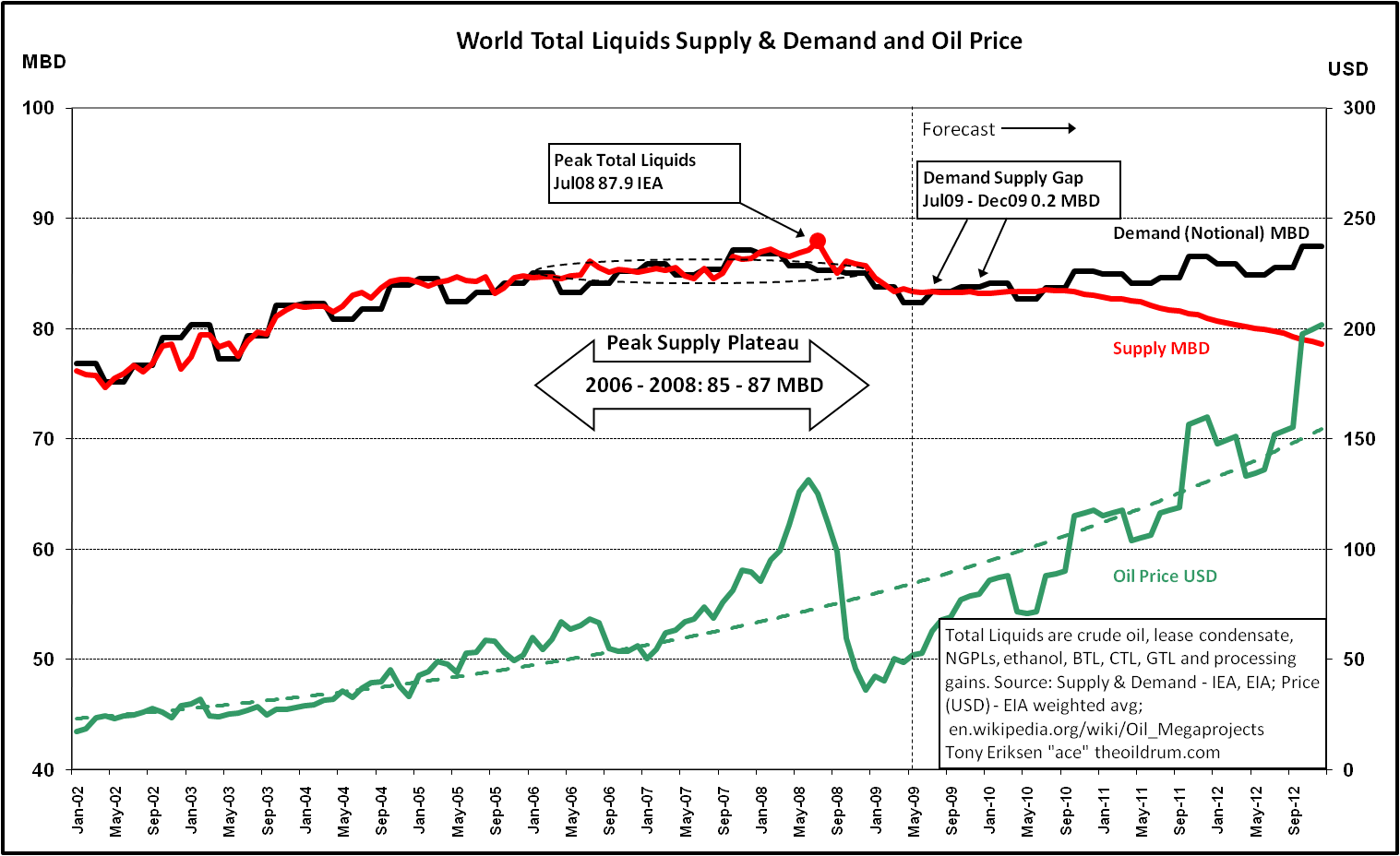
The definition of oil used by the International Energy Agency (IEA) also includes natural gas liquids (NGL), bio-fuels, processing gains and other liquids derived from natural gas and coal. OPEC NGLs were supposed to cause a significant net increase in world NGLs but this has not happened yet as NGL production is struggling to exceed 8 mbd. According to the EIA NGL data, 2007 production was 7.96 mbd, 2008 was 7.94 mbd and 2009 year to date was lower again at 7.80 mbd. Although bio-fuels production has been growing exponentially, world liquids production has probably passed peak in July 2008 at 87.9 mbd as shown below. In 2008, US ethanol production was 0.6 mbd, Brazilian ethanol production was 0.4 mbd, and bio-fuels production outside the US and Brazil was 0.5 mbd.

The average oil price should stay below $US 80/barrel for the remainder of the year as average demand is forecast to be only slightly greater than supply from July 2009 to December 2009. Furthermore, OPEC is unlikely to cut supply further which reduces the upward pressure on oil prices. Some recent evidence of increased demand is shown by US crude oil stocks dropping from a recent peak of 26.2 days at the end of April down to 25.5 days in early May. However, oil prices could exceed $100 in late 2010 as world liquids production drops further. High volatility of future oil prices is also expected due partly to delays in investment causing future oil capacity additions to decline sharply to 2012.

Fig 3 - World Supply, Demand and Price to 2012 - click to enlarge

Sources of Future Liquids Production

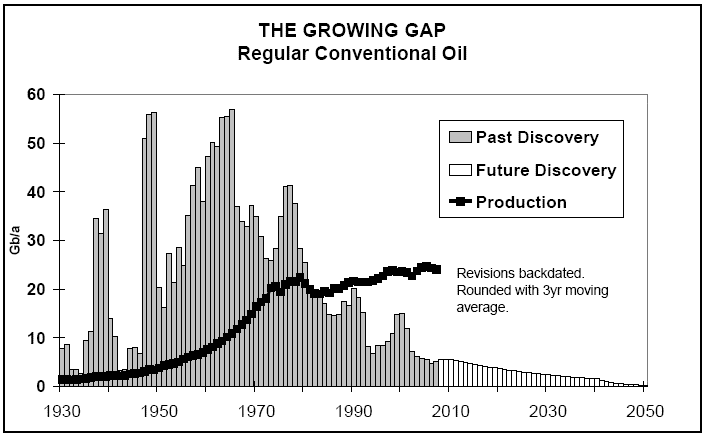
There are many sources of future liquids production but it is highly unlikely that production from these sources will cause liquids production to increase above its July 2008 peak because the cumulative declines from existing crude oil production sources are too great. Key sources of future production are future discoveries. The chart below, from Colin Campbell's newsletter, shows that annual discoveries have been decreasing since the mid 1960s. It also shows that production has exceeded discoveries since 1984 which is clearly unsustainable. Campbell also forecasts future discoveries to be 110 billion barrels (Gb) which is also the number assumed for the forecasts in Fig 2 above.

Fig 4 - World Oil Discoveries and Production, excluding Extra Heavy, Deepwater and Polar Oil - click to enlarge

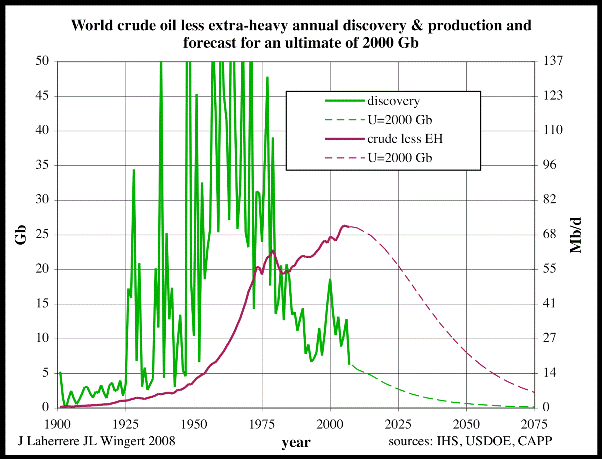
Jean Laherrere also produced a discovery and production chart below from his 2008 presentation. Future discoveries, represented by the area under the dashed green line, are about 120 Gb being slightly higher than Campbell's estimate. Laherrere's discovery curve includes deepwater discoveries and also indicates that production peaked in 2008. Many of these future discoveries are likely to be either deepwater or in arctic regions. These discoveries may be significant but the time between discovery and first oil can easily be ten years which will probably not change the peak production year of 2008 but should lessen the future production decline rate.

Fig 5 - World Oil Discoveries and Production, excluding Extra Heavy Oil - click to enlarge

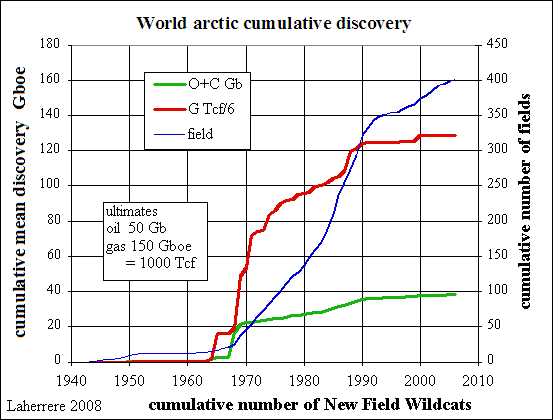
The arctic region is prospective for both oil and gas but quantities need to be estimated. Jean Laherrere estimated that the ultimate recoverable oil reserves are about 40 Gb while Colin Campbell estimates 52 Gb. There was a panel presentation at the 2009 Offshore Technology Conference (OTC.09) which discussed arctic energy challenges. One of the speakers was from Wood Mackenzie who confirmed that the arctic was prospective but mainly for gas not for oil. A report by Wood Mackenzie and Fugro Robertson estimated that the arctic will produce only about 3 percent of the world's oil and that arctic oil production, at best, would peak at 3 mbd several decades from now. Future production from the arctic region should help decrease future oil production decline rates but will probably not change the peak oil production year from 2008.

Fig 6 - World Arctic Cumulative Discovery Oil and Gas - click to enlarge

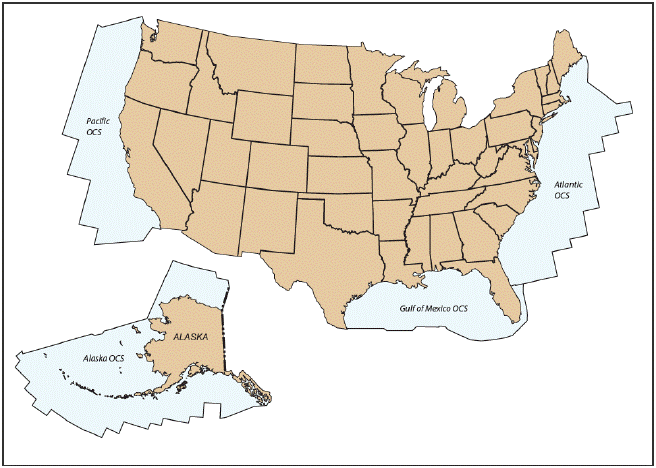
Other regions considered prospective are the US outer continental shelf (OCS) and Alaska's Arctic National Wildlife Refuge (ANWR). (Please note that the oil production potential of ANWR has also been included in the discussion above of the arctic). At this OTC.09 panel presentation on energy challenges, there was much discussion about allowing further drilling on the OCS and the ANWR. The American Petroleum Institute (API) was represented by its CEO at the panel and the API recently released this ICF report detailing potential reserves and future production from currently restricted areas in the OCS and the ANWR. This report concluded that an additional 1.1 (middle case) to 2.0 mbd (alternative case) of oil production, the majority from ANWR, might be possible by 2030 if drilling was allowed in these restricted areas. This additional production would benefit the US but would not change the peak oil date of 2008.

Fig 7 - US Outer Continental Shelf (OCS) - click to enlarge

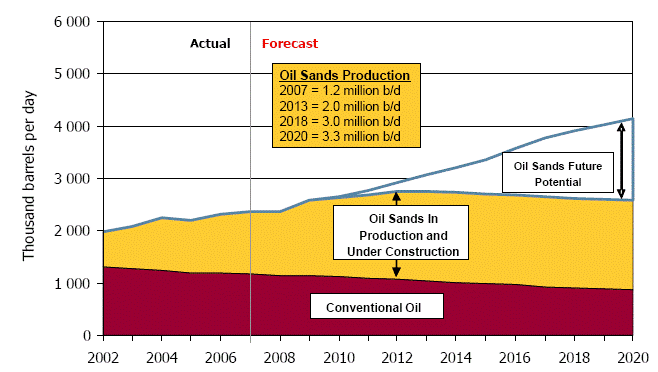
Canada often states that its oil reserves are almost 180 Gb. However, it is critical that 173 Gb of these reserves relate to oil sands which are not easy to produce. The chart below is from a recent presentation by the Canadian Association of Petroleum Producers and indicates the potential of Canada's total oil production to reach over 4 mbd by 2020. The forecast indicated by the red line in Figure 2 assumes that Canada oil sands production will reach a maximum of 2 mbd. Oil sands production was 1.2 mbd in 2007 and the International Energy Agency (IEA) is forecasting 2009 oil sands production to be slightly greater at 1.34 mbd. David Hughes, a Canadian geologist estimates that oil sands production will stay below 2.5 mbd due to constraints on natural gas, water and diluents. Oil sands production may reach 2.5 mbd but will not change the peak oil year.

Fig 8 - Canada Oil Sands Production Forecast to 2020 - click to enlarge

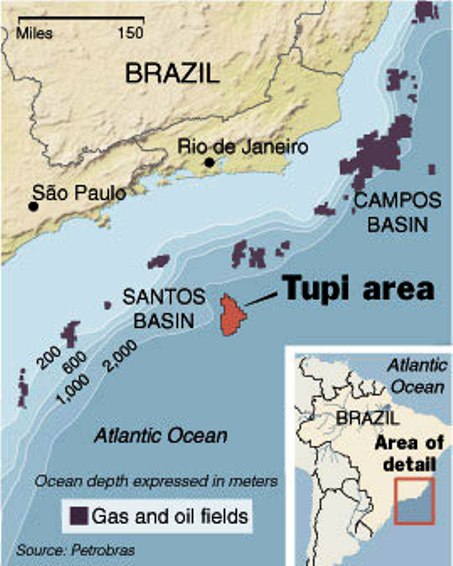
A promising area of future liquids production is the Santos basin, offshore Brazil. There are technical challenges, explained during a Petrobras OTC.09 presentation, with the pre-salt discoveries such as very high pressures and temperatures but Petrobras is optimistic about the Santos basin, stating that this basin may almost double Petrobras' oil reserves. This implies that the Santos basin could hold as much as 15 billion barrels of recoverable oil. However, it is always important to focus on the potential future production rates in addition to the size of the reserves.

The Tupi field was discovered in November 2007 in the Santos basin and an extended well test (EWT) started in early May at a rate of 15 thousand barrels per day (kbd), to be increased to 30 kbd by the end of 2009. The Tupi EWT will run for about 16 months to better understand the flow characteristics of the pre-salt reservoir. If this EWT performs well, then a pilot test of 100 kbd should start in late 2010. If the pilot test is satisfactory then plans for full scale commercial production would be implemented. However Petrobras CFO expects a long ramp up period with Tupi peaking at over 200 kbd at the earliest in 2017. A Wood MacKenzie analyst predicted that Tupi could peak at around 1 mbd in 2022 which appears significant but Petrobras will need this increased production from the Santos basin to maintain total production at 2 mbd. The reason is that declines from existing offshore fields are about 10% or 0.2 mbd per year as confirmed by the Petrobras CFO. Future production from the Santos basin will benefit Brazil but will probably have only a negligible impact on the world production past 2012 (see Fig 2 above).

Fig 9 - Tupi Field and Santos Basin - click to enlarge

Iraq is perhaps the most promising country in the world for future potential oil production. However, it has not been an attractive country for investment not just because of terrorism but also the lack of petroleum legislation which includes national revenue sharing from the oil fields of the semi-autononous region of Kurdistan. The chart below shows that Iraq's production might reach 8 mbd by 2020 if sufficient investment was available, peace prevailed and satisfactory petroleum legislation was passed. The ultimate recoverable reserves of oil of 130 Gb is based upon Laherrere's 2003 analysis. Colin Campbell had originally forecast 4.5 mbd being reached by 2014 but now has revised that lower to 2.65 mbd in his June 2008 newsletter. In mid May 2009, the former Iraq oil minister said that Iraq's output could reach 4 mbd by 2014 and 7 mbd by 2019 if satisfactory petroleum legislation is passed in 2010. My forecast, shown by the red line in Fig 2, assumes that Iraq will produce 2.7 mbd in 2012. If the former Iraq oil minister's predictions become true then future production may be closer to the green line in Fig 2 rather than the red line. The peak oil year of 2008 would be unchanged.

Fig 10 - Iraq Crude Oil and Lease Condensate Production to 2050 - click to enlarge

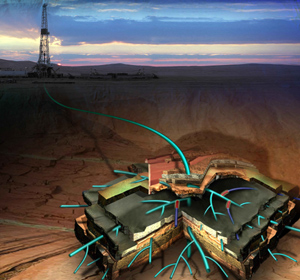
The application of advanced technology on existing discoveries is often thought to have potential for increasing production rates and recovery factors. The first production wells developed were vertical then horizontal wells became common practice. Next maximum reservoir contact wells were used for some reservoirs. Finally extreme reservoir contact wells, graphically illustrated below, are being researched by Saudi Aramco in an effort to boost recovery efficiencies. Generally, more horizontal laterals in a production well allows faster extraction of the oil but at the expense of higher production decline rates later. This recent Uppsala University report on decline rates of giant oil fields stated the following:

The important conclusion is that higher decline rates must be applied to giant fields that enter decline in the future. Prolonged plateau levels and increased depletion made possible by new and improved technology result in a generally higher decline rates. Detailed case studies of giant oilfields suggest that technology can extend the plateau phase, but at the expense of more pronounced declines in later years.

In conclusion, this analysis shows that the average decline rate of the giant oil fields have been increasing with time, reflecting the fact that more and more fields enter the decline phase and fewer and fewer new giant fields are being found. The increase is in part due to new technologies that have been able to temporarily maintain production at the expense of subsequent more rapid decline. Growing average decline rates have also been noted by IEA (2008). The difference between using a constant decline in existing production and an increasing decline rate is significant and could mean as much of a difference of 7 Mb/d by 2030.

There are other technologies such as injection to increase pressure in the reservoir. Natural gas, water, nitrogen and carbon dioxide injection can all help to maintain reservoir pressure and production rates. In 2008, Saudi Aramco injected a massive 13.7 mbd of water to maintain reservoir pressure so that 8.9 mbd oil could be produced. Fracing or fracturing the reservoir formation is another technology which can help increase production rates. The fracing can be done by forcing fluid into the formation causing fractures which are held open by special frac sand. Acid can also be used for fracing as the acid can dissolve some of the rock and increase permeability.

New technologies can extract the oil faster but can the recovery factor be increased? Schlumberger has stated that the average recovery factor for all reservoirs is about 35%. This BP study stated that the average global recovery factor is about 30-35% based on 9,000 fields from the IHS Energy database. Conversely, Saudi Aramco stated in its 2008 Annual Review that they are targeting recovery factors of 70 percent partly through the use of reservoir nano-bots known as Resbots. These Resbots would be deployed with the fluids injected into a reservoir to record pressure, temperature and fluid type which could be retrieved later in an effort to increase recovery rates. The OTC.09 Panel Presentation on Technology discussed the importance of technology and one of the presenters believed that technology will allow companies to recover over 3 trillion barrels of oil. It appears that recovery factors can be increased by using new technology but the magnitude of the increase is not clear yet. However, it is unlikely that the improved recovery factors will cause oil production to exceed its 2008 peak.

Fig 11 - Extreme Reservoir Contact Well - click to enlarge

Mexico's Cantarell field is an excellent example of the use of advanced technology to stimulate the production rate, followed later by a steep decline rate. This field once produced over two million barrels per day (mbd) in 2004 and now production is less than one mbd with an annual production decline rate of over 30%. The chart below, from Matt Simmons' OTC.09 peak oil presentation, shows the steep production decline continuing into 2009. In early 2000, Pemex started using the technology of nitrogen gas injection to keep up pressure to increase production rates which was successful. However, production began to decline after 2004 and Pemex drilled horizontal wells in 2006 in an effort to extract more oil. These horizontal wells probably helped to slow the production decline rate. These technologies of nitrogen injection and horizontal wells have helped to keep production rates high. As the impact of these technologies weakens, the annual production decline rate has increased to over 30%. The expanding gas cap in the Cantarell dome continues to intersect more production wells which decreases the production rate leading to an expectation that Cantarell could become uneconomic as early as 2014.

Fig 12 - Mexico Cantarell Field Production Rate - click to enlarge

Implications

The future sources of liquids production discussed above will help decrease the future rate of decline but it is highly unlikely that the 2008 peak will be exceeded because there are not enough countries with increasing oil production able to offset those countries with decreasing oil production. IEA oil supply warnings have been made in late 2008 when chief economist Birol said that the world needs the equivalent of four new Saudi Arabias just to maintain existing production to 2030. In April 2009, IEA's executive director Tanaka said that the world may face a crude oil shortage by 2013. As world oil production declines, consumption must also decline. Consequently, action must be taken now to reduce oil consumption and switch to alternative renewable energy sources. These sources include electricity generation from wind turbines, photovoltaic panels and geothermal sources. Other sources might be ocean energy which includes tidal energy, wave energy, thermal energy and ocean algae biofuels. Ocean thermal energy conversion was the subject of an OTC.09 panel discussion.

The IEA has recently published some recommendations to improve energy efficiency which apply not just to individuals but also to industry. For example, in the transport sector, the IEA is encouraging the use of fuel efficient tires and introducing mandatory fuel efficiency standards for light duty vehicles. In addition, this IEA document, called Energy Efficiency Policy, also encourages energy efficiency by providing links to almost 30 documents containing energy efficiency policies. One of these documents called Saving Oil in a Hurry suggests many conservation actions including increased use of public transit, car-pooling, telecommuting and speed limit restrictions. For further information, the IEA has its own energy efficiency web page. This recent Oil Drum story proposes many oil conservation ideas for individuals such as moving to a walkable neighbourhood and trading in your car for one with better mileage.

There is no simple solution to the problem of declining world oil production. A simultaneous multipronged approach will emerge which not only addresses oil conservation but also the development of alternative renewable energy sources. As oil production declines, a possible solution is to secure long term oil supply contracts ahead of the next oil price shock. China has been securing long term oil supplies from Russia, Venezuela and Iran. As oil remains critical for economic activity there is a high probability that some countries will act more aggressively in securing oil supplies, even to the extent of oil resource wars. In mid May 2009, Russia raised the prospect of war to enforce its claims on Arctic oil and gas riches.

Additional Information Sources

World Oil Production Peaked in 2008, March 17, 2009

Saudi Arabia's Crude Oil Production Peaked in 2005, March 3, 2009

Non OPEC-12 Oil Production Peaked in 2004, February 23, 2009

USA Gulf of Mexico Oil Production Forecast Update, February 9, 2009

Disclosure: The author, Tony Eriksen, has investments in the oil and gas sector. The American Petroleum Institute (API) sponsored the author's attendance to the Offshore Technology Conference (OTC.09) in Houston, Texas on May 4-7, 2009 of which the presentations reaffirmed the author's views on declining world oil production.