Thursday, July 24, 2008

Peak Oil a Theory No More

UPDATE 9/30/08:
Demand destruction is starting to have some impact. The price of oil has fallen substantially, to the point that the price may be artificially low, hovering around $100. The reasons have certainly to do with an overshoot in prices at $147/barrel and the rise in the dollar over recent weeks, but demand destruction plays its role. US crude oil consumption has dropped by upwards of 1million b/d over the previous year,taking some of the edge off demand. The puzzler, however, is world consumption is not yet in negative territory due to demand in Asia, particularly Chindia and every high rises in consumption in many OPEC nations, where gas (petrol) prices are subsidized. Additional downward pressure comes from the holiday seasons - more driving - ending and people getting back into normal routines. That is, the price decline is partly seasonal.

The takeaway is that demand is moderating due to demand destruction in some countries due to high prices, putting some downward pressure on prices, and, theoretically, oil production.

We need to remember, however, that it was only a year ago that $100 oil was considered a death knell for the world economy. The price rise to $147 has made $100 oil seem cheap by comparison. That is a mistake we cannot afford. The same pressure still applies to the economy, now even more weakened by the continuing chaos in the financial sector. This chaos will only continue and grow worse over time. The mortgage defaults have not even peaked yet and housing prices in the U.S. probably have another 15% to 30% - or more - to go till they bottom out. Mortgage defaults will continue through 2011. We're maybe 1/3 of the way through what is supposedly the cause of all this chaos. What this means is the price of oil truly is exacerbating the problem as people are paying much more for fuel and energy now than even a year ago, even with the price correction.

So, don't let the "low" price of oil fool you. It is still a very big drain on the world economy, it is not stopping the growth in demand on the global level, and is an indicator that Peak Oil is still with us. Even global demand destruction can only put off the inevitable. this brings us back to the events of today.

I would expect what happened today to add to demand destruction and start to spread that on a more global basis. I don't expect demand to actually decrease just yet, but the growth in demand should slow further with demand starting to retreat in the not-too-distant future as the global recession/depression takes hold. Great! Less fossil fuels being used means lower prices and a reduction in GHGs, right?

No and maybe. While demand may start falling globally, it may not keep pace with decline in oil production in older fields, and the rising consumption in OPEC and other oil producing nations will reduce exports. What does this mean? For oil net importing nations, Peak Oil is already here,or is just around the corner.

Briefly, old fields fall in their production over time as the oil in the fields is pumped out and the pressure drops to the point that only a small fraction of the peak production can still be extracted, and that only with massive inputs of effort, money, energy and technology. Since a majority of oil produced int he world comes from a very small number of the total fields on the planet, and those fields are all old and in or near decline, the decline rate is accelerating. Dick Cheney, may he roast in hell, stated the decline rate was 3%/yr. in 1999. Up until the last 6 to 8 months, the IEA held the decline rate to be 4.5%/yr. The current popular number is 5.2%, and even that is in question. The IEA will be releasing their most recent estimate in November, and it may be over 6%. We'll see.

This decline rate means we need a minimum of nearly 4 million barrels a day of new oil production each year. We're not getting it. The difference is being made up by unconventional oil (tar sands, etc), natural gas, etc., but oil itself has been flat since 2005. (Even with prices so high? Aren't they motivated to pump more? Yes. They can't.) So, our decline in consumption is not even meeting the need created by decline. Demand will have to fall by 4mb/d to avoid Peak Oil. That may happen, but not tomorrow. But even then, it wouldhave to keep falling because oil production will keep falling, and the rate is expected to accelerate as it already has been doing. 3%, 4.5%, 5.2%.... What's next? Don't know, but at 6% we need to produce or conserve 4.4 million more barrels a day each year just to keep even.

Then there's the net exports problem, well stated by the Export Land Model. This model says oil producing countries tend to have increasing demand at home which reduces exports over time. When the nation in question starts to decline in oil production, the problem only worsens, leading to exports declining at twice or three times the decline rate for that nation. This is a BIG DEAL.

Essentially, it means that oil importing nations like the US are facing Peak Oil now even though world production (of all petroleum liquids) is not falling. (Crude production is flat or falling, remember.) That decline rate, instead of being 5.2% or 6% ends up being the equivalent of 10% or more.

So... think about a world with oil falling at 10% a year. Then think about the financial storm we are now fully into. then think about climate Change and the need to, and cost of, ameliorating that... then add in food and water scarcity...

Don't get complacent. We are just getting started.


Original post:

But, then, it never was. Peak oil production (Peak Oil), or peak any commodity, is a material fact. In this case, a geological fact. There are limits to resources that the Earth holds and limits to how quickly we can produce them. That Peak Oil has arrived is not necessarily news to anyone who has followed what is called "Peak Oil," but it is important because it sets the point in time where the conversation can shift from
A: Peak Oil is REAL!
B: No it ISN'T
A: Yes, it IS!
B: No, it ISN'T!
to
A: Nyah, nyah, nyah, nyah, nyah!
B: Your momma!
A: I told you! I told you! I told you! I told you!
B: You suck! Shut up.
In fact, much as it is now possible to just tune out the lies (Exxon and BuCheney administration 1 2 3 4) and bogus science (Exxon 1 2 3 and BuCheney Administration 1 2) about climate change, we can now just point to the data and return the conversation to solving the problem, leaving Peak Oil denialists babbling to themselves in the corner and chewing mindlessly on their SUV and foreclosed McMansion keys. 1 2 3 4

HISTORY
Let me get to the point. World oil production has hinged on production from the Kingdom of Saudi Arabia (SA) since the first oil crisis in 1973. The primary reasons are two: At the time, the US was the world's largest producer of crude oil and SA was the third largest producer - and had the largest (conventional) crude oil reserves. In 1973 OPEC at that time produced 56% of the World's crude. 1 When they turned off the spigot, it was a serious problem. Historically, SA wanted the price of oil to be at equilibrium between making money and staving off competition. When prices have gotten too high, they have produced more oil. For example, during the 1979 "oil crisis," Iran shut in production, but SA took up the slack and fairly quickly added a million barrels per day (mb/d).

The developed world drastically cut their oil consumption because of the oil crises of 1973 and 1979. Alternative energy, conservation, nuclear, etc., were developing, CAFE standards were rising, Americans started buying economical little cars from Japan - even though they weren't sure about the quality. Jimmy Carter even put solar panels on the White House.

So, SA flooded the market. Additionally, in the late '70's Prudhoe Bay was finally ramping up production and the North Sea began producing in earnest. But the key point is, when they wanted to, they could ramp up production and did. So, in the late '80's and in the '90's we had a flood of oil and prices ranging between $10 and $30 a barrel - too low for alternatives to be developed causing many programs to shut down... and Ronald Reagan had taken the solar panels off the White House.

TODAY
How, then, are prices so high today? Why are alternatives being developed all over Hell's Half Acre? Why do the OPEC nations not only put up with, but invest in alternative "oil" and other energy sources? They can no longer produce at will. I can point you to a number of resources, one of which is a link to the right to comments and claims by Sadat al Husseini, a former head of production at ARAMCO. But the real secret gun, or, more accurately, shot heard round the world (only because people actually LISTENED to this one while ignoring many before it), was a recent article in Business Week. It reiterated what al Husseini had already said: the KSA would never produce more than 12.5 million barrels of oil a day (mb/d). Actually, Business Week (BW) said 12.0. The key to taking the BW article seriously is the source. It purports to have received inside info from a current high ranking employee. al Husseini, you see, is a former employee, thus it was possible to dismiss him as disgruntled. So, the open secret is now just common knowledge: SA can't give much more than it already is.

Why This Is Important
There is a very good discussion of this article by Dave Cohen of ASPO USA, but let me repeat some things he says and add a bit here and there of my own. That is, let me simplify.

1. Oil production = economic development
2. Oil production = food production
3. Oil production = a large percentage of transporation
4. Renewables do not = oil production and are unlikely to take up the slack quickly enough to avoid major economic and social disruptions.

Let's look at a graph of population and energy usage. Pay attention to the green zone. That is the amount of population a pre-fossil fuels world supported and likely would have supported to this day. What developments would we have now that we could also have had without fossil fuels? Cars? Skyscrapers? Food shipped in from all over the world? Cell phones? No. It is an inescapable reality that the world we have created is a direct result of cheap, seemingly abundant, energy.
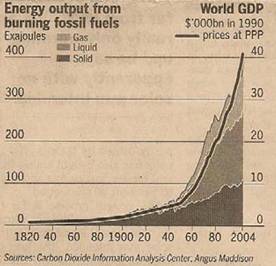


Look at this graph of global fossil fuels use and economic growth. It's a pretty good match, don't you think? Common sense tells us that without the cheap energy provided by first coal, then oil, we would not have been able to develop as we have. (At least, those of us in the OECD.) Our infrastructure road and cars), the food to feed so many (fertilizers) and even everyday items (look around your house and try to think of something that has no petroleum involved in its production or transport) all rely on oil. Even at $140 a barrel oil is about 16.75 cents a cup or $3 a gallon. You can't get a cup of coffee for anywhere near 17 cents. (h/t Matt Simmons.)
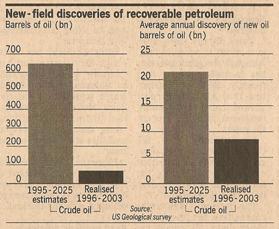
Now look at another graph of the U.S. Energy Information Agency's (EIA) former projected global discoveries of oil world production and actual production. There is a huge difference between the projected and actual. Why? Well, OPEC can produce ad nauseum and we'll keep discovering at the same rate as always! Simple! Sure, simple as in idiotic. All the EIA had to do was look at a graph of past discoveries to know they were blowing smoke up their own arses. So, if we are not discovering more oil at the same rate we once did, how can we expect to keep producing it at the same rate? We can't. Now we have the proof we need to prove this without further debate or argument. If SA is at their limit, the world is at its limit, just as Matt Simmons has been saying.

Take a look at a graphical illustration of the problem. Even though this graph is a couple years out of date, it still accurately reflects the problem. There have been some new discoveries - there always are - but none that are going to change the future because they are too small. Look at all that space under the black line. That's draining world reserves at a rapid rate. Perhaps you've heard of 30 billion barrels found off Brazil? Even if every barrel were recoverable (they aren't) and they could be gotten out in one year (instead of 30 to 50), it would still only give enough oil for the world to use for.... one year. And that's the biggest find in decades.

The assumption has been that OPEC, and SA in particular, could produce at will and would cover future demand growth. Why? Just because. That's right. because they had, it was reasoned, they always would. That was a false assumption. To be fair, one reason the USGS and others bought this lie was because of surious reserves growth in OPEC in the 1980's. Oil reserves in the Middle East/OPEC were doubled over night. Political and economic considerations created the necessary lie. Sadat al Husseini essentially confirmed this by telling us last October that oil reserves were overstated by some 300,000,000,000 barrels. Interestingly, this matches up with the spurious increases in reserves in the 80's.

You say, "So? Who cares? They're pumping enough oil now. Two or three mb/d more from SA sure sounds like a lot to me!!" Except it isn't. As many had suspected, the declining production from older fields is accelerating. Assumed to be 4% a year just one year ago, now the International Energy Agency (IEA) says it is at 5.2% a year. If current all liquids (oil, gas, tar sands, etc.) production is 86.5 mb/d, then we are losing 4.5 mb/d each year. That's almost as much as the US produces and half of what SA produces. Basically, we would have to find, and start producing oil from, a field equal to the biggest field ever found (Ghawar in SA) every year just to keep production flat. As already discussed, that's not happening.

"B-b-b-but there are other places to drill! Other countries to produce!" Yup. And you already know how that turns out. Go back to the graph. Why that decline rate is speeding up? The US - once the world's largest oil producer at over 11 mb/d - has been declining since 1970, less a small bump from Alaskan oil. The North Sea, the largest complex of oil found and developed in many decades has been in decline since around 1999. Mexico, also one of the top ten, has been declining since 2004. Russia, the Number 2 oil producer in the world, started their second decline (their real peak was at the time of the break up of the USSR, which caused a huge decline in production that had recovered until recently) late in 2007. There are no other massive producers, and there won't be.

How can we say there will be no more megaproducers? Imagine a hay stack. In the haystack are 10 basketballs, 100 tennis balls and 1000 marbles. Which are you going to find first? Second? Last? Yes, you will certainly find some of the tennis balls and marbles before you find all the basketballs, but you just as certainly will find all the basketballs before you find all the tennis balls, and all the tennis balls before you find all the marbles. Oil is the same. We're down to a few tennis balls and a bunch of marbles.

And that is why SA peaking by 2011 (their stated goal to reach 12.5 mb/d) is important. That rising production cannot be replaced. We have reached the end of the road with regard to oil production. It has reached or will reach its absolute peak between now and 2012.

What It All Means
As you can see, the peak is nigh, but renewables are decades from being able to replace them 100%. (Keep in mind there are some things only a substance like oil can do. Some things we have and/or do today will be going the way of the Dodo.) The pinnacle of oil production means the end of the world as you know it. A new world will have to rise in its place, or this one will simply die out. Solar is too expensive and not nearly widespread enough. Do you have it? I don't. What percentage of roofs do you see with panels? The percentage is small overall.

What about wind? Those big wind farms? Don't want them around? How about a mini system buzzing in your yard? There are only 105,000,000 households in the US. Surely we can build that many windmills in just three years! Uh... right? Right?! (Sorry, no.)

I know! I know! Ooooh! Pick meeee!!! Biofuels!! Sure. OK. We're making about 23 million barrels a year in the US. We need 31.5 billion barrels a day to replace world oil demand. Good luck with that.

"Hey, what about nuclear," says the heckler in the back. Nuclear, schmuclear, I say. At around 12 billion a pop, building the 1,000 we need in the US and the 10,000 we need around the world is just not doable. And it's not just money, there are steel shortages, there's only one producer of containment vessels who can build something like four a year. Etc.

Time is a problem.

Luckily, the things we do (except for food being turned into biofuels and raising food prices through the roof) for Climate Change are basically the same that we need to do for Peak Oil: reduce, reuse, recycle, localize.

Now that you know peak oil is here, let's not be shy about discussing solutions. Watch for my future posts. Hopefully the next won't be several months coming! In the meantime, look at my TEOTWAWKI and Build Out posts. And don't forget: A Perfect Storm Cometh. Remember to factor in the economic crisis (Can we afford the solution?) and Climate Change (Can we handle all three at the same time?) when thinking about all this.

Sunday, May 4, 2008

Famine II

Famine, malnutrition, hunger. I posted in February on problems with world food supplies, prices and possible famine coming as early as this year due to inflationary pressures from oil prices feeding through to costs in food production (97% of the process is petrochemical dependent), not the least of which is the cost of fertilizers, grain and acreage being diverted to biofuels production, and weather-related (Global Warming) reductions in crops produced. All that is still the case. The difference is that the effects were seemingly minor and limited to the very poorest of the poor. That is no longer the case. China, Korea and Japan are all buying up land in other countries to feed their burgeoning populations. Japan has experienced shortages of a few commodities already:

Japan's Hunger

"In the past, Japan was a rich country with a powerful yen that could easily buy cheap imports such as wheat, corn and soybeans," said Mr Shibata, who directs the Marubeni Research Institute in Tokyo. "But with enormous competition from the booming Chinese and Indian economies, that's changed forever. You also need to take into account recent developments, including the damage to crops caused by drought and other disasters in exporting countries like Australia," where the value of wheat exports has tumbled from $3.49 billion to $2.77 billion in the past three years. The situation has been compounded by a surge in demand for bio-fuels such as ethanol, made from maize, encouraging farmers around the world to divert their efforts away from wheat and barley and into maize, further driving up prices.

Arguably Japan's biggest concern, however, is its weakening ability to sustain its population with domestic produce. In 2006 the country's self-sufficiency rate fell to 39%, according to the Agriculture Ministry.

Japan is among the richest nations on Earth. A nation that assumed until recently that it could buy all the food it needed. The rise of China and India has changed that. Food prices are soaring, a wealthier Asia is demanding better food and farmers cannot keep up. In Korea, where they are nearly self-sufficient in rice production, but import 95% of everything else, prices are skyrocketing. Prices went up 3% in Nov. and Dec., 2007, over the previous year. By January, prices were already jumping:

Skyrocketing international prices of oil, gas and grain are making food and household goods more expensive.

"I think I felt better during the 1997 financial crisis," said Yang Young-geun, 53, who has run a Chinese restaurant in southeastern Seoul for 12 years. "It has never felt tougher than today."

As the prices of flour and oil, the main ingredients of jajangmyeon (noodles with black bean paste sauce), have climbed, he said, he no longer makes any profit on the dish.

"The cost of the ingredients to make the noodles has risen from 30 percent to 45 percent of the total cost," Lee said. "After paying salaries to my employees and maintenance costs, I have almost nothing left."

... The 51-year-old owner of a Chinese restaurant in Seocho, southern Seoul, has started selling the noodles at 4,000 won, up 500 won from last year.

"I tried to avoid raising the price by cutting personnel costs, but I could not stand the skyrocketing prices of ingredients anymore," said the female owner, who refused to be named.

"I am afraid to shop these days because the price of everything goes up day by day,"
said Kim Gyeong-soo, a 54-year-old housewife in Jung District, Seoul. "Our family now takes vitamin C instead of eating fruit."

Since then, the things have gone from bad to worse:

The Korean economy is facing a bout of stagflation with lower economic growth at a time of sharply rising prices, a government report said yesterday.

Producer prices rose the fastest in almost 10 years due to increasing costs of crude oil and agricultural products. The announcement came a day after the Bank of Korea said that economic growth will likely be far less than earlier projected.

“Korea’s economy already peaked and is entering a downward phase,” the Ministry of Strategy and Finance said in a report on the overall economy.


Wholesale Prices Make Biggest Jump In Years

Economy goes down, further contraction expected: ministry

Around the globe, people are protesting and governments are responding with often counterproductive controls on prices and exports - a new politics of scarcity in which ensuring food supplies is becoming a major challenge for the 21st century.

Damaged by severe weather in producing countries and plundered by a boom in demand from fast-developing nations, global wheat stocks are at 30-year lows. Grain prices have been on the rise for five years, ending decades of inexpensive food.

Drought, a declining dollar, a shift of investment money into commodities and use of farm land to grow biofuel crops have all contributed to food woes. But population growth and the growing wealth of China and other emerging countries are likely to be more enduring factors.

World population is set to hit 9 billion by 2050, and most of the extra 2.5 billion people will live in the developing world. It is in these countries that the population is demanding dairy and meat, which require more land to produce.

"This is an additional setback for the world economy, at a time when we are already going through major turbulence, but the biggest drama is the impact of higher food prices on the poor," Angel Gurría, head of the Organization for Economic Cooperation and Development, said.

A Perfect Storm Cometh... bifurcations... tipping points... complex systems...

In Gurría's native Mexico, tens of thousands took to the streets last year over the cost of tortillas...

Global food prices... rose 35 percent in the year to the end of January, markedly accelerating an upturn that began, gently at first, in 2002. Since then, prices have risen 65 percent.

In 2007 alone... dairy prices rose nearly 80 percent and grain 42 percent.

"The recent rise in global food commodity prices is more than just a short-term blip," the British research group Chatham House said in January.

"Society will have to decide the value to be placed on food," it added...

...A number of governments, including Egypt, Argentina, Kazakhstan and China, have imposed restrictions to limit grain exports and keep more of their food at home.

..."If one country after the other adopts a 'starve-your-neighbor' policy, then eventually you trade smaller shares of total world production of agricultural products, and that in turn makes the prices more volatile," said Joachim von Braun, director general of the International Food Policy Research Institute in Washington.

In Argentina, a government tax on grain led to a strike by farmers that disrupted grain exports.

Vietnam and India, both major rice exporters, announced further curbs on overseas sales Friday, sending rice higher on U.S. futures markets.

...Waves of discontent are already starting to be felt. Violent protests hit Cameroon and Burkina Faso in February. Protesters rallied in Indonesia recently and media reported deaths by starvation. In the Philippines, fast-food chains were urged to cut rice portions to counter a surge in prices.

Trade Minister Kamal Nath of India said Monday that the government was looking to cut duties on food items to rein in rising prices.

In short, the world faces a food crisis and in some places it is already boiling over. Geopolitics will increasingly be affected by shortages and competition for a smaller pool of resources. Let us not forget Japan annexed Korea in 1910 in part to use Korea as a rice bowl. A large portion of Korean rice production was shipped to Japan during the period of occupation. What is to prevent old animosities from rising up a people become hungry, malnourished or even face starvation? A nation like Korea which is pinched between two more powerful neighbors must keep such possibilities in mind. (Not to mention what might happen if the DPRK (North Korea) destabilizes or China decides to have a presence there.)

Climate problems persist and will likely worsen over time. While Australia had a bit of a reprieve from their on-going drought, scientists worry the drought conditions are a long-term, essentially permanent feature of Australia's climate. This is obviously problematic if this loss of production isn't made up elsewhere.
Coupled with the problems of Climate Change damaging food production and Peak Oil transferring food production to fuel production, is this problem of population and wealth, i.e. consumption. That is, the dogma of perpetual growth.

Albert Bartlett (link to the left) warns us of the dangers of never-ending growth.

Friday, February 29, 2008

Build out: The Grid vs. The Household - Towards a Community-based Solution to CC and PO

Originally published on theoildrum.com here in response to this on this thread which all started here. The post has been modified for this space.

The Grid vs. The Household

Some believe we have time before a crash, or, that there will be no crash, but a relatively smooth transition from fossil fuels to renewables. They believe this slow decline in fossil fuels will allow the time needed to build hundreds (the U.S.) and thousands (the world) of nuclear power plants/reactors. However, the assumption there is time and/or there will be no crash is a dangerous one. Failure to prepare to mitigate the effects of a swift decline in energy will almost certainly lead to disaster. We must look at risk.

When we can provide a huge amount of power for a fraction of the cost and time needed to build up our nuclear grid to a level that will protect us from oil production decline, why would we not do it? Nuclear plants take years to build and require very skilled workers that must be trained. In Return to Olduvai they estimate a minimum of 20, and an upper end of 90, new reactors and/or power plants per year. At 5 - 12 billion each. That's up to 12 TRILLION dollars for the U.S. alone. But where is it written the backbone of our power grid must be built before the localized, household-based renewable infrastructure? Why shouldn't they be built concurrently, at least?

My proposal is intentionally localized due to the high degree of certainty (my certainty, not a consensus) that neither the government nor the market will be able to handle this in isolation. You have the perfect example in WWII. Victory gardens weren't just a good idea, they were necessary for continued good nutrition. The same went for resources, which led to rationing and recycling.

My position on global warming is the same. The best thing we can do is build nuclear reactors to displace coal power plants.

How can the best we can do be something that is unsustainable? Nuclear plants will need replacing two or three times a century at a current cost of billions per. The localized grid will, too, but, again, you are looking at a very small fraction of the cost for the same degree of replacement. For the same billions per *one* reactor we can supply a good fraction of the total power generation needed and leave the robust solutions for backbone, greatly reducing the number of large plants we need. If we add to this equation lifestyle changes of reducing, recycling, reusing and localization, all the more so.

I would argue, in fact, that meeting the localization goal is more important because it deals with the real issue: consumption. A massive localization drive could achieve partial energy autonomy for every household in the US within a period of a few years, not decades. It would have the added benefit of *requiring* lifestyle changes with concomitant savings of energy by reducing use via the renewables and behavior changes. However, if we assume we have a 5 - 10 year period before the shit really hits the fan, then the current grid supplies the backbone as the new backbone is built out. Under this scenario, deprivation may be eliminated for some or all over that initial time span.

Additional benefits occur from the localization of the household-based energy build out. In order to achieve this, there will be flexibility needed. Economies of scale interfere if we just assign a few companies to build all the windmills, heat pumps, solar panels, retrofitting materials for homes/apartments/businesses, etc, needed. No, the key to the plan is that it be localized solutions built out by local people wherever possible. This means, for example, the scavenging of materials needed everywhere and anywhere possible, rather than the manufacture of new materials. In the cities, we would likely need to commercialize the process a bit, but hopefully only to the level of resources. I imagine a return to the days of barn raising, but with windmills, etc.

By making this a community-based process where community solutions are customized by the community with assistance from knowledgeable locals or other reference persons/professionals, we instantly integrate the whole system into a localized whole. This might have the added benefit or reducing the need for relocation. A localized solution of this magnitude would save incredible amounts of financial resources. Those resources might be applied to some of the macro level solutions (things other than backbone) that certain communities, such as cities in the southwest dealing with water shortages, might need.

If real net oil production declines of 4% or more a year set in, we will never have the opportunity for [a nuclear and/or BAU grid-type] plan. My plan would have a good chance of succeeding whether those declines come or not. This is simple risk analysis.

I realize a great deal of interest and even fun comes out of the intellectualizing entailed in the intellectual process we are all engaged in at TOD to deal with Peak Oil and Climate Change, but the time for chat and brainy ideas is quickly passing, if it has not already passed us. I hope to encourage people to begin narrowing the conversation to the realities at hand and try to get to some conclusions before the decisions are taken out of our hands by circumstances.

Tom Whipple serves up a similar view of the future. His article doesn't deal with the sequence of events, but does outline a vision of where we may end up, albeit not in a collapse scenario, per se.

The Peak Oil Crisis: Catenaries and Pantographs

As the availability of liquid fuels dwindles, those supplies that remain will be increasingly allocated to uses for which there are no readily available substitutes -- such as powering aircraft and ships. Electric power for land vehicles appears to be the most realistic option for the present...

...For the immediate future only electricity, which can come from conservation of existing power production, nuclear power stations and renewable sources, appears to be the most likely power source for land vehicles.

Powering cars and light trucks with electricity does not seem to be an insurmountable problem provided that one is willing to live with their limitations...

The U.S. currently has some 230 million light vehicles in its fleet... these vehicles are simply going to be abandoned...

...At the rate our natural resources are running out, however, it is doubtful we will be building and selling 100’s of millions of non-fossil fuel cars in the foreseeable future.

...new rail lines would... use diesel-electric power initially... electric-powered railways coupled with short haul electric trucks, busses and cars...

...One idea... was to repower our long-haul trucks with electric engines, some battery capacity, and pantographs to contact overhead wires...

...We already have some 2 million 18-wheelers in America and one would hate to see them scrapped for lack of fuel.

...When affordable liquid fuels dry up, we are going to be left with a lot of vehicles and their infrastructure that will no longer be of use. With a little imagination, time, and money, much of this stranded investment can become useful again. There certainly will be powerful incentives to introduce whatever works.

The abandoned vehicles and infrastructure could instead be intentionally converted, before abandonment in at least some cases, to be used in the build out I outline above.

I agree with Tom:
In its day, the internal combustion engine was a wonderful device that served us well for over a century. That day, however, will soon be over. It is time to start thinking about and planning for alternatives.

Other articles by Tom Whipple can be found here.

Thursday, February 28, 2008

Lucy! We're hooooome!

The image is at once unnerving, surreal and calming: coming home to a place you no longer know, and that no longer recognizes you. Walking the dusty ground and the ancient rock of Olduvai must be an awe-inspiring experience for those from a more modern world. The sort of experience a typical American might get visiting some of the very old or ancient sites of Europe, our sense of the age of human kind being so poorly developed by TV, video games, shopping malls and the like. Having seen Roman columns in Sevilla Spain, ancient forests in Costa Rica, stone temples in Korea, and more, I can imagine just a little the awe that might come over one at Olduvai speaking a silent "I'm home" to Lucy.

Going home again tends to be either joyful or traumatizing - or at least stressful. How and why we go home matters. Home for the holidays to a warm and loving family, who wouldn't look forward to that? Home for an extended period after the collapse of a marriage, hitting hard financial times, to care for a sick and/or dying parent... who would look forward to that? The one is full of happy moments (perhaps punctuated with the old bickering that families all do), the other is full of self-doubt, uncomfortable explanations, broken expectations and the sheer difficulty of living differently in a place that is no longer yours. These may be the choices we face as we race towards the end of cheap energy (at least, unless or until we harness solar energy on a grand scale).

In Olduvai Revisited 2008, an update to the Olduvai Gorge Theory proposed by Richard Duncan, Luís de Sousa and Euan Mearns of TheOilDrum:Europe present to us the choices we may face in how we go back to Olduvai Gorge. In a series of scenarios for the end of the Fossil Fuel age, the data suggests we may yet have a choice as to how we go home. We can go home beggers, paupers, broken and beaten, or we can go home with good news of grand new ways of doing things, and maybe a better life for all. They conclude:

According to our analysis, conventional fossil fuels are set to peak in a decade or so and following that, decline will open an ever widening gap from today's per capita energy use. Based on finite FF resources, energy per capita is indeed headed towards a cliff, and this may lead Mankind back to the Olduvai Gorge if action is not taken to address this problem. Many of those who have studied this problem in the past have concluded that the journey back to Olduvai is unavoidable.

The analysis presented here suggests that it is within the capacity of human endeavor to build new energy gathering infrastructure to substitute for the decline in conventional fossil fuels. By combining energy efficiency measures with the simultaneous expansion of solar, wind and nuclear energy Mankind may secure a civilised existence for the XXI century. A tremendous opportunity exists to build a more sustainable energy future and building this future will provide vast opportunity for economic growth and prosperity...

The next two to three decades are crucial, where the fastest build of alternative infrastructure is needed, and when the efficiency wedge will have the slowest effect. But the numbers contemplated here are not insurmountable, and should be tackled with the right commitment and timely action.

Click here for a video presentation of the above.
We have a choice. Do we go home to Lucy for a visit to our ancient ancestral home full of hope, vigor and new ideas for the Old Mother to squint at and whisper small wonders at, or do we go home out of desperation to share what little resources remain, struggling to survive as long as we can before the dust covers our bones and we are dug from the rock in some far future? Are we to be wondered at by beings puzzling at how we could have traveled so far just to end up back where, and how, we began?

Saturday, February 23, 2008

Famine

We're running out of food.

Famines May Occur Without Record Crops This Year, Potash Says

Feb. 20 (Bloomberg) -- Grain farmers will need to harvest record crops every year to meet increasing global food demand and avoid famine, Potash Corp. of Saskatchewan Inc. Chief Executive Officer William Doyle said.

People and livestock are consuming more grain than ever, draining world inventories and increasing the likelihood of shortages... Global grain stockpiles fell to about 53 days of supply last year, the lowest level since record-keeping began in 1960, according to the U.S. Department of Agriculture.

``If you had any major upset where you didn't have a crop in a major growing agricultural region this year, I believe you'd see famine,'' Doyle, 57, said in New York.


The reasons are broad: drought in Australia...

Australia's farmers

Dried up, washed out, fed up

After rains fell in May after 11 dry years in a row, Bruce Crafter borrowed from his bank to sow a wheat crop... thousands of Australian farmers... have watched... country's worst drought in a century... follow-up spring rains in September... never arrived, and the crops that promised salvation have failed...

...The farming crisis is so bad that the federal government in late September announced A$1.1 billion ($1 billion) in drought aid. It included payments of A$150,000 each to the most debt-ridden of Australia's 130,000 farmers to leave their land... Its impact cut three-quarters of a percentage point off Australia's growth rate in 2006-07.
...massive economic growth in China and India...

Rising Economic Growth in China, India Contributes to Food 'Inflation'

...Mark Thirlwell... says China and India's economic growth has changed the nature of food demand, because their wealthier populations are shifting away from traditional meals based on rice and local vegetables.

"In China we are seeing increases in meat and dairy products, which has direct implications for those markets," said Thirlwell. "But also it has implications for the inputs into the meat and dairy, so grains for example."

...world grain stocks are expected to fall to their lowest levels in 30 years. World export prices of wheat soared to record prices, up about 25 percent alone in September.

The result is higher prices in much of the world ...China's ...food prices up more than 18 percent from a year earlier..

...U.S. milk prices are up 18 percent since the start of the year, while eggs cost 35 percent more than they did a year ago.

...and grains being diverted from food production to ethanol/bio-fuels...

Wheat shortage sends bread, pasta prices soaring

...The price of flour has doubled in the past two months as weather problems, including two years of droughts in Australia, have depleted wheat stocks to lows not seen since the 1970s.

Also contributing to the shortage is the flux of grain farmers switching to other crops, such as canola or corn, that produce biofuels.

"It's a very, very tight situation," said Canadian Wheat Board analyst Bruce Burnett. "World production has been under consumption in the last couple of years, so we have been drawing stocks down … and we've finally hit levels that have made the market very, very concerned about supplies and rightly so"...

Pasta la vista as world wheat shortages bite

...the looming pasta crisis is the result of Italian farmers increasingly growing durum wheat for biofuel production rather than food.

The report says the price of durum wheat is two-and-a-half-times higher than June last year as supplies have tightened, forcing some suppliers to cease pasta production...

By now you should be convinced there are problems looming. Just one more element of The Perfect Storm That Cometh, adding to its size and ferocity.

More headlines and links:

Rising prices threaten millions with starvation, despite bumper crops

Link found via the oil drum.com

There has never been anything remotely like the food crisis that is now increasingly gripping the world, threatening millions with starvation. For it is happening at a time of bumper crops.

All the familiar signs of impending disaster are here, and in spades. Across the developing world already hungry people are now having to eat even less. Food stocks have plunged to record lows. Food prices have scaled new heights. Food riots are spreading around the globe. Yet the world is still harvesting record amounts of grain.

Feed The World? We Are Fighting A Losing Battle, UN Admits

(From countercurrents via The Guardian)

27 February, 2008

“This is the new face of hunger,” Sheeran said. “There is food on shelves but people are priced out of the market. There is vulnerability in urban areas we have not seen before. There are food riots in countries where we have not seen them before.”

WFP officials say the extraordinary increases in the global price of basic foods were caused by a “perfect storm” of factors: a rise in demand for animal feed from increasingly prosperous populations in India and China, the use of more land and agricultural produce for biofuels, and climate change.

The impact has been felt around the world. Food riots have broken out in Morocco, Yemen, Mexico, Guinea, Mauritania, Senegal and Uzbekistan. Pakistan has reintroduced rationing for the first time in two decades. Russia has frozen the price of milk, bread, eggs and cooking oil for six months. Thailand is also planning a freeze on food staples. After protests around Indonesia, Jakarta has increased public food subsidies. India has banned the export of rice except the high-quality basmati variety.

“For us, the main concern is for the poorest countries and the net food buyers,” said Frederic Mousseau, a humanitarian policy adviser at Oxfam. “For the poorest populations, 50%-80% of income goes on food purchases.
Grain prices should be good this year, wheat board specialist says
... “Everybody was asleep at the switch. We’ve eaten ourselves out of the global food surpluses we had,” said Burnett.
...An estimated 3.9 million tonne increase in world wheat production will easily be absorbed by consumption as the globe enters a third year of less production than use...
Low global grain stocks, combined with weather events, will create volatile price swings...
...Minneapolis wheat prices exploded to $25 a bushel. The price was $12 last fall.
...Ethanol use of corn in the U.S. will require 10 million bushels more this year to use 87 million bushels of an estimated 277 million bushel crop.
The U.S. will have to curb corn exports if it wants to maintain year end stocks, he said.
Worldwide shortage of rice shoots prices soaring
Thursday, 21 February 2008

Wheat prices could defy a recession


Bread will cost more dough