Tuesday, July 5, 2011

Current State of the Arctic Sea Ice - A Layman's Analysis

Updated 7/9/11

We've had warnings for several years now that the Arctic Sea ice is melting away at a rate that is truly frightening. Multiple lines of evidence support there is cause for concern. They include the general fact of the dynamics of climate change that the Arctic will warm faster than the rest of the planet, a scenario in which the Arctic is ice-free by 2016 +/- 3 years, the finding that most sea ice melt is from the bottom up because more water from the Pacific and Atlantic is getting into the Arctic Ocean than previously understood (and into fjords and under ice shelves adding to Greenland and Antarctic melt), observations of melting permafrost across the Arctic for a long period of time, the 2007 report of expansion of thermokarst lakes by a factor of three over just a few years and the resulting increase in methane emissions from them, the discovery of plumes of methane bubbling out of the Arctic Ocean floor along the Siberian Arctic continental shelf, an ice assessment aboard a ship that did direct observations that found what was believed to be heavy pack ice was ice that they could steam through at regular speed , and the expectation that the sea ice melt back would have an effect up to 1,000 miles inland.

Any one of these issues is a serious problem, but all of them happening at the same time is a signal that the Arctic is  destabilizing on a massive scale. Readers unfamiliar with the climate science should note, for example, that the break down of methane clathrates on the sea floor was not expected to begin for a century at least. Just a few percent of these clathrates being released into the atmosphere can give a boost to warming that may leave us powerless to arrest the process. We are playing Russian Roulette with civilization in allowing the Russian Arctic clathrates to dissolve into the oceans and the atmosphere.

I've been feeling all season we are going to have a large drop off in ice volume this year and the season so far is backing that up. The sea ice has been growing thinner, and falling in total volume for five or six years without exception. Even as ice extent, how spread out the ice is, seemed to "recover" after 2007, the actual amount of ice has kept falling. This means the ice has been getting thinner and thinner with less and less old ice - thick ice - remaining each year. The old, thick ice is key to avoiding an ice-free Arctic Ocean. It acts as a sort of anchor for new ice each year and reduces the amount of solar insolation by keeping some of the water covered so the sun's energy is reflected back out to space. With less and less of this ice, more and more of the open water is exposed each summer, leading to even more warming of the ocean and the atmosphere as heat is exchanged between them directly, and more so by the transformation of water to ice. There is a large pulse of heat out of the oceans and into the atmosphere each Fall as the sea ice forms. This warm air coming out of the warmed sea water, and combining with the warmer water, is affecting the formation of sea ice causing it to form later than usual, thus having less time to thicken, making it more vulnerable to melting the following summer. As Mark Serreze has stated, a death spiral.

My pessimism this year is based on all the points raised earlier, but key are the findings that the ice was in such poor condition when directly observed; the steady reduction year over year of total ice volume, which indicates the sea water is warmer than expected since 2/3 of ice melt is from below rather than above; the very large losses of old, thick ice; and the very late growth of sea ice last Fall. Some areas of the Arctic and areas of Canada did not cover with ice until December when they would usually be covered with ice by the end of November. The late growth was eventually reflected in a new record low total ice extent in the winter. The ice extent has been, and remains, below the record lows for most of the winter, spring and summer, as reflected in the following graph.

Arctic Sea Ice Extent from the NSIDC. The current extent is just below the extreme lows of 2007. Barring a shift to cold, calm weather for the rest of the melt season, we appear to be headed to a new record low extent, and almost certainly a new record low of total ice volume a new record low of old, thick ice. It's important to note the extent is 3 or 4 standard deviations from the baseline. in terms of the Bell Curve, this is well out on the tail. Statistically, this is a very large deviation, i.e. very abnormal. 
The opening of the Northwest and Northeast passages give us a simple proxy for the state of the Arctic Sea Ice. That they are open at all is a large anomaly, that both have been open in recent years is a huge deviation from normal conditions. They are opening for a longer period of time each year. Last summer they were open long enough for two different ships on different expeditions to circumnavigate the Arctic Ocean. This year, I expect a new record with both opening this month, and likely by the middle of the month. 

An important regional effect comes via the Arctic Oscillation, which in its negative phase tends to disperse cold air to the lower latitudes and brings warmer air into the Arctic. The AO is currently in a negative phase, which may be enhancing the current melt. The nice thing for me? Where I live, we get a fairly direct effect from the AO, which is likely keeping temps from being hot. In fact, I casually track the weather patterns and they seem to have a near-perfect fit to the AO here. We're warm right now, but not hot. I'd rather be hot and have a cooler Arctic, though. And nothing lasts forever. When the AO goes positive, it's going to get very warm.
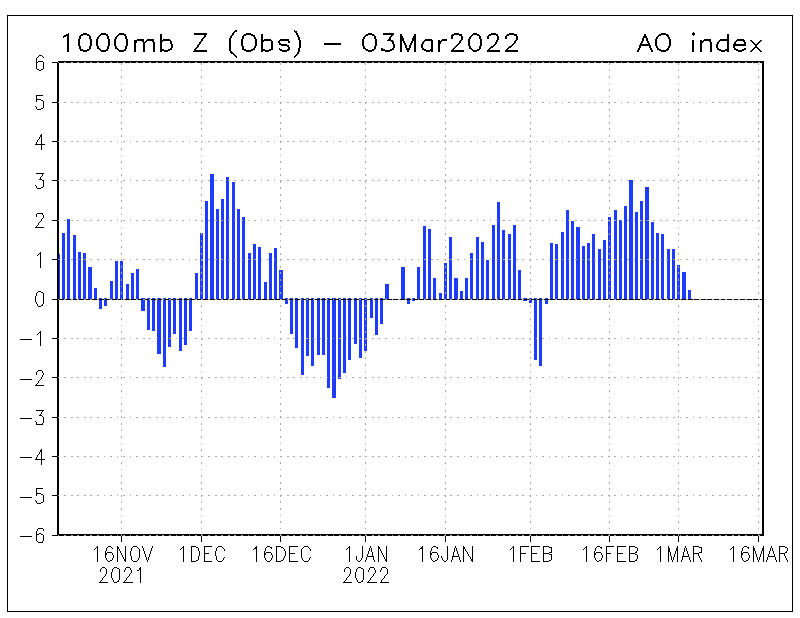
The Arctic Oscillation Index from the NOAA.
The following images show the western end of the Northwest Passage through the Canadian Archipelago. All the broken up ice and cracks you see in the channel have occurred in about the last week, so break-up seems to be picking up speed. The first image shows the sea ice as it had been, roughly, for weeks. It had slowly been breaking off small chunks and backing away from the open ocean. That process accelerated suddenly after the 27th of June which coincides with the beginning of a steep move into the negative AO, as you can see above. UPDATE: I read somewhere today, probably on Neven's site, that the AO is going more strongly negative for the immediate future with a strong high over the central Arctic Ocean. I would expect this to exacerbate the sea ice melt. July is commonly the month of greatest melt.
Western end of the Northwest Passage 6/27/11
 In the image from 6/29, the area of breakup has nearly doubled. Cloud cover prevents us from seeing the condition of the ice further down the channel, but it likely had visible cracks indicating where the next breakups were going to be.
Western end of the Northwest Passage 6/29/11
 You can see the area has again nearly doubled just one day later. There are cracks further back which you can see between the obvious last large crack and the thin passage in the upper left of the photo.
As we will see, the breakup continues along those lines.
Western end of the Northwest Passage 6/30/11
Here there is little change as wind and/or currents appear to have pushed the ice to the south, closing the cracks a bit. One of the difficulties in predicting sea ice is that it is inherently unstable and capricious. Winds and currents regularly push the entire Arctic ice floe one direction then another. Thus, it is entirely possible the NWP and NEP could open and close repeatedly during the summer, and be open or closed at different times.
Western end of the Northwest Passage 7/01/11
 In the next image we see that the ice appears to be stable - those cracks still haven't opened - but in fact, new cracks beyond the narrow passage at the top have developed and foreshadow significant breakup to come.
Western end of the Northwest Passage 7/02/11
Not much change here....
Western end of the Northwest Passage 7/03/11
but then it all comes apart. I suspect that the breakup will accelerate once the elbow has been turned and the NWP will be opening up not long after. Depending on the weather, of course. Remember, however, the ice is very thin and vulnerable.
Western end of the Northwest Passage 7/04/11

We have to look at the other end of the passage, also. The first image below is the eastern end of the NWP on 6/30. The ice had been stable in that general area for weeks. There are several islands in the channel at this point, and it is where the channel opens up from the narrower passage between here and the open sea further east. I believe the islands played a role in keeping this ice locked in place, but once the ice disintegrates beyond the islands the pace may increase. Note the areas of grayish ice. Those are areas where the ice has already begun to break free and where future breakup can be expected.

Eastern end of the NWP 6/30.
 Here we can see the breakup beginning with the little peninsula and some ice to the left of the channel breaking up. Again, note the gray areas.
Eastern end of the NWP 7/2.
 Here we see significant cracks forming left and further up the channel in preparation for disintegration.
Eastern end of the NWP 7/3.
 And here we now see cracks all across the channel roughly along a line drawn from the corner of the island on the right and upward and over to the islands on the left. I think we can expect significant break up over the next week or two. Perhaps the interplay of the breakups at both ends of the channel will accelerate both.
Eastern end of the NWP 7/4.
UPDATE: The area is showing signs of rapid breakdown just a day later:


The following two images show the full length of the channel. (NOTE: the channel is only part of the NWP.)

NWP along the Canadian Archipelago 6/26.
NWP along the Canadian Archipelago 7/2.
As stated earlier, I consider the NW and NE Passages to be proxies for the Arctic Sea Ice overall. One reason for this is that the oldest sea ice is supposed to be along the Canadian Archipelago in the Arctic Ocean, yet, this passage is opening every year. I'd think the narrow passages would encourage retention of sea ice since it should be difficult for it to flush out. Perhaps this assumption is wrong and the channel acts to accelerate water flow through it. Also, once the ice melted out several years ago, most of the old ice would be gone from the channel with little or no old ice floating around to help refill the channel leaving it vulnerable in subsequent years. 

UPDATE: The Northeast Passage ice is showing rapid mass and extent loss, as is much of the Arctic Sea Ice the last couple days. Here's an image from July 8th:
It's looking very much like a race to see whether the NW or NE will open first, but right now it looks like the NEP has a good lead over the NWP.

EDIT: Looks like the supposition of old ice being flushed out was correct:
This image shows ice is not static. Any ice that survives the summer becomes multi-year, thicker ice. The key to rebuilding Arctic Sea Ice is for that to happen year after year. At this point, we  are losing too much ice each summer, and because we are losing so much, it moves about more than it used to allowing more old ice to find its way out of the Arctic Ocean or adrift where it will more easily melt. Hat tip to Neven via Tenney.
Perhaps the heat retained by the islands or water flowing off of them plays a role, too. Whatever the case, since it first opened up, it has continued to open each year and I see no reason why it would not continue to do so.

Consistent with this, we have seen new lows in ice volume nearly every year, and 2007 - 2010 have been the four or five lowest years on record for volume and extent since tracking began with satellites in the late '70's. With the continued thinning year after year, the huge loss of old, thick ice, the late freeze last fall/winter, the record ice extent lows over the entire cold season and up to today, and the nearly open NW and NE Passages now, I have a very hard time not seeing a new record low for both extent and volume.

Here is a view of the entire Arctic Ocean, with annotations.

Arctic Sea Ice on 7/3/11. Some areas are obscured by clouds, but are considered open (by me) based on previous observations. Some areas of "open" water contain ice, but not enough to prevent navigation, imo. The NWP and NEP are roughly 70% and 80% open, respectively.
I'll be very surprised if both passages are not open by the end of the month, and see a 50/50 chance they will be open in the next two weeks. At minimum, all the ice should be broken up, even if not flushed out, and may be navigable. (The resolution on these images doesn't give a clear idea of space between ice floes/icebergs.)

UPDATE:  The ice bound up along the Alaskan/Canadian coast has moved offshore, opening the passage. This leaves, at least for the moment, only the ice in the Canadian Archipelago between an open and closed Northwest Passage.

The images above were taken from here. It is an interactive image you navigate like Google Earth. you can zoom in and out and drag the image around. You can also double-click anywhere to zoom and center the image at the same time. These images have the highest resolution I have found. Learning to tell clouds from ice takes a little attention in the beginning. Because it is not radar, you can't see areas covered by clouds. I encourage you to explore the sea ice to see for yourself the desperate condition it is in.

Sunday, July 4, 2010

PRI-De Family and Community Garden

Tuesday, May 11, 2010

Back to the Salem Witch Trials

Idiot calls for investigation of Michael Mann, whose research has only been proven to be accurate by subsequent research.

To me, it's just another sign of the overwhelming complexity that so many people can be swayed by bullshit and outright lies. When the evidence is staring you in the face, when ice is disappearing all over the planet, temperatures are rising, habitats moving, destructive storms increasing, winters warming... when every sign points to the clear, undeniable evidence and there is, literally ZERO scientific evidence to support any other conclusion, one can only conclude that we prefer our delusions and will defend them at any cost. Or, that those who possess power will lie the world into mass destruction before giving up that power. And that is possible only because it is impossible for the average person to know for certain who is lying and who isn't. 

We aren't scientists. It wasn't that long ago that the basic daily lives of scientists was much like that of you and I. We all observed the same world. But now? Now scientists' daily life experiencea are nothing like ours. We have little ability to judge what we are being told is reality, so we are susceptible to the lies and propaganda that power and ideology generate to hold onto the last vestiges of  the power and wealth that fossil fuels made possible.

But it is possible to know. Just look around you. And don't pretend to yourself that scientists sit around contemplating separating you from your wallets because some uneducated idiot on the radio, in the newspaper, on TV or in Congress tells you so. For, if you are willing to accept that virtually every climate scientist on the planet is in a conspiracy to control the world, then the whacko is the one in the mirror. 

Think about it. For a person to deny climate science due to some conspiracy theory involving virtually every climate scientist, every major science organization, and from every nation on the planet, not only means to do the preceding, but it means it had to start more than a hundred years ago when the problem of green house gases was first identified. And if we are willing to do that, then how does one trust **any other** science? Why should we trust cars or airplanes? They exist because of science. How can you trust doctors? After all, they're paid to treat your illnesses. Maybe they're the ones making us sick! How do we trust our computers? They are how we see and hear all our info an news these days, so they must be filling us with nanobots to control us!

It's time to come back from the era of the Salem Witch trials and re-enter the current century. A letter from climate scientists to you:

Climate Change and the Integrity of Science

We are deeply disturbed by the recent escalation of political assaults on scientists in general and on climate scientists in particular. All citizens should understand some basic scientific facts. There is always some uncertainty associated with scientific conclusions; science never absolutely proves anything. When someone says that society should wait until scientists are absolutely certain before taking any action, it is the same as saying society should never take action. For a problem as potentially catastrophic as climate change, taking no action poses a dangerous risk for our planet. Scientific conclusions derive from an understanding of basic laws supported by laboratory experiments, observations of nature, and mathematical and computer modeling. Like all human beings, scientists make mistakes, but the scientific process is designed to find and correct them. This process is inherently adversarial—scientists build reputations and gain recognition not only for supporting conventional wisdom, but even more so for demonstrating that the scientific consensus is wrong and that there is a better explanation. That's what Galileo, Pasteur, Darwin, and Einstein did. But when some conclusions have been thoroughly and deeply tested, questioned, and examined, they gain the status of "well-established theories" and are often spoken of as "facts."
For instance, there is compelling scientific evidence that our planet is about 4.5 billion years old (the theory of the origin of Earth), that our universe was born from a single event about 14 billion years ago (the Big Bang theory), and that today's organisms evolved from ones living in the past (the theory of evolution). Even as these are overwhelmingly accepted by the scientific community, fame still awaits anyone who could show these theories to be wrong. Climate change now falls into this category: There is compelling, comprehensive, and consistent objective evidence that humans are changing the climate in ways that threaten our societies and the ecosystems on which we depend.


Many recent assaults on climate science and, more disturbingly, on climate scientists by climate change deniers are typically driven by special interests or dogma, not by an honest effort to provide an alternative theory that credibly satisfies the evidence. The Intergovernmental Panel on Climate Change (IPCC) and other scientific assessments of climate change, which involve thousands of scientists producing massive and comprehensive reports, have, quite expectedly and normally, made some mistakes. When errors are pointed out, they are corrected. But there is nothing remotely identified in the recent events that changes the fundamental conclusions about climate change: (i) The planet is warming due to increased concentrations of heat-trapping gases in our atmosphere. A snowy winter in Washington does not alter this fact.
(ii) Most of the increase in the concentration of these gases over the last century is due to human activities, especially the burning of fossil fuels and deforestation.
(iii) Natural causes always play a role in changing Earth's climate, but are now being overwhelmed by human-induced changes.
(iv) Warming the planet will cause many other climatic patterns to change at speeds unprecedented in modern times, including increasing rates of sea-level rise and alterations in the hydrologic cycle. Rising concentrations of carbon dioxide are making the oceans more acidic.
(v) The combination of these complex climate changes threatens coastal communities and cities, our food and water supplies, marine and freshwater ecosystems, forests, high mountain environments, and far more.
Much more can be, and has been, said by the world's scientific societies, national academies, and individuals, but these conclusions should be enough to indicate why scientists are concerned about what future generations will face from business-as-usual practices. We urge our policy-makers and the public to move forward immediately to address the causes of climate change, including the unrestrained burning of fossil fuels.
We also call for an end to McCarthy-like threats of criminal prosecution against our colleagues based on innuendo and guilt by association, the harassment of scientists by politicians seeking distractions to avoid taking action, and the outright lies being spread about them. Society has two choices: We can ignore the science and hide our heads in the sand and hope we are lucky, or we can act in the public interest to reduce the threat of global climate change quickly and substantively. The good news is that smart and effective actions are possible. But delay must not be an option.
P. H. Gleick,* R. M. Adams, R. M. Amasino, E. Anders, D. J. Anderson, W. W. Anderson, L. E. Anselin, M. K. Arroyo, B. Asfaw, F. J. Ayala, A. Bax, A. J. Bebbington, G. Bell, M. V. L. Bennett, J. L. Bennetzen, M. R. Berenbaum, O. B. Berlin, P. J. Bjorkman, E. Blackburn, J. E. Blamont, M. R. Botchan, J. S. Boyer, E. A. Boyle, D. Branton, S. P. Briggs, W. R. Briggs, W. J. Brill, R. J. Britten, W. S. Broecker, J. H. Brown, P. O. Brown, A. T. Brunger, J. Cairns, Jr., D. E. Canfield, S. R. Carpenter, J. C. Carrington, A. R. Cashmore, J. C. Castilla, A. Cazenave, F. S. Chapin, III, A. J. Ciechanover, D. E. Clapham, W. C. Clark, R. N. Clayton, M. D. Coe, E. M. Conwell, E. B. Cowling, R. M Cowling, C. S. Cox, R. B. Croteau, D. M. Crothers, P. J. Crutzen, G. C. Daily, G. B. Dalrymple, J. L. Dangl, S. A. Darst, D. R. Davies, M. B. Davis, P. V. de Camilli, C. Dean, R. S. Defries, J. Deisenhofer, D. P. Delmer, E. F. Delong, D. J. Derosier, T. O. Diener, R. Dirzo, J. E. Dixon, M. J. Donoghue, R. F. Doolittle, T. Dunne, P. R. Ehrlich, S. N. Eisenstadt, T. Eisner, K. A. Emanuel, S. W. Englander, W. G. Ernst, P. G. Falkowski, G. Feher, J. A. Ferejohn, A. Fersht, E. H. Fischer, R. Fischer, K. V. Flannery, J. Frank, P. A. Frey, I. Fridovich, C. Frieden, D. J. Futuyma, W. R. Gardner, C. J. R. Garrett, W. Gilbert, R. B. Goldberg, W. H. Goodenough, C. S. Goodman, M. Goodman, P. Greengard, S. Hake, G. Hammel, S. Hanson, S. C. Harrison, S. R. Hart, D. L. Hartl, R. Haselkorn, K. Hawkes, J. M. Hayes, B. Hille, T. Hökfelt, J. S. House, M. Hout, D. M. Hunten, I. A. Izquierdo, A. T. Jagendorf, D. H. Janzen, R. Jeanloz, C. S. Jencks, W. A. Jury, H. R. Kaback, T. Kailath, P. Kay, S. A. Kay, D. Kennedy, A. Kerr, R. C. Kessler, G. S. Khush, S. W. Kieffer, P. V. Kirch, K. Kirk, M. G. Kivelson, J. P. Klinman, A. Klug, L. Knopoff, H. Kornberg, J. E. Kutzbach, J. C. Lagarias, K. Lambeck, A. Landy, C. H. Langmuir, B. A. Larkins, X. T. Le Pichon, R. E. Lenski, E. B. Leopold, S. A. Levin, M. Levitt, G. E. Likens, J. Lippincott-Schwartz, L. Lorand, C. O. Lovejoy, M. Lynch, A. L. Mabogunje, T. F. Malone, S. Manabe, J. Marcus, D. S. Massey, J. C. McWilliams, E. Medina, H. J. Melosh, D. J. Meltzer, C. D. Michener, E. L. Miles, H. A. Mooney, P. B. Moore, F. M. M. Morel, E. S. Mosley-Thompson, B. Moss, W. H. Munk, N. Myers, G. B. Nair, J. Nathans, E. W. Nester, R. A. Nicoll, R. P. Novick, J. F. O'Connell, P. E. Olsen, N. D. Opdyke, G. F. Oster, E. Ostrom, N. R. Pace, R. T. Paine, R. D. Palmiter, J. Pedlosky, G. A. Petsko, G. H. Pettengill, S. G. Philander, D. R. Piperno, T. D. Pollard, P. B. Price, Jr., P. A. Reichard, B. F. Reskin, R. E. Ricklefs, R. L. Rivest, J. D. Roberts, A. K. Romney, M. G. Rossmann, D. W. Russell, W. J. Rutter, J. A. Sabloff, R. Z. Sagdeev, M. D. Sahlins, A. Salmond, J. R. Sanes, R. Schekman, J. Schellnhuber, D. W. Schindler, J. Schmitt, S. H. Schneider, V. L. Schramm, R. R. Sederoff, C. J. Shatz, F. Sherman, R. L. Sidman, K. Sieh, E. L. Simons, B. H. Singer, M. F. Singer, B. Skyrms, N. H. Sleep, B. D. Smith, S. H. Snyder, R. R. Sokal, C. S. Spencer, T. A. Steitz, K. B. Strier, T. C. Südhof, S. S. Taylor, J. Terborgh, D. H. Thomas, L. G. Thompson, R. T. Tjian, M. G. Turner, S. Uyeda, J. W. Valentine, J. S. Valentine, J. L. van Etten, K. E. van Holde, M. Vaughan, S. Verba, P. H. von Hippel, D. B. Wake, A. Walker, J. E. Walker, E. B. Watson, P. J. Watson, D. Weigel, S. R. Wessler, M. J. West-Eberhard, T. D. White, W. J. Wilson, R. V. Wolfenden, J. A. Wood, G. M. Woodwell, H. E. Wright, Jr., C. Wu, C. Wunsch, M. L. Zoback

* To whom correspondence should be addressed. E-mail: petergleick@pacinst.org

Notes

Monday, May 3, 2010

Easter Egg Hunt at the GSCG

We had a great time, as always, hanging out with the Georgia Street Community Collective - and the Easter Bunny. This was Conor's first Easter Egg Hunt.


Thanks to the GSCC for preserving the memory with this beautiful little film. It was filmed at the Georgia Street Community Garden I, Georgia Street Community Orchard, and future Community Store.

Saturday, March 27, 2010

Wow! Scientists are REAL PEOPLE!

Shocking, isn't it? Rhetorical question, of course. OK, so here's the thing about denial of climate change (despite the ice melting, the air warming, the oceans warming, the Arctic melting, the permafrost melting, thermokarst lakes increasing in size and number, habitats moving and leaving behind the fauna and vice-versa, corals dying, methane increasing, CO2 increasing, the fact that the signatures of CO2 show beyond doubt where the CO2 is coming from...), why is Climate Science the only science these people don't trust? Do they attack their doctors and medical science? No. Do they not drive their cars because they don't understand how they work? No. Do they not fly airplanes because aerodynamics is crap? No. Do they refuse their food because Big Ag used genetic science (breeding and GM) to create the food they eat? No. Do they doubt astrophysics? No. Do they doubt chemistry? No. Do they doubt the physics and engineering that keep their boats afloat? No...

Where have we seen this before...? Hmmm.... real head-scratcher, that one...

We've seen it with smoking, for one. And many of the same people, too. (Right, Fred Singer?) Do yourself a favor and watch Naomi Oreskes work on Climate Denialism. Anywho... 


This is as good an explanation of Climategate E-Mail Foolishness (a.k.a. The time a bunch of denialists lied about and distorted some irrelevant e-mails ) as you are ever to find. Of course, there are many who will read the following text and determine every evil thing hey ever thought about climate scientists is true.

They will fail to understand, most with malice aforethought, what is being said and choose to reinforce the previously-solidified constructs built up by lies and bullshit. There will be nothing new or interesting in this. It is a fact of the world we live in.

On the off chance lightning strikes and a circuit gets switched, here ya go, from comments at RealClimate:

Kate (#20): I’m afraid to say that a lot of the personal emails between academics in any field are probably not very nice. We tend to be very blunt about what appears to us as ignorance, and intolerant of anything that wastes our time, or distracts us from our work. And when we think (rightly or wrongly) that the peer review process has let another crap paper through we certainly don’t hold back in expressing our opinions to one another. Which is of course completely different to how we behave when we meet one another. Most scientists seem able to distinguish clearly between the intellectual cut and thrust (in which we’re very rude about one another’s ideas) and social interactions (in which we all get together over a beer and bitch about the downsides of academic life). Occasionally, there’s someone who is unable to separate the two, and takes the intellectual jabs personally, but such people are rare enough in most scientific fields that the rest of us know exactly who they are, and try to avoid them at conferences!

Part of this is due to the nature of the academic research. We care deeply about intellectual rigor, and preserving the integrity of the published body of knowledge. But we also know that many key career milestones are dependent on being respected (and preferably liked) by others in the field, such as the more senior people who write recommendation letters for tenure and promotion and honors, or the scientists with competing theories who will get asked to peer review our papers, etc.

Most career academics have large egos and very thick skins. I think the tenure process and the peer review process filter out those who don’t. So, expect to see rudeness in private, especially when we’re discussing other scientists behind their backs with likeminded colleagues, coupled with a more measured politeness in public (e.g. at conferences).

Now, in climate science, all our conventions are being broken. Private email exchanges are being made public. People who have no scientific training and/or no prior exposure to the scientific culture are attempting to engage in a discourse with scientists, and these people just don’t understand how science works. The climate scientists whom they attempt to engage are so used to interacting only with other scientists (we live rather sheltered lives- they don’t call it the ivory tower for nothing), that we don’t know how to engage with these outsiders. What in reality is a political streetfight, we mistake for an intellectual discussion over brandy in the senior commonroom. Scientists have no training for this type of interaction, and so our responses look (to the outsiders) as rude, dismissive, and perhaps unprofessional.

Journalists like Monbiot, despite all his brilliant work in keeping up with the science and trying to explain it to the masses, just haven’t ever experienced academic culture from the inside. Hence his call, which he keeps repeating, for Phil Jones to resign, on the basis that Phil reacted unprofessionally to FOI requests. You don’t get data from a scientist by using FOI requests, you do it by stroking their ego a little, or by engaging them with a compelling research idea you want to pursue with it. And in the rare cases where this doesn’t work, you do the extra work to reconstruct it from other sources, or modify your research approach (because it’s the research we care about, not any particular dataset itself). So to a scientist, anyone stupid enough to try to get scientific data through repeated FOI requests quite clearly deserves our utter contempt. Jones was merely expressing (in private) a sentiment that most scientists would share – and extreme frustration with people who clearly don’t get it.

The same misunderstandings occur when outsiders look at how we talk about the peer-review process. We’re used to having our own papers rejected from time to time, and we learn how to deal with it – quite clearly the reviewers were stupid, and we’ll show them by getting it published elsewhere (remember, big ego, thick skin). We’re also used to seeing the occasional crap paper get accepted (even into our most prized journals), and again we understand that the reviewers were stupid, and the journal editors incompetent, and we waste no time in expressing that. And if there’s a particularly egregious example, everyone in the community will know about it, everyone will agree it’s bad, and some will start complaining loudly about the editor who let it through. Yet at the same time, we’re all reviewers, so it’s understood that the people we’re calling stupid and incompetent are our colleagues. And a big part of calling them stupid or incompetent is to get them to be more rigorous next time round, and it works because no honest scientist wants to be seen as lacking rigor. What looks to the outsider like a bunch of scientists trying to subvert some gold standard of scientific truth is really just scientists trying to goad one another into doing a better job in what we all know is a messy, noisy process.

The bottom line is that scientists will always tend to be rude to ignorant and lazy people, because we expect to see in one another a driving desire to master complex ideas and to work damn hard at it. Unfortunately the outside world (and many journalists) interpret that rudeness as unprofessional conduct. And because they don’t see it every day (like we do!) they’re horrified. 

Comment by Steve Easterbrook — 25 March 2010 @ 6:04 AM