Tuesday, January 29, 2008

CERA: Peak Oil No Big Deal; Oil Drum/Hirsch: Come again?

ADDED Feb. 7, 2008:
A stiff challenge has been thrown down to CERA, which is led by Yergin, to put their money where their predictions are. I applaud. CERA is apparently listened to by serious people and taken seriously. This is a problem given their poor track record, noted below.

The Bet

HOUSTON (Feb. 6, 2008) – A group of businessmen and energy experts who believe that global oil production will soon peak, plateau and decline has issued a $100,000 wager to Cambridge Energy Research Associates (CERA), a prominent oil forecasting think tank. Members of the challenger group also renewed an invitation to hold a public debate on the issue of peak oil with CERA.

The group is betting against CERA’s June 2007 forecast that world oil production capacity will reach 112 million barrels per day (mmb/d) by 2017, which extrapolates* to107 mmb/d of actual production, up from about 87 million barrels today. CERA will hold its annual conference in Houston next week.

“CERA is forecasting an addition of 20 million barrels within a decade,” said Steve Andrews, co-founder of the Association for the Study of Peak Oil-USA (ASPO-USA). “That’s a vision in search of reality. Anything is possible on paper, but we are betting you can’t do that with the drill bit.”

The challenger group also notes that CERA called for a civil dialogue on peak oil, but then declined several invitations to engage in such a conversation...

“CERA projections have been wrong so often that policy makers should think twice about embracing their data,” added Bob Kanner, CEO of Cleveland-based PubCo Corporation, who has wide-ranging investments in the oil and gas industry. “I’m participating in this bet to illustrate the need for greater truth and clarity in the prediction of oil and gas supplies. We’re not just betting our money, we’re betting our nation’s future.”

...To call the bet, CERA must match the Peak Oil group’s $100,000 letter of credit from National City Corporation. In the event production in 2017 doesn’t exceed CERA’s forecast of 107 million b/d, the individuals of the group have agreed to donate their winnings to an energy-focused non-profit organization.

“If the CERA seers really believe their crystal balls, they should call our bet,” said Texas oilman Baldauf.


------------------------------------------------

The Peak Oil debate bears a commonality with the Climate Change debate: The Deniers. Yes, the mysteriously funded, don't-worry-folks-nothing-to-see-here crowd that always has an answer for everything. That is, unless you actually pay attention. CERA, for example, bases their claims on a proprietary database. I.e., something that we can't take a look at to vet or confirm the accuracy of. We must take their word for it.

An interesting group of deniers is CERA. They are lead by Daniel Yergin, who is highly respected for his work documenting the history of the oil business, but has some serious detractors when it comes to his prognostications on same. Robert Hirsch, who led an authoritative study (Linked in the side bar to the right.) for the US government in 2005 on Peak Oil that came to the conclusion we are in deep doo-doo, takes on CERA's recent pronouncement that Peak Oil is a lot of nothing much to worry. They claim new fields will cover all new demand and yearly declines in existing fields. Quite a claim given we need 5,000,000 or more barrels a day in new production each year to meet that new demand and depletion - and that's if depletion is only 4.5 percent, which appears to be pretty doubtful.

First, drop down to the bottom of this blog and take a look at the chart showing production vs. discoveries. Though Hirsch's rebuttal is a good read, all you need to know to see that CERA has a snowball's chance in hell of being correct on this is what is displayed on that graph. We haven't found such amounts of oil for decades, let alone been able to produce them. Light Crude oil production peaked in 2005 at around 73,000,000 b/d. Current liquid fuel (oil, gas, bio-diesel, etc.,) consumption is more than 14,000,000 b/d above that already.

Second, go read a thorough thrashing of Yergin's and CERA's prognostications through the years written by Glenn Morton, a geophysicist in the oil industry, over at The Oil Drum, found here.

Third, if you haven't hurt yourself falling over with laughter at the absurdity of CERA's claims by then, read Robert's rebuttal, partially reprinted below. CERA's claims can be accessed here, but it's behind a firewall at the WSJ. The full article can be found here. You can read all of Hirsch's rebuttal by clicking on the title below.

The WSJ Article on a CERA Oil Decline Study Written by Robert L. Hirsch
Monday, 28 January 2008
On January 17, The Wall Street Journal published an article entitled New Fields May Offset Oil Drop, reporting and commenting on a study by CERA entitled, “No Evidence of Precipitous Fall on Horizon for World Oil Production: Global 4.5% Decline Rate Means No Near-Term Peak: CERA/IHS Study.” Here are some WSJ article highlights and related comments / questions:
"Output from the world's existing oil fields is declining at a rate of about 4.5% annually."
Comment: Because of CERA's established record of marked optimism in oil and natural gas, a prudent observer might assume 4.5% as a lower bound on this extremely important parameter.
"This study supports a view that there is no impending short-term peak in global oil production."
Comment: What does short-term mean? The world has been on a liquid fuels production plateau since mid 2004, when viewed in the framework of a 4% fluctuation band, which was independently developed...
"The CERA study, however, asserts that fewer than half of the fields scrutinized were in decline."
Comment: ...this statement is without value. What matters most is which giant fields are now in decline, how fast they are declining, and how close other giant fields are to going into decline.
"This is a daily, hourly and minute-by-minute challenge for the world's oil industry."
Comment: If world oil production is as robust as CERA claims, why make this rather ominous statement?
"Andrew Gould, the longtime chief executive of oil-services titan Schlumberger Ltd., has estimated that the industry's average decline rate is closer to 8% a year and growing."
Comment: Schlumberger may have better data than anyone else on oil fields throughout the world, because they operate almost everywhere that oil is produced. This includes the OPEC countries... Indeed there is no indication that IHS/CERA has better oil field data than anyone else. Schlumberger and Gould have been too responsible for too long to believe that they would off-handedly estimate an 8% decline rate without knowing the facts...
"CERA argues that nearly half of that output will come from non-conventional sources such as biofuels and natural-gas liquids."
Comment: How is this credible without a worldwide crash program, which has not yet been seriously considered, let alone initiated?

...Finally, CERA, like others, has made a number of incorrect forecasts in the past, so why should their work be taken at face value now? CERA asks the world to trust it, but with the risks of error being so large, would that be prudent?

Tuesday, January 22, 2008

Money, Debt, the Fed and Usury

If you don't understand the Federal Reserve, you don't understand the world you live in. Draw your own conclusions...

This is the best presentation I've ever seen on the Federal Reserve. It is made to be understood by anyone, regardless of knowledge of The Fed.

Money as Debt 1
Money as Debt 2
Money as Debt 3
Money as Debt 4
Money as Debt 5

Another take:
Federal Reserve Part 1
Federal Reserve Part 2
Federal Reserve Part 3
Federal Reserve Part 4
Federal Reserve Part 5

A Cliff's Notes-type version:

A History of Money and Banking Secrets That Banks Dont Want Published A History of Money and Trade
To start with a history of money and debt, we must go back many years ago when people used to trade their wares for the things they wanted and needed.In place of money or Federal Reserve Notes, you could trade a well made pistol for a cow, which you could eat or trade a remainder of for other items like clothing.It didn't take long for people to realize there needed to be a more efficient means of trade. If you were a farmer, it was too difficult to carry baskets of fresh corn around to trade for a new horse. And, the person selling the horse might not want any corn at all.

A History of Money and Gold
So, people used gold for cash money, which always had a stable value, to trade for the items they wanted and needed... Gold was very heavy to carry and hard to conceal. In the beginning of our banking history what people would do is leave their gold with a goldsmith.The goldsmith would then give them a note, or paper money, that stated how much gold they had on deposit with the goldsmith (bank).The farmer could then take this paper money note... ...the note would continue to trade hands and very few people would ever go redeem it for the gold it was backed by.It didn't take long for the goldsmith to understand this reality. So, here he is storing all of this gold for other people. Let's give it a value to make this next principle clear.Let's say the gold he is storing is valued at $1,000 and there are $1,000 in real cash money notes backed by this real gold being circulated.

A History of Money and Loans
When many people wanted a loan for say a total of $1,000, he decided no one would notice and it would be real easy to lend them someone else's gold... And, he'd only charge 10% interest... ...why not lend out to anyone who looks like they can repay? And, that year he lent out a total of $10,000 worth of newly created or you could say counterfeit, funny money notes.

A History of Money and Inflation
...There is now ten times as much currency/notes floating around then there is real gold to back it. This causes the value of the original $1,000 to loose 90% of its value...Everyone now has way more money then they did the year before, they feel rich...This means there is still $1,000 of real cash money notes backed by REAL gold. $9,000 in funny money loans outstanding, $9,000 in total notes circulating and the goldsmith has pocketed $2,000.So, the goldsmith is now up $2,000 out of thin air...

A History of Money and Recession
People tighten up their spending for no apparent reason, but it is soley because there are less notes in circulation. So, prices start to fall... RECESSION...Year five, the borrowers paid back $1,400 worth of principal and $600 in interest. There is still only $1,000 in gold. $4,000 in loans outstanding, $1,000 in total notes circulating and the goldsmith has pocketed another $2,000, totaling $10,000 thus far, but $4,000 is still owed.With only $1,000 in total notes circulating, people obviously cannot continue to pay, so there is one thing left and that is the confiscation of their assets, and the remaining $1,000 in total notes circulating. Can you say BANKRUPTCY...

A History of Money and the FED
Oh, I know says the goldsmith, I'll just have to keep lending this counterfeit money backed by nothing so they can work hard for me for free, and I will own every asset on this planet for free. So the goldsmith starts to lend out money again and lends out $10,000 the first year which again causes the BOOM. And, on and on it goes....the goldsmith's are now called the Federal Reserve System and the funny money counterfeit notes are called Federal Reserve Notes. In the 1930's there was roughly $30 Billion in gold at Fort Knox, and now we owe $7,937,046,735,823.So, then I ask you fellow American, is this a history of money and debt that you thought was going on when you borrowed from Capital One or Providian?...

Friday, January 18, 2008

Bush: Can Saudi Arabia Increase Output?

As noted by The Oil Drum . Com, during his trip to Saudi Arabia Bush openly questioned whether SA had the capacity to increase production. One would be quite surprised were one to learn Bush needed to go to Saudi Arabia to obtain this information. One is further surprised Bush had decided to openly, though indirectly, acknowledge Peak Oil. While it is a certainty that BushCheney knows about Peak oil due to their extensive background in the oil industry and Cheney's statements in 1999 regarding oil, depletion and future supply, their prior association with Matt Simmons of Twilight in the Desert fame, etc., it is still startling to hear the president day it.

I know, you're thinking, "He said no such thing! Conspiracy theorist!" In fact, he did. This is a simple conclusion based on the following facts:
  • The EIA, the USGS and the IEA all state that the bulk of future oil production must come from the Middle East, i.e. OPEC.
  • Most of the other OPEC nations are producing at or near their limits.
Logically, it follows that if the KSA (Saudi Arabia) cannot ramp up production, nobody can make up the difference. In actuality, the KSA can ramp up, but probably not as quickly as many would like to believe. They have been adding wells at a huge rate over the last few years in preparation for ramping up production to 12.5 mb/d. One assumes, given that all fields deplete and the KSA's largest fields have been producing for decades, that they are also drilling to maintain production in older fields. But it takes time to bring new oil to market, whether from new wells at existing fields or new wells at new fields, and especially the latter. We recently had an announcement from Aramco that production at the new **** field will be delayed.

According to former Aramco production and exploration chief, Sadad al Huseini, 12.5 is all the KSA is likely to ever produce. BushCheney certainly know this if you and I do. One can only speculate that the public admission that the KSA may not have the capacity to ramp up is meant for the masses. It's a warning shot fired as if it wasn't meant to be serious. "We were only kidding" as it were. Plausible deniability so that BushCheney can later claim Peak Oil took them by surprise, too.

So, there you have it from the horse's ass's mouths: de facto statements of Peak Oil.

Here's some more on the topic:

Bush Acknowledges Peak Oil

This is a pretty stunning admission, during his press conference in Saudi Arabia:


I hope that OPEC, if possible, understands that if they could put more supply on the market it would be helpful. But a lot of these economies are going -- a lot of these oil-producing countries are full out.


...There is no longer any argument in the industry that non-OPEC oil is peaking (that includes the International Energy Agency and even ExxonMobil)

...the topic was disucssed 3 separate times in the interview:

I also understand the dynamics behind the issue, and that is growing demand from U.S., but more particularly, China and India, relative to supply.

Oil is a commodity; it isn't something you just turn a tap. I mean, it requires investment, exploration, a lot of capital. I talked to His Majesty early on in my presidency in the hopes that they would explore for new fields; they have. They've increased their capacity. But in the meantime, demand has gone up quite substantially.

Note that Bush states that Saudi Arabia has increased its production capacity since "early on in his presidency"...

...BP statistics show that Saudi internal consumption jumped from 1.5mb/d in 2000 to 2.0mb/d, which means that fully one third of Saudi Arabia's production increase went to domestic demand).

I would like for them to realize that high energy prices affect the economies of consuming nations. And that if these economies weaken, those economies will eventually be buying fewer barrels of oil. And having said that, there is not a lot of excess capacity in the marketplace. What's happened is, is that demand for energy has outstripped new supply. And that's why there's high price.
That's the third time he said it.
Now ask yourself, "Why is George Dumbya Bush off-grid?" (Thanks to LATOC for the link.) Here we have the most anti-environment, ecologically devastating president in the history of this nation, but he's off the grid? Is he telling YOU to get off the grid? Is he telling YOU to conserve? Is he telling YOU to build yourself a passive solar home complete with gray water re-use? No? Why not? This is the man who invaded a nation for its oil. Why in the world would he be against Kyoto, deny global warming for years, eviscerate the science of his own Executive Branch and muzzle James Hansen, perhaps the world's leading climate scientist, but live in an OFF THE GRID home?

As my economics prof in university used to say, "Rhetorical question."

Thursday, January 17, 2008

Can they save the economy? No.

NOTE: Found this today. Sounds about right:

A $3 Trillion Bankruptcy Will Now Start To Emerge

An experienced European banker told EIR this morning that "the problems of 2008 are of a completely different order of magnitude than those we saw in 2007."... the real write-off concerns some $3 trillion, the source said. That is what is starting to emerge now.

Back to my blogging:

Let's set aside the obvious point I would make about Peak Oil and the energy problem and what it is/will do to GDP. But that doesn't solve our problems. The economic issues we face in and of themselves are going to be a disaster. What we have is a series of positive feedbacks, i.e. a set/series of reinforcing disasters.

An interesting non-issue, as far as the media and the economists are concerned, is the effect of the wars in Iraq and Afghanistan on the economy. It used to be thought war stimulates the economy. And this is true. In the short term. In the long term, it eats up valuable investment in capital and infrastructure. War spending is non-investment. The materials created get used. They get depleted. And they add nothing to future growth. The only long term advantage to war is conquering and/or controlling resources and gaining additional land for expansion.

Studies show that around the sixth year of a war the false propping up of the economy in the form of a rush of money supply expansion begins to be shown for what it is: reckless spending. It's not hard to see why. Imagine you have a neighborhood feud. You and your neighbor go at one another all the time. One day you find your roses cut up. You retaliate. Eventually you put in a fence. Looks great. Doesn't solve the problem. Your dog gets poisoned. (Don't worry, you've got a good vet. But he's expensive. More money goes out.) You put in a security system and slash his tires. He keys your car. You get motion detectors and salt his entire yard. He... anyway. So, you've got a new fence, etc., and have spent thousands of dollars you couldn't spare. Where are you now?

War spending undermining U.S. economy

One of the world’s most exclusive business clubs warned the United States recently that its open-ended national security and war expenditures, along with tax cuts that led to large budget deficits, could erode the country’s status as a powerful economic force.

The Geneva-based World Economic Forum issued its 2006-07 Global Competitiveness Index (GCI) rankings and listed the United States in sixth place, down from the top spot...

“With a low savings rate, record-high current account deficits and a worsening of the U.S.’s net debtor position, there is a non-negligible risk to both the country’s overall competitiveness and, given the relative size of the U.S. economy, the future of the global economy,” said Augusto Lopez-Claros, chief economist of the World Economic Forum’s Global Competitiveness Network.

The myth of the war economy
“'In previous periods when the U.S. has been involved in war, what you
typically end up with is an artificially propped up economy followed
by a decline in economic activity when the war is over,’ said
economist Patty Silverstein of Littleton-based Development Research
Partners.”

“'War is a wonderfully inflationary pressure on the economy,’ added
Tom Clark, director of the Jefferson Economic Council in Jefferson
County. ‘It's a wonderfully nonproductive use of assets, usually
followed by a period of hyper-inflation.’”
Stimulus packages, the other side of this plug nickel, are also a big mistake. What got us here, after all? Unlimited spending, unlimited lending/borrowing, unlimited money supply (Check the Shadow Government Stats link), huge tax breaks almost all for the wealthy (Trickle down? Kiss my ass...), Greenspan telling banks to get creative with their lending while interest rates hovered near zero, crazy new debt instruments... No, what is needed is fiscal responsibility at all levels. Long term, the fractional banking system (usury) needs to die a quick, painful death.

Stop Bush, Democrats Before They Save Our Economy: Amity Shlaes

Jan. 16 (Bloomberg) -- ...economic experts have already endorsed the concept of such short-term measures.

Former Treasury Secretary Larry Summers... Nobel Prize winner Joseph Stiglitz... President George W. Bush, briefed by experts, may take up the stimulus concept as early as this week...

This is perverse. The real question about tinkering should not be ``how?'' but ``why?'' The persistence of the stimulus habit, and the endorsements by experts, makes it worthwhile to review such previous interventions and their consequences.

Back in the early 1990s, great economies confronted trouble. ...U.S... Japan, banks were foundering, and the real estate bubble had popped...

...economists... talked about a $10 billion or $15 billion outlay... For Japan... Christopher called the Japanese leader's $115 billion stimulus plan merely ``a useful first step.'

Fortunately, Republicans and conservative Democrats tamped Clinton's domestic project down into nothing... with spectacular results.

Japan, by contrast, heeded the U.S. and the experts and dutifully ``stimulated'' the economy for years.

...A number of stimulus packages and Bridges to Nowhere later, the Japanese economy slept on.

...in the early 1970s...

Nixon's greatest tinkering came after his Camp David retreat in 1971. He emerged from the hills to order an end to the gold-exchange standard and a 90-day freeze on wages and prices. His eight-point plan also slapped a 10 percent surcharge on imports.

...the plan was not great. Its consequences were terrible ruction for the gold market and the stagflationary 1970s...

The worst problem with the tinkering impulse is what it precludes: necessary permanent reform...

Thursday, January 10, 2008

The Elephant in the Room

Population. None of the problems this blog is about exist without rapidly expanding population. Global Warming?
"Stabilize CO2 emissions!"
OK, let's get the population rate down to 1:1. There. Done.

"Reduce fossil fuel consumption!"
OK, let's get population growth rate down to 1:1, reduce, reuse, re-localize. There. Done.
Simple, eh? Not quite. According to Dr. Albert Bartlett, even if you go to zero population growth as a policy and actually do it, the population doesn't actually stabilize until all the people who were alive when the policy took hold have passed away. So, that's 70 more years of population growth. 70 more years of increased consumption.

But, what if we become more efficient?
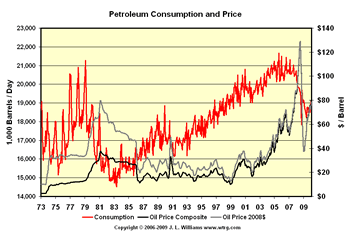
We already did. After the two oil crises of '73-5 and '80-81 the US dropped consumption from around 19 mb/d in '73 and over 21mb/d in '79 to less than 15mb/d in '83. Since then we have only become even more efficient. In fact, one reason given for $95 oil not driving us into recession already (don't worry, it actually is) is increased efficiency. Well, if efficiency is improving, why do we use more than 20,000,000 barrels a day today? Could it be population?

Population trumps all. US population was around 210,000,000 in '73. It's around 310,000,000 now. That's a 50% increase. No matter how efficient we get, if population keeps rising we will eventually erase any gains in efficiency.

Jared Diamond on population and consumption:
...Per capita consumption rates in China are still about 11 times below ours, but let’s suppose they rise to our level. Let’s also make things easy by imagining that nothing else happens to increase world consumption — that is, no other country increases its consumption, all national populations (including China’s) remain unchanged and immigration ceases. China’s catching up alone would roughly double world consumption rates. Oil consumption would increase by 106 percent, for instance, and world metal consumption by 94 percent.

If India as well as China were to catch up, world consumption rates would triple. If the whole developing world were suddenly to catch up, world rates would increase eleven fold. It would be as if the world population ballooned to 72 billion people (retaining present consumption rates)...

I haven’t met anyone crazy enough to claim that we could support 72 billion. Yet we often promise developing countries that if they will only adopt good policies — for example, institute honest government and a free-market economy — they, too, will be able to enjoy a first-world lifestyle. This promise is impossible, a cruel hoax: we are having difficulty supporting a first-world lifestyle even now for only one billion people...
Does this strike you as sustainable? Neither does Dr. Bartlett. Dr. Bartlett is fond of asking if we are dumber than yeast. I'll let him explain.

...Bacteria grow by doubling. One bacterium divides to become two, the two divide to become 4, the 4 become 8, 16 and so on. Suppose we had bacteria that doubled in number this way every minute. Suppose we put one of these bacteria into an empty bottle at 11:00 in the morning, and then observe that the bottle is full at 12:00 noon. There's our case of just ordinary steady growth: it has a doubling time of one minute, it’s in the finite environment of one bottle.

I want to ask you three questions. Number one: at what time was the bottle half full? Well, would you believe 11:59, one minute before 12:00? Because they double in number every minute.

And the second question: if you were an average bacterium in that bottle, at what time would you first realise you were running of space? Well, let’s just look at the last minutes in the bottle. At 12:00 noon, it’s full; one minute before, it’s half full; 2 minutes before, it’s a quarter full; then an 8th; then a 16th. Let me ask you, at 5 minutes before 12:00, when the bottle is only 3% full and is 97% open space just yearning for development, how many of you would realise there’s a problem?

...They now have four bottles, before their discovery, there was only one. Now surely this will give them a sustainable society, won’t it?

You know what the third question is: how long can the growth continue as a result of this magnificent discovery? Well, look at the score: at 12:00 noon, one bottle is filled, there are three to go; 12:01, two bottles are filled, there are two to go; and at 12:02, all four are filled and that’s the end of the line.

Get it now? Some math for you to play with on your own:

You just take the number 70, divide it by the percent growth per unit time and that gives you the doubling time. So our example of 5% per year, you divide the 5 into 70, you find that growing quantity will double in size every 14 years.

Well, you might ask, where did the 70 come from? The answer is that it's approximately 100 multiplied by the natural logarithm of two. If you wanted the time to triple, you'd use the natural logarithm of three. So it's all very logical. But you don't have to remember where it came from, just remember 70.

Let's practice. We are using 73,000,000 barrels of oil a day. Growth is at 1.7 - 2% a year. So, 70 / 1.7 = 41. In 41 years we'll need 146,000,000 a day of oil. For all oil liquids we are using 86,000,000 b/d, so we'd need 172,000,000b/d. The OECD countries are in decline. Most nations are. Everyone you read or hear will tell you the bulk of future oil production lies with OPEC. OPEC is going to produce an additional 73 - 86 mb/d? No way in hell. Saudi Arabia states their goal is a decades-long plateau of 12.5 mb/d. Well, there's 3mb/d!

As for population, there are now more than 6.5 billion people. The world growth rate is over around 1.14 according to wiki. 70/1.14=61. Thus, in 2067 world population will be 13+ billion. Hmmm... Per capita energy use is a strong indicator of standard of living. The image to the right shows what's happening to oil production per capita, from dieoff.org.

You see, without addressing population, we cannot address any of the issues we face. How do we have that many people and produce LESS CO2 and other gases, even with strong conservation? Where does the energy come from? Since the poor want to live like we do (not that we don't have our own poor...), when do they just start trying to take it? Or what happens as we keep taking their energy? We took Iran's. Look what happened. We are taking Iraq's. Look what's happening.

Would the world as we know it exist without oil? The chart at the right suggests not. Found here.

Hang on, It's going to be a bumpy ride.